

ForceWAM reaches 85%-95% robot success rate in preprint tests
The arXiv preprint says task-agnostic play data improved results by 15–45 percentage points, but the work has not been peer reviewed.
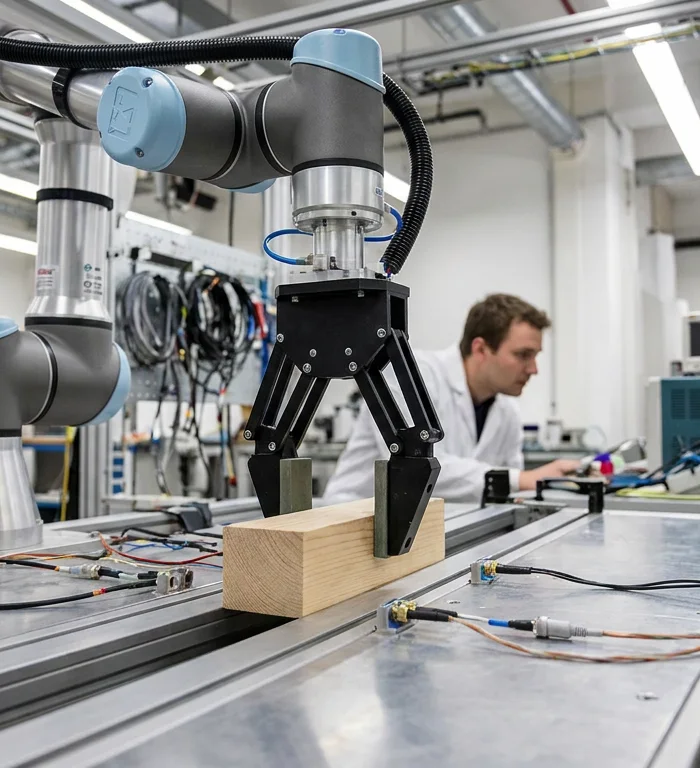
ForceWAM, a robotics model described in an arXiv preprint submitted Oct. 13, reached an 85%-95% mean success rate across real-robot contact tasks, according to the authors.
The ForceWAM result matters because adding task-agnostic play data improved success by 15-45 percentage points versus the authors’ non-play setup, suggesting broader contact experience may help force-sensitive robot control.
Zijun Xu and 18 co-authors presented ForceWAM as a system for contact-rich manipulation, where a robot must manage physical force while moving objects. The paper covers force-regulated sliding, box flipping with and without disturbances, and ring placement.
The method separates two learning problems that are often linked. One component is trained on successful demonstrations to forecast future images and six-axis force/torque readings, which measure pushes, pulls and rotational force.
A second component, described as an inverse dynamics model, maps current observations and intended visual-force futures back into robot actions. The authors wrote: “Play data thus provide knowledge of force responses for goal-directed execution.”
At deployment, the paper says, the inverse model converts predicted visual and force paths into actions while using fresh wrench feedback between updates from the world model. In robotics, wrench refers to combined force and torque measurements.
The approach targets a common gap in robot learning. Demonstrations can show a successful route through a task, but they may not expose enough variations in how contact forces change when the robot moves differently. Play data, by contrast, can record broader contact behavior without tying every motion to a specific task objective.
The reported comparison is against world-modeling and reactive baselines, according to the abstract. The source text does not provide the baseline success rates, the number of trials, the robot hardware, or the amount of demonstration and play data used.
The findings remain early. arXiv preprints are not peer reviewed, and the supplied arXiv page does not list a sample size or funding information for the experiments. The page says a project page and code are available.
The next test for ForceWAM is whether other robotics groups can reproduce the reported gains on contact-heavy tasks beyond the scenarios described in the Oct. 13 preprint.
Source: arXiv preprint, Oct. 13, 2026
More stories
- Europe faces attribution gap after 16 cyber, physical incidents
- PIF backs Grand Theft Auto as Saudi players embrace game
- Signal limits screenshots to curb AI access to messages
- Cognition runs Devin Mac workspaces on EC2 in 6 AWS regions
- Salesforce engineers cut 600-failure triage to 90 minutes
- Türkiye Desk: GTA 6 puts console access and network demand in focus
- Rockstar plans GTA 6 PC release by March 2027, GamesBeat says
- Loadout’s $LOAD launch tests funding model for 40 games
- Thinking Machines launches Inkling as AI rivalry deepens
- Silent floating robot brings soft companionship indoors
Latest news
- Trump prepares tariffs on China and other major exporters
- New-car buyers pay record average $50,087 in October
- Banks face ECB reserve debate over liquidity and profits
- Investors see Anthropic debut gains fade below $83 a share
- Iraq orders federal control over Kurdish-area oilfields
- Germans oppose Ukraine aid as poll shows support slipping
- Kim Jong-un receives 10 envoys after constitutional shift
- Ukraine claims Libya strike sinks Russian naval corvette