Silent floating robot brings soft companionship indoors
Silent floating robot research from Keio University uses helium buoyancy and soft fins to explore quieter, safer robotic companionship indoors.
Omar Farouk ·
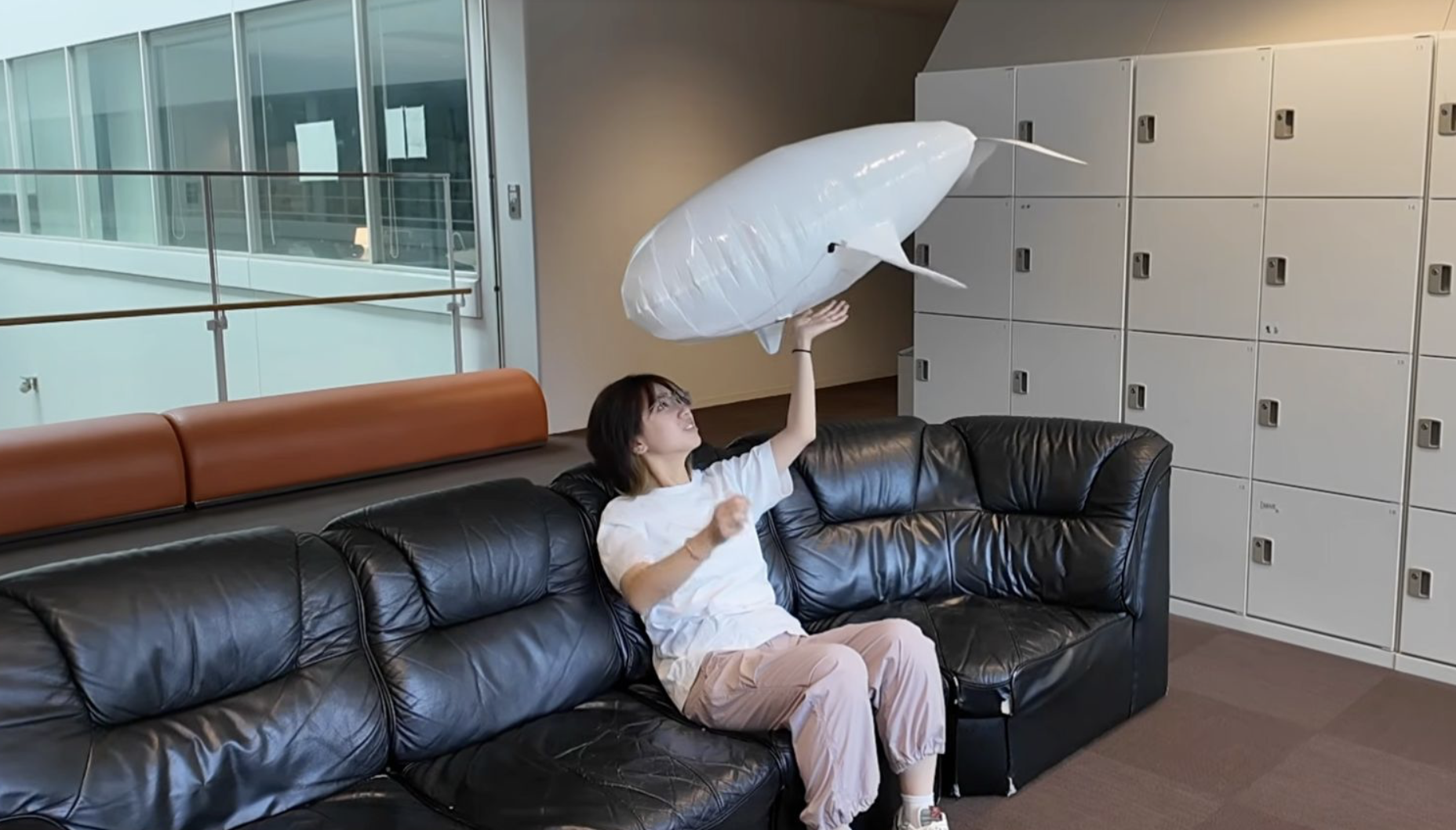
Silent floating robot research in Japan is testing a helium-supported companion that hovers quietly indoors. Keio University led the prototype.
The Tokyo-based team, working with collaborators including the MIT Media Lab, designed the lighter-than-air robot to feel less like equipment and more like a calm presence in a room. The researchers describe a soft, whale-like body that moves through indoor air without the floor-bound mechanics of many home robots or the exposed rotors associated with drones.
Helium carries the whale
The prototype belongs to a category the researchers call soft floating robots, or SFRs. Their design framework combines helium buoyancy, inflatable bodies and movement inspired by biological forms to make indoor robots quieter and less physically intrusive.
Helium does the lifting work that propellers usually perform in drones. Because buoyancy supports most of the robot’s weight, the propulsion system is used mainly for movement and steering, which the researchers say can reduce energy demand and allow longer hovering than rotor-dependent designs.
Soft fins replace rotor noise
The team’s model glides with soft flapping fins rather than exposed propellers. That design choice is central to the concept: the robot is meant to avoid rotor noise and the strong downward air movement that can make multirotor drones uncomfortable in close indoor settings.
The researchers drew visual inspiration from fictional characters including Tinker Bell, Pokémon’s Mew and Studio Ghibli’s Soot Sprites. The result resembles a small white floating whale, using smooth and rhythmic motion to make the machine appear more creature-like than appliance-like.
A companion for shared rooms
Demonstrations described by the team show the floating companion performing light domestic and social functions. It can wake users, deliver reminders, keep someone company while studying, dance alongside an owner and provide playful entertainment.
The concept is not presented as a replacement for smartphones, smart speakers or conventional home devices. Its role is physical presence: a robot that occupies the same airspace as a person, moves visibly and responds in a way intended to feel natural inside a home.
That distinction matters for home robotics, where acceptance often depends on noise, perceived safety and whether a machine disrupts ordinary behavior. A silent floating body could broaden the design space beyond screens on counters, wheeled assistants on floors and drones that feel too industrial for bedrooms, studies or living rooms.
If the design proves reliable outside demonstrations, the near-term effect would likely be strongest in companion robotics, elder-care support, education and ambient home interfaces. For Keio University and its collaborators, successful refinement would strengthen a research platform around soft aerial interaction; for the wider sector, it could redirect attention from raw mobility toward comfort, quietness and social design.
If control, durability, cost or safety certification become barriers, the effect would remain narrower. In that case, the macro impact would be limited to research and design influence, the Keio-led project would stay closer to laboratory development, and the industry would continue leaning on smart speakers, mobile screens, wheeled robots and conventional drones for practical indoor automation.
The biggest open questions are operational rather than aesthetic. The source material does not provide measured sound levels, flight duration, cost, safety certification status or a timetable for commercialization, so the prototype’s promise rests on whether its gentle behavior can be matched by dependable performance in ordinary homes.