

Ethiopian families in Kenya face food gaps after 50,000 arrivals
A government-backed assessment found food, water, shelter and healthcare needs rising in Moyale, where host communities are under pressure.
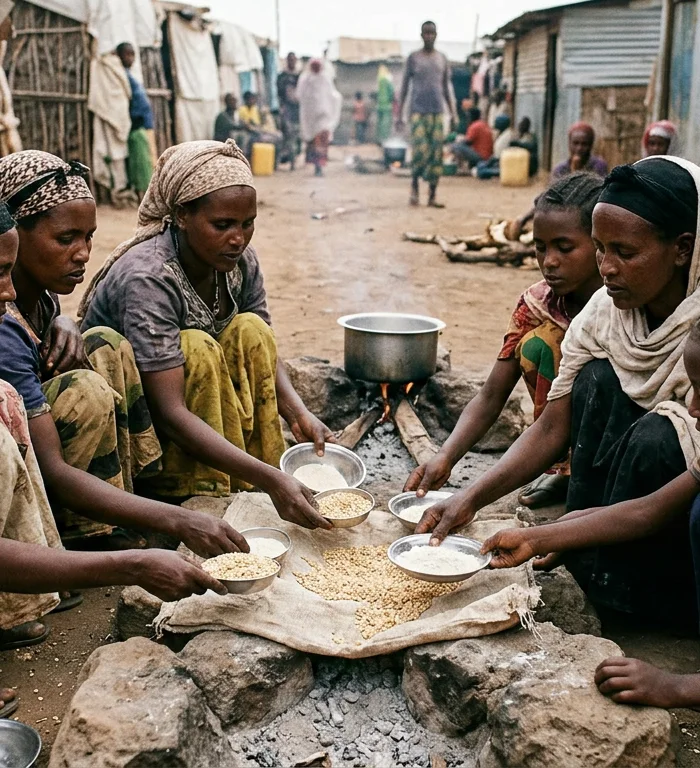
Ethiopian families sheltering in Kenya's Moyale area face acute shortages after an estimated 50,000 people crossed by Oct. 29, a government-backed humanitarian assessment published Nov. 9 found.
The Oct. 29-30 assessment, conducted by the Government of Kenya and Marsabit County Government with IOM and UN support, found 71% of surveyed households lacked enough food and 80% named food as their top need.
The findings point to a widening relief burden in Kenya's northern border region, where displaced families are relying largely on relatives and host communities with limited resources. The assessment covered 758 households in temporary displacement sites and host communities in Moyale.
"Families who fled are facing serious shortages of food, water and adequate shelter, while communities hosting them are already facing limited resources," Nomagugu Ncube, IOM Kenya Chief of Mission, said.
"Assistance needs to reach both these displaced families and the communities that have opened their homes to them," she said.
The assessment said 96% of households surveyed had fled Ethiopia, mainly from the Oromia and Somali regions. Nine in 10 respondents said their entire villages had left, according to the assessment, indicating that displacement has affected whole communities rather than only individual households.
Living conditions vary across Moyale. Most families have been taken in by relatives or other local households, while others are staying in schools or temporary sites. Some displaced people have slept outdoors, according to the assessment.
Children make up more than half of the displaced population, including many under age five, raising health concerns because food, clean water and sanitation are inadequate. For water, 44% of surveyed households reported insufficient access to drinking water, and more than three-quarters lacked handwashing facilities.
The assessment identified especially difficult conditions at temporary displacement sites in Somare, Taqwa Mosque and St. Mary's Catholic, where water and sanitation services were sharply constrained. More than half of households also reported difficulty reaching nearby health facilities, mainly because of high costs and medicine shortages.
IOM and humanitarian partners called for urgent funding to expand food distribution, emergency shelter, clean water, sanitation and healthcare access for displaced families and host communities in the border area.
Source: Capital FM article distributed by AllAfrica, Nov. 9, 2026.
More stories
- Monrovia mayor-designate seeks $14.5m city budget
- Iran's attacks hit 25 tankers near Strait of Hormuz
- Russia strikes Ukraine as Odesa faces electricity strain
- Bahrain reports two injuries after Iranian aerial attacks
- Baltic responders fight Sparta II fire after drone strike
- Estonia to close 5 Russia road crossings for six months
- Iran secures Chinese oil sites for sanctioned crude, letter says
- French police officers face up to 15 years over 2020 beating
- Israel coalition talks loom as rivals fall short of power
- Serbia, Georgia and Turkey face EU accession limits over alignment
Latest news
- Nvidia board gets Trump input on Jensen Huang return as CEO
- Rwanda faces budget strain from 85% electricity access push
- ICE arrests at Seattle airport draw protests and scrutiny
- AI doubts leave Asian stocks facing a new investment test
- EU rejects COP31 deal as fossil fuel divisions block pact
- Deal Sheet: Fortis shutdown costs over 400 jobs
- Germany to pay about $11 a month into child pension accounts
- Laura Brand curbs prison messages after YouTube dispute