

Cerebras releases wafer software with 1.6 PFLOP/s benchmark
The company is pitching Tungsten and Aviary as a way to bring wafer-scale computing to scientific simulations and AI coding agents.
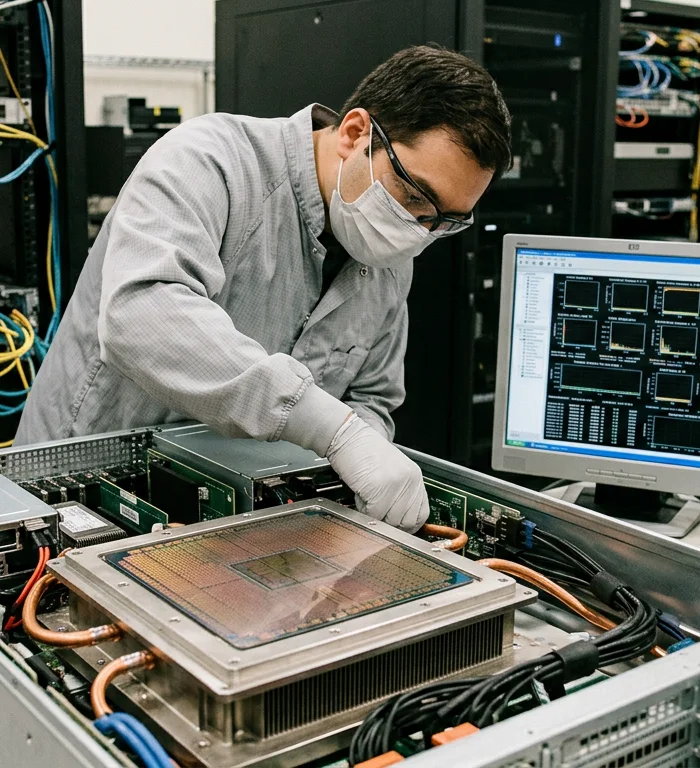
Cerebras Systems released Tungsten and Aviary on Nov. 16, saying in a corporate blog post that a SNAP benchmark runs at 1.6 PFLOP/s on a single CS-4 system.
The release matters because Cerebras is trying to make its wafer-scale hardware usable by scientists who are not hardware specialists; the company said the same test exceeded performance from 10,800 GPUs on El Capitan.
Tungsten is the new programming layer. Michael James, co-founder and chief architect of advanced technologies at Cerebras, said in the blog post: “Tungsten is a language and compiler that lets you program the Wafer-Scale Engine at a high level without giving up performance.”
Cerebras said Tungsten models the Wafer-Scale Engine’s architecture and assigns resources including access patterns, fabric calls, loop definitions and microthreads. The Wafer-Scale Engine has 900,000 cores, according to the company, and uses dataflow computing, where work is triggered as data reaches processing cores.
Aviary is the application portfolio built with Tungsten. Cerebras said it includes tutorials and scientific codes for particle transport, sparse workloads, molecular dynamics, fast Fourier transforms, shallow-water equations and particle-in-cell plasma simulation.
The performance claims are company-provided. Cerebras said SNAP, a proxy for nuclear radiation transport codes, reached 1.6 PFLOP/s, or 1.6 quadrillion floating-point operations a second, on one CS-4 system. It also said the HPCG benchmark reached 1.04 PFLOP/s on a single system, and that its wafer-scale molecular-dynamics work ran 748 times faster than Frontier.
The blog post also tied the release to AI-assisted scientific software development. Cerebras said one researcher used a coding agent over about two weeks to produce a particle-in-cell simulation for plasma physics, with the agent writing the code, tests, figures and documentation.
That simulation advanced 60 million particles at 7,200 time steps a second, equal to 430 billion particle updates a second on one system, according to Cerebras. James said: “A simulation fast enough to run beside an AI model becomes its world model, so the AI can test thousands of designs against real physics.”
The company said the same Tungsten code can run on one wafer or across a cluster, and that its AI deployments scale to 2,048 systems. Cerebras also said a design optimizer for Aviary is coming soon, without giving a release date.
Cerebras did not release pricing, revenue expectations or independent benchmark validation in the blog post. The tools are available at labs.cerebras.ai, according to the company.
More stories
- Europe faces attribution gap after 16 cyber, physical incidents
- PIF backs Grand Theft Auto as Saudi players embrace game
- Signal limits screenshots to curb AI access to messages
- Cognition runs Devin Mac workspaces on EC2 in 6 AWS regions
- Salesforce engineers cut 600-failure triage to 90 minutes
- Türkiye Desk: GTA 6 puts console access and network demand in focus
- Microsoft plans Project Helix as Xbox console for PC games
- OpenAI buys travel startup Odessia
- Meta VR Glasses launch at $1,299 to challenge Apple Vision
- PlayStation and PC software sales rise to 21 million in Japan behind Capcom's latest hit
Latest news
- Trump prepares tariffs on China and other major exporters
- New-car buyers pay record average $50,087 in October
- Banks face ECB reserve debate over liquidity and profits
- Investors see Anthropic debut gains fade below $83 a share
- Iraq orders federal control over Kurdish-area oilfields
- Germans oppose Ukraine aid as poll shows support slipping
- Kim Jong-un receives 10 envoys after constitutional shift
- Ukraine claims Libya strike sinks Russian naval corvette