

Australia and Papua New Guinea Expand Defense and Security Integration
Australia and Papua New Guinea are deepening security ties through military rotations, infrastructure investment, and a novel ADF recruitment program for PNG…
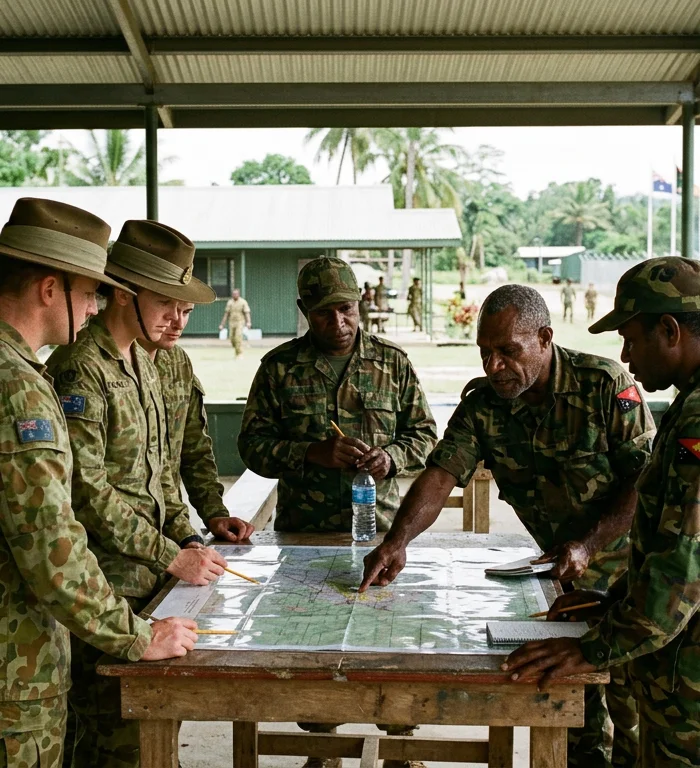
Australia and Papua New Guinea (PNG) have initiated a series of defense and infrastructure projects following the implementation of the Pukpuk Treaty. The bilateral cooperation includes the deployment of a 130-person Australian Defense Force (ADF) combat group to PNG on three-month rotations, designated as the Magani Rotation. This initiative aims to enhance interoperability and military coordination between the two nations.
To support these operational goals, Australia has committed $77 million toward an infrastructure investment fund. These funds are earmarked for upgrading PNG military facilities to improve housing, training, and sustainment capabilities for personnel. The investment is intended to facilitate a more permanent and integrated security presence in the region.
In a significant shift in recruitment policy, Australia will begin accepting applications from PNG citizens for the ADF starting in November 2026, with a pilot program scheduled for 2027. While the initial intake is limited to approximately 50 recruits per cohort, the program is designed to foster long-term institutional and cultural links. Recruits will eventually be required to obtain Australian citizenship through standard pathways.
This digital alignment complements existing security programs
Beyond military cooperation, the two nations have formalized a partnership focused on digital governance and network security. This agreement seeks to improve PNG’s telecommunications infrastructure, which is considered essential for regional military coordination and the protection of critical infrastructure. This digital alignment complements existing security programs, which have seen Australia commit approximately $130 million since 2023 to support PNG’s police and justice institutions.
These initiatives reflect a broader strategic effort by Australia to secure its northern approaches and maintain regional influence. For PNG, the success of these agreements depends on whether the integration effectively enhances domestic sovereign capabilities and development objectives. Both nations face the challenge of transitioning these commitments into sustainable, long-term security infrastructure.
More stories
- Germans oppose Ukraine aid as poll shows support slipping
- Kim Jong-un receives 10 envoys after constitutional shift
- Ukraine claims Libya strike sinks Russian naval corvette
- COP31 climate talks collapse over fossil fuels and funds
- Russian military faces 1,087 recorded suicides in Ukraine war
- US faces China, Russia in Africa minerals contest
- Iran's attacks hit 25 tankers near Strait of Hormuz
- Russia strikes Ukraine as Odesa faces electricity strain
- Wisconsin Prosecutor Declines to Charge Officer in Fatal Shooting of Black Man
- Shenzhen trilateral brings Trump, Putin, Xi together at APEC
Latest news
- Trump prepares tariffs on China and other major exporters
- New-car buyers pay record average $50,087 in October
- Banks face ECB reserve debate over liquidity and profits
- Investors see Anthropic debut gains fade below $83 a share
- Iraq orders federal control over Kurdish-area oilfields
- Nvidia shares retreat as AI rally cools before PCE data
- Macy’s parade faces balloon limits as storm winds approach