Attacks on Saudi oil facilities push Iraq into new probe
Saudi oil facilities were targeted by drones, leaving Riyadh pressing Iraq to stop its territory being used for cross-border attacks.
Omar Farouk ·
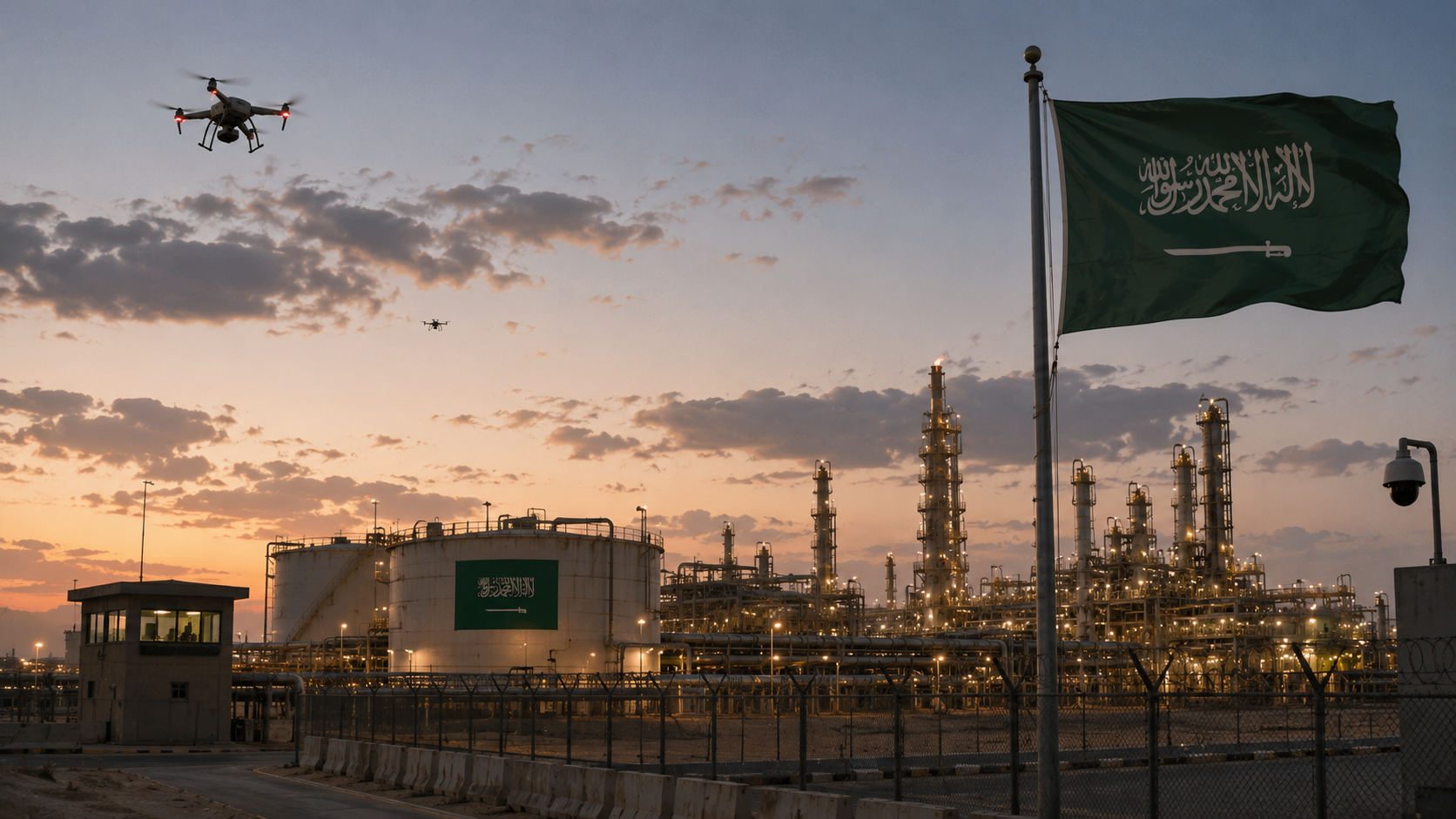
Saudi oil facilities were targeted by drones Monday, prompting Riyadh to press Iraq to prevent its territory being used for attacks.
Saudi Arabia said it intercepted a number of drones aimed at its energy infrastructure and blamed militias in Iraq aligned with Iran. The allegation places Baghdad under immediate pressure because no Iraqi militia had publicly accepted responsibility, while Yemen’s Houthis separately said they had struck Saudi oil sites.
Riyadh points to Iraqi territory
The Saudi statement demanded that Iraq take all necessary steps to stop its land from becoming a launch point for attacks on the kingdom. Riyadh framed the incident as a security breach tied to cross-border militias rather than a conventional state-to-state strike.
Iraqi Prime Minister Ali al-Zaidi ordered security authorities to investigate the accusation. He said Iraq would not allow its territory to be used as a corridor or base for attacks against friendly countries, a formulation that sought to reassure Riyadh without publicly confirming the Saudi claim.
The immediate uncertainty is responsibility. Saudi Arabia pointed toward Iraq-based groups, the Houthis claimed their own operation, and Iraqi militias remained silent, leaving investigators to determine whether Monday’s drones came from one launch network or several overlapping fronts.
Abqaiq damage claim raises stakes
One Gulf official said Monday’s attack caused minor damage at Abqaiq, Saudi Arabia’s oil-processing and stabilization hub. The same official described Abqaiq as handling roughly 7 million barrels a day, making even limited disruption at the site sensitive for energy markets.
Images from the European Union’s Sentinel-2 Earth observation satellite showed flaring at the plant, according to the account provided. Saudi Arabia’s official statement did not identify Abqaiq as a target, so the location and scale of any damage remain partly unconfirmed.
The reported targeting follows a wider pattern since the U.S. and Israel jointly launched a war against Iran in February. Militias aligned with Tehran in Iraq have carried out repeated drone attacks on Saudi Arabia and other Gulf states, according to the account, while often operating outside the control of Iraq’s central authorities.
A Saudi assessment found that up to half of nearly 1,000 drone attacks on the kingdom came from inside Iraq, according to a person familiar with the report. People familiar with the matter said previous strikes included a refinery in the Red Sea oil hub of Yanbu and fields in the eastern province, where Monday’s attacks occurred.
Red Sea route faces pressure
Saudi Arabia has also retaliated with strikes against Iran-backed militias in Iraq, people familiar with the matter said. That cycle raises the risk that Iraq becomes a more active arena in a regional conflict already pulling in major oil producers and export routes.
The Houthis said they targeted Saudi oil facilities because Saudi drones had entered Yemeni airspace. Their claim matters because the group has also threatened the sea lane Saudi Arabia uses to reach Asian buyers when Gulf shipping routes are under strain.
Riyadh has relied on a pipeline moving crude west across the kingdom to a Red Sea port, where tankers can sail through Bab al-Mandeb toward the Indian Ocean. Last week, the Houthis said they would impose a naval blockade on Saudi Arabia and carried out several attacks against Saudi vessels in recent days, according to the account.
If Iraq’s investigation identifies launch sites and Baghdad can constrain militia activity, the global effect would be to reduce one source of risk premium around Gulf crude. For Saudi Arabia, that would protect key processing sites and preserve confidence in the westbound export system; for the wider energy sector, it would lower the chance that insurers, shippers and refiners price in a broader Red Sea disruption.
If responsibility remains contested and attacks continue from multiple directions, the mechanism runs the other way. Global markets would face more uncertainty over spare export routes, Saudi Arabia would need to split attention between inland air defense and maritime security, and regional energy companies would confront higher operating, insurance and routing costs.