ASEAN meeting opens in Manila with security strains in view
ASEAN meeting opened in Manila with maritime tensions, Hormuz shipping risks and Myanmar diplomacy shaping a week of regional talks.
Mei Lin ·
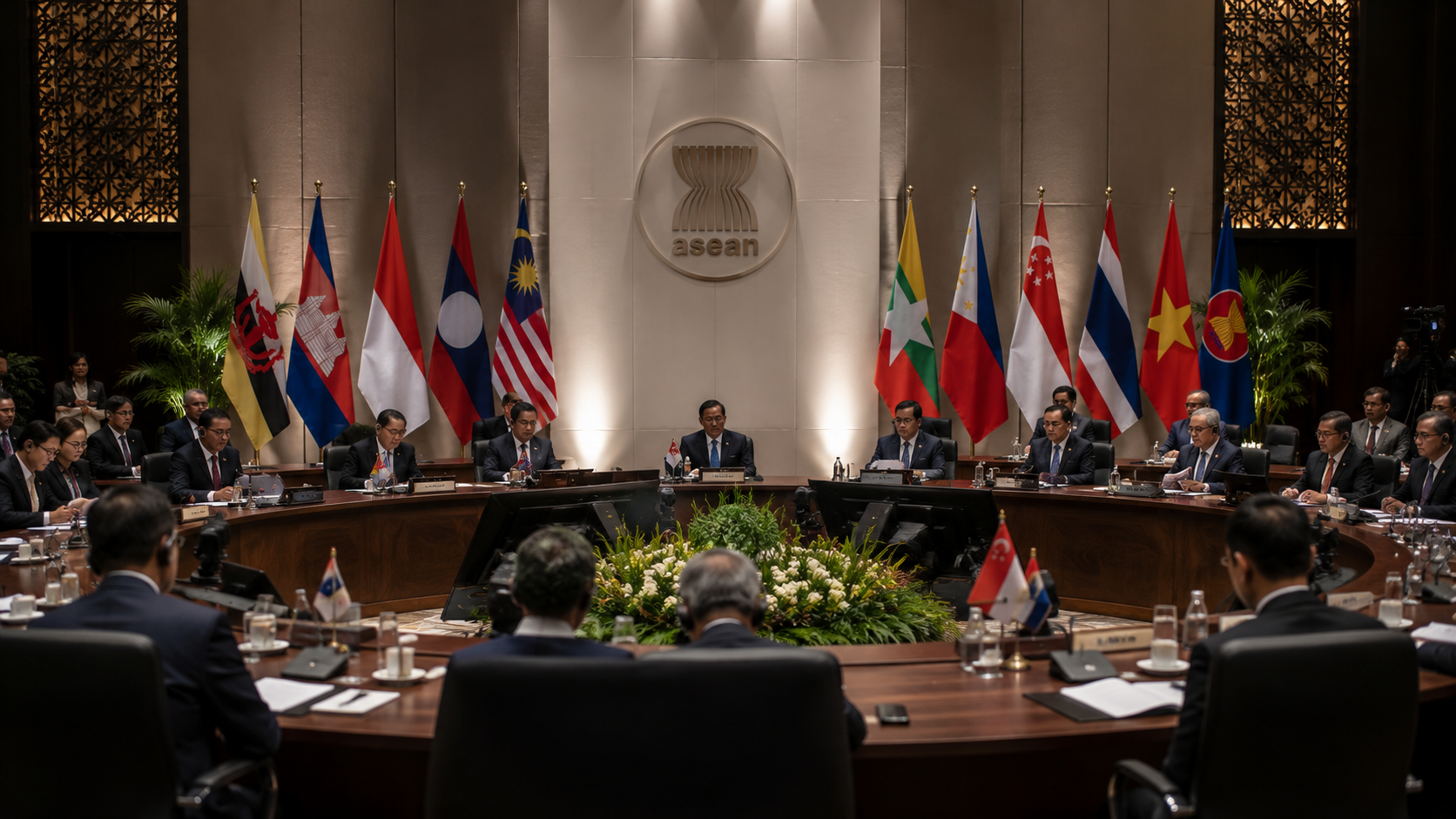
ASEAN meeting opened in Manila with maritime tensions, Hormuz shipping risks and Myanmar diplomacy shaping a week of regional talks.
Philippine Foreign Secretary Ma. Theresa Lazaro used the opening of the 59th ASEAN Foreign Ministers’ Meeting to press for regional cohesion. She described a global environment marked by "upheaval, uncertainty and unpredictability" and said Southeast Asia needed "active, deliberate problem solving."
Lazaro framed unity as a practical defense against external pressure, not a diplomatic slogan. "In a fractured global landscape, no single nation can weather these storms alone. Our strength and resilience lie in our community," she said.
Manila gathers rival powers
The foreign ministers’ session begins a wider week of meetings in Manila involving ASEAN members and major external partners. U.S. Secretary of State Marco Rubio, Chinese Foreign Minister Wang Yi and Russian Foreign Minister Sergey Lavrov are confirmed for the East Asia Summit Foreign Ministers’ Meeting and the ASEAN Regional Forum on July 23.
Those gatherings are expected to create a dense schedule of bilateral talks alongside formal sessions. The format gives ASEAN a convening role at a time when disputes involving the United States, China and Russia are spilling into trade, security and energy policy.
The agenda reflects how far ASEAN’s traditional consensus model is being tested. Ministers are set to discuss the South China Sea, renewed fighting in the Middle East and the bloc’s stalled effort to address the conflict in Myanmar.
Hormuz risks reach Southeast Asia
A draft statement attributed to the ministers called for the restoration of "safe, unimpeded, and continuous transit passage of vessels and aircraft in the Strait of Hormuz." The passage is a critical route for crude oil supplies, and the source said Southeast Asian economies are heavily dependent on it.
The same draft linked Middle East tensions to regional trade, energy and food security. It cited possible effects on energy markets, supply chains and agricultural production, showing how a conflict far from Southeast Asia can quickly become a domestic economic issue for the bloc’s governments.
For ASEAN, the problem is not only oil transport. Disruptions in shipping lanes can raise freight costs, complicate procurement for refiners and food importers, and force governments to weigh consumer-price pressures against budget support.
The South China Sea adds a second maritime layer to the talks. The source said regional security issues are expected to dominate, with tensions in those waters sitting beside Middle East risks and Myanmar on the agenda.
Myanmar initiative stays stalled
ASEAN’s effort to resolve the Myanmar conflict remains one of its most difficult internal tests. The bloc’s diplomacy depends on consensus, but Myanmar has exposed how hard that model becomes when member states differ on pressure, engagement and enforcement.
That challenge matters for ASEAN’s credibility beyond Myanmar. If the bloc cannot move a regional crisis toward a political track, its ability to shape conversations with larger powers may weaken during the same week it hosts them.
The immediate effect falls on ASEAN as an institution rather than on a single company. Manila’s meetings will show whether the bloc can turn shared statements into practical coordination across security, humanitarian and economic files.
Three paths from Manila
If ministers hold a united line on Hormuz, South China Sea tensions and Myanmar, ASEAN gains leverage as a diplomatic platform. The global macro effect would come through lower perceived shipping risk; ASEAN would strengthen its convening role; and regional energy, logistics and agriculture sectors would get clearer signals on policy coordination.
If divisions surface instead, the mechanism reverses. External powers would have more room to work through bilateral channels, ASEAN’s institutional weight would thin, and companies tied to fuel, shipping and food supply chains would face a less predictable policy environment.
A third path is a limited consensus: firm language on maritime transit and Middle East hostilities, but little progress on Myanmar or disputed waters. That would contain the most immediate energy-security concern while leaving the wider regional order exposed to recurring shocks.
The open questions are concrete. Ministers must show whether the draft language becomes a public position, whether sideline meetings reduce friction among major powers, and whether ASEAN can revive its Myanmar initiative with steps beyond another statement.