ArXiv prototype says schools could 3D‑print tactile braille books on demand
A preprint on arXiv describes a browser-based pipeline that generates printable braille pages with matching raised illustrations using consumer 3D printers…
Hannah Vogel ·
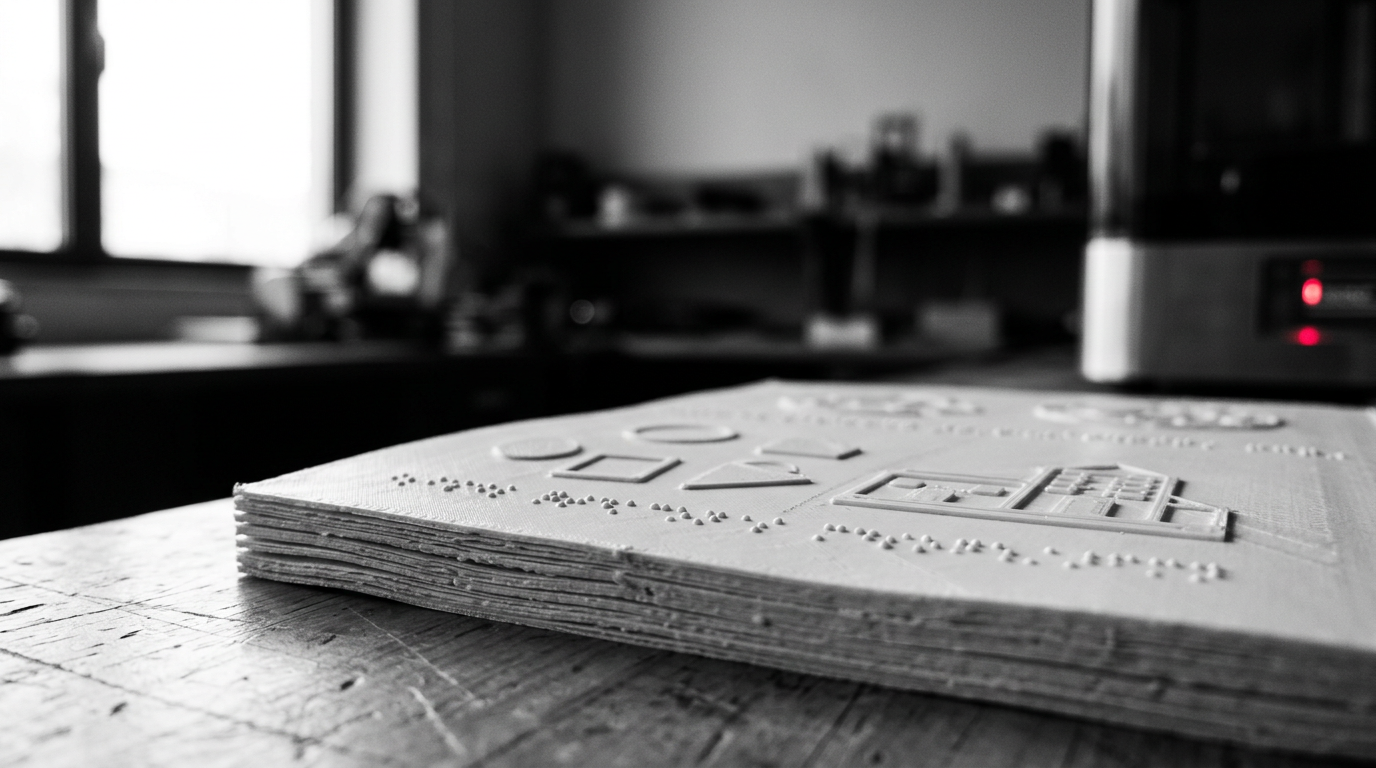
In a preprint on arXiv dated 14 September 2026, the authors describe Tact, a “zero-cost, browser-based pipeline” that converts a spoken or typed story idea into printable braille with a paired raised tactile illustration, designed to run without an account and with an offline-capable fallback. The paper frames the project as a response to falling braille literacy among school-age children and documents an end-to-end engineering approach spanning a consumer fused-deposition modeling (FDM) printer, a deterministic Grade 1 braille translator, verified pagination, a 93‑shape hand-drawn tactile illustration library, and a voice-first interface with synthesized sound cues. The authors also state, plainly, that further work is required before the system is ready for real blind and low-vision readers. This is, so far, single-source — arXiv only, with no independent confirmation, and no one in the reported packet is on the record.
A browser and a consumer 3D printer instead of specialized embossing is a budget shift, not a gadget
The preprint’s claim is not a new device but a different cost path: produce tactile braille story pages with a commodity 3D printer and a browser, instead of specialized software and trained labor for embossed braille and tactile graphics. The abstract links literacy decline “in part” to the need for specialized tools and labor to produce illustrated braille, implying that lowering production barriers could change how schools, libraries and parents source materials. If the engineering holds up, spend that currently flows to per-page embossing services and proprietary layout software could migrate to one-time or already-sunk capex in printers and free, offline-capable software, with operating cost reduced to filament and staff time. The paper’s emphasis on consumer FDM hardware is the tell: procurement would have multiple vendors to source from and fewer lock-in constraints than with niche embossing ecosystems. That would be a channel and margin problem for incumbent service providers, even if high-volume or archival runs continue to favor embossers.
No account, an offline path and a deterministic translator map directly to procurement and legal checklists
The preprint emphasizes that Tact requires no account and offers local, hosted and fallback language-model paths, plus a deterministic Grade 1 braille translator. Those are not engineering flourishes; they are procurement criteria. An offline-capable path reduces data-transfer risk; no-account operation avoids student data collection; and a deterministic translator offers predictable, auditable output in a domain where transcription errors have safety and equity consequences. For districts and libraries operating under strict data-privacy and accessibility obligations, these design choices ease legal review. A browser-based tool that can be pinned to a managed device image and run without network access is more deployable in constrained IT environments than a cloud-only service. Conversely, the Grade 1 scope is a limitation to flag early in any buying discussion: contexts that require other grades would need either translation extensions or separate approval.
The authors themselves list limitations and say the system is not yet ready for real readers
The preprint is explicit about status: it documents “engineering verification, ethical commitments, limitations, and the work required before the system is ready for real blind and low-vision readers.” That caveat pulls this out of the “available product” bucket and into “research prototype.” For buyers, that means no vendor to hold accountable, no support contract, and no field evidence on reading comfort, durability, page throughput, or long-run costs. Tactile quality is a particularly material unknown: while the paper details physical braille geometry and printer calibration, comfortable reading depends on dot height, spacing, sharpness and consistency across pages and runs—a standard specialized embossers are designed to meet. Print times and failure rates on consumer FDM machines will also determine whether on-demand production is viable in a classroom schedule. Until the authors or third parties report trials with blind and low-vision readers, this remains a promising but unproven path.
If the approach holds up, the value chain shifts from specialized services toward commodity hardware and content workflows
Even without a vendor behind it, the preprint sketches a different division of labor. Under the traditional model, schools and libraries procure embossed braille and tactile graphics through specialized providers, or invest in dedicated embossers and staff training. Under the Tact approach, the classroom or library could generate short-run, custom content—story-driven pages with matched tactile art—on demand. That positions the 3D printer as a general-purpose classroom asset doing double duty, with incremental filament spend instead of per-page service fees. Workflow would move from ordering to authoring: teachers or parents speak or type a story idea, let the pipeline generate a draft, then check and print the verified layout. The included 93‑shape tactile illustration library is modest by design and signals a constrained, consistent “vocabulary” of textures—good for predictability, but also a reminder that this is not an infinite-image generator. For edtech distributors and makers of classroom 3D printers, the route to market would not be a new SKU as much as a bundle: filament profiles, verified printer settings, and training materials aligned to the paper’s calibration and geometry guidance.
The obvious skeptic’s read: FDM resolution and classroom cadence may break the promise
Critics will point to two risks the preprint itself cannot resolve without trials. First, tactile quality: consumer FDM printers vary widely, and even well-tuned machines can produce artifacts that matter for fingertip reading. The paper’s attention to geometry and calibration is necessary but may not be sufficient for a comfortable, fatigue-free reading experience. Second, cadence: if it takes tens of minutes to print a page and a story needs multiple pages, classroom use may be limited to pre‑printing rather than genuine “on demand.” Those are not fatal, but they bound the use case. The authors’ ethical model assumes a sighted operator; that fits school staffing but further distances this from DIY adoption by blind users themselves. The preprint’s own “not ready” language keeps the bar where it should be: this needs user testing.
What changes for vendors and buyers over the next school year if this gets traction
For assistive publishers and embossing service providers, the threat is not immediate displacement but substitution at the edge: one-off or highly customized story materials that today are expensive or slow to source could be locally produced. That erodes the most defensible small-batch revenue and forces providers upmarket to complex textbooks, standardized testing materials, and archival-quality outputs. For 3D printer makers and edtech distributors, this is a positioning opportunity: accessibility use cases typically unlock grant budgets distinct from general technology refresh cycles. The procurement hooks in the preprint—offline path, no account, deterministic translator—map neatly to district RFP requirements. Expect marketing that leans into compliance and teacher workflows rather than maker‑lab tinkering. Meanwhile, for school procurement teams, the shortlist of questions is straightforward: what’s the per‑page print time and failure rate on your existing fleet? Which printers meet the geometry specs? How will you verify braille translation and tactile legibility before materials reach students? Until those questions have documented answers, this remains a pilot, not a rollout.
The near-term signals to watch will be pilots, printer profiles and policy language
Within two terms, the test will be whether any district, library system, or non-profit conducts a documented pilot based on the paper’s approach—ideally with blind and low-vision reader feedback on comfort and comprehension. On the supply side, look for printer vendors or resellers publishing Tact‑style calibration profiles and filament recommendations tuned for braille geometry. On the policy side, watch accessibility and procurement guidance: if RFPs begin to allow 3D‑printed tactile materials alongside embossed outputs for certain categories (e.g., storybooks or enrichment materials), the channel is opening. Conversely, if standards bodies or accommodations policies explicitly exclude 3D‑printed braille for core instructional materials, the ceiling will be low. The authors’ claim that no account is needed and an offline path exists will matter here; privacy-by-design is often the swing vote in classroom tech.
The arXiv preprint does not sell a product. It sells a possibility: that a browser, a voice interface, and a consumer 3D printer might be enough to put tactile storybooks within reach of more classrooms and homes. If that possibility survives contact with readers and teachers, spend will quietly re-route—not in a press release, but in which invoices stop showing up and which machines start working after school.