Anthropic Claude flags DNA system in California lab debut
Anthropic Claude identified a DNA enzyme system in lab work, while Anthropic said the biology program remains limited to lower biosafety levels.
Jason Kwon ·
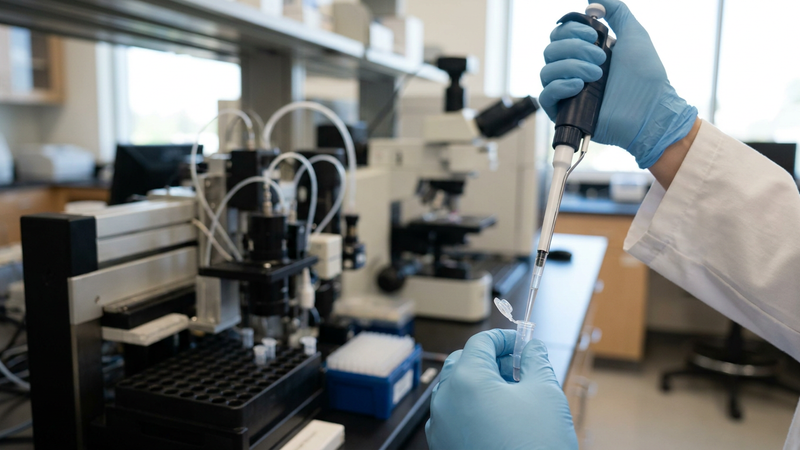
Anthropic Claude flagged a DNA enzyme system likened to CRISPR, the gene-editing tool tied to a 2020 Nobel Prize, as lab ambitions widen.
Anthropic said the finding came from a biology lab it has opened in California, where Claude helps scan genetic material, review scientific literature and steer proteins toward physical testing. The company described the target as a "previously unknown enzyme system" inside DNA, while cautioning that researchers still need to learn what it does.
California lab brings Claude offline
The disclosure gives Anthropic a more concrete role in experimental biology than software-only demonstrations. Its lab allows hypotheses generated by Claude to move into real-world tests run by human researchers, rather than remaining as text outputs or database rankings.
Dario Amodei, Anthropic's chief executive, said the work does not yet involve Claude operating lab machinery on its own. He said such a setup may one day be possible with safeguards, but added that "we aren't doing that today."
DNA search narrows candidates
The current process begins with DNA sequences connected to proteins whose functions are not well understood, according to Anthropic. Claude reviews relevant scientific work, prepares reports for researchers and weighs whether the evidence justifies further testing.
Most possible targets are discarded during that review, the company said. Proteins that survive the screen are then examined in the California lab, where researchers try to characterize them and assess whether they could support further biological research.
The first public result is a molecular system that Amodei said Anthropic suspects may represent a new gene-editing mechanism. That comparison is consequential because CRISPR reshaped biological research and was central to the Nobel Prize awarded in 2020, but Anthropic has not claimed its system can perform the same role.
Biosafety limits define the program
The biology work arrives as advanced AI systems face scrutiny over whether they could lower barriers to dangerous biological design. Anthropic addressed that concern by saying the research uses only lower biosafety risk levels and does not involve pathogens capable of infecting humans.
That limitation matters for how the program should be read. Anthropic is presenting Claude as an assistant for discovery and triage, not as an autonomous biological agent or a system conducting high-risk pathogen research.
The company's central claim remains single-sourced to its own announcement, and the scientific utility of the enzyme system has not been established in the material provided. Anthropic itself said it will "take much more work to learn what this system does, and whether it can be put to similar use."
Discovery paths split from here
If the enzyme system proves controllable and useful, the immediate effect would be scientific before it is commercial. Anthropic would gain a proof point for Claude in laboratory research, biotechnology companies would have an incentive to test similar AI-to-lab workflows, and research-intensive economies would see pressure to connect models with experimental infrastructure.
If follow-up work shows the system has a narrow or unclear function, the effect would be more limited. Claude could still matter as a filtering tool that reduces wasted lab time, but the discovery would not by itself change gene-editing markets or near-term macro assumptions.
The open questions are specific: whether outside researchers can reproduce the result, whether the enzyme system has a reliable biological function, and whether Anthropic's safety controls scale as experiments become more complex. Until those answers arrive, the story is less about a finished biotechnology tool than about AI systems moving closer to the bench.