AI Biofoundry Designs and Runs Experiments, Raising Questions for Neuroscience
China's new AI platform autonomously conducts biological research from simple commands, accelerating discovery while raising new ethical concerns.
Mei Lin ·
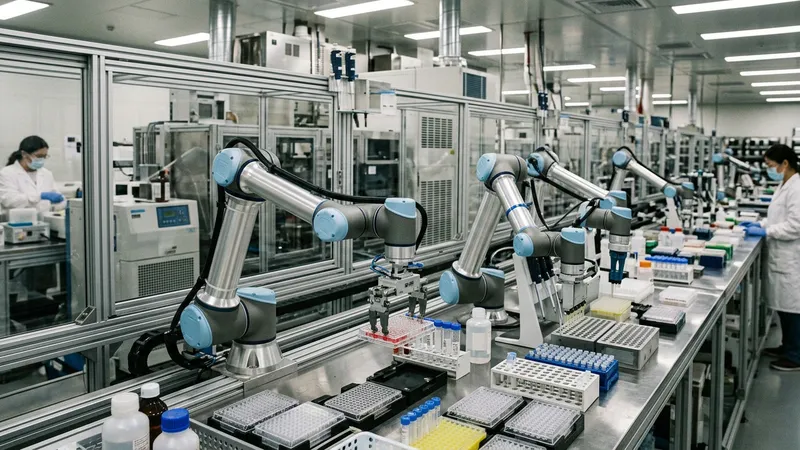
AI Biofoundry Designs and Runs Experiments, Raising Questions for Neuroscience Researchers at China's Westlake University and Zhejiang University have unveiled an AI-powered cloud platform that can autonomously conduct biological research, according to a recent preprint posted to bioRxiv. The system, called iCloudBiofoundry, translates plain-language goals into robotic experiments, raising new possibilities and ethical questions for complex fields like neuroscience and drug discovery. ## Background The iCloudBiofoundry platform creates a closed loop for scientific discovery. It uses a large language model, iBioGenie, to interpret high-level research objectives written in natural language and translate them into concrete, executable experimental protocols. A second AI system, BiofoundryAI, then manages the automated hardware of a biofoundry—a robotic laboratory for biological engineering—to perform the experiments, collect data, and learn from the results. This work represents a significant step beyond using AI for data analysis. While tools like DeepMind's AlphaFold have revolutionized protein structure prediction, this new platform automates the entire research cycle: design, build, test, and learn. By linking computational design directly to physical experimentation without a human in the loop for each step, the system can independently run through multiple iterations to achieve a goal, such as optimizing a cell's production of a specific chemical. ## Why it matters The ability to automate discovery could dramatically accelerate research in neuroscience and psychopharmacology. An AI could be tasked with exploring vast chemical libraries to find molecules with specific effects on brain receptors, potentially designing novel psychedelics or antidepressants much faster than human chemists. The platform could run thousands of variations on a molecular structure, test each one's biological activity in cell cultures, and use the results to design the next, improved batch. This could speed the development of therapies for psychiatric and neurological disorders. This automation also introduces profound challenges. If an AI can design and validate a novel psychoactive compound on its own, it raises questions of intellectual property, safety, and regulatory oversight. Furthermore, the platform's core capability—translating an abstract goal into a novel experimental procedure—could one day be applied to more complex systems like brain organoids or even simple organisms. Tasking an AI with "finding a way to increase neural plasticity" could yield protocols that a human scientist might not have conceived, bypassing the intuition, serendipity, and ethical checkpoints that characterize traditional scientific inquiry. ## What to watch The immediate test for this technology's relevance to neuroscience will be its application beyond industrial synthetic biology. Watch for publications from the iCloudBiofoundry team or other groups that use a fully autonomous design-build-test-learn loop to address neurological targets. Key indicators would include AI-driven design of novel molecules targeting specific brain receptors, automated optimization of cell cultures for brain organoids, or high-throughput screening for neurodegenerative disease models. If by early 2025, papers emerge demonstrating such applications, it will confirm that the age of autonomous neuroscience research is arriving. If the platform's use remains confined to producing biofuels or industrial enzymes, its direct impact on brain science will remain a more distant prospect.