

Abiy seeks stronger capacity after 19-year Megech delay
The 185 million-cubic-meter dam is tied to a wider push to improve delivery capacity as Ethiopia faces economic and security strains.
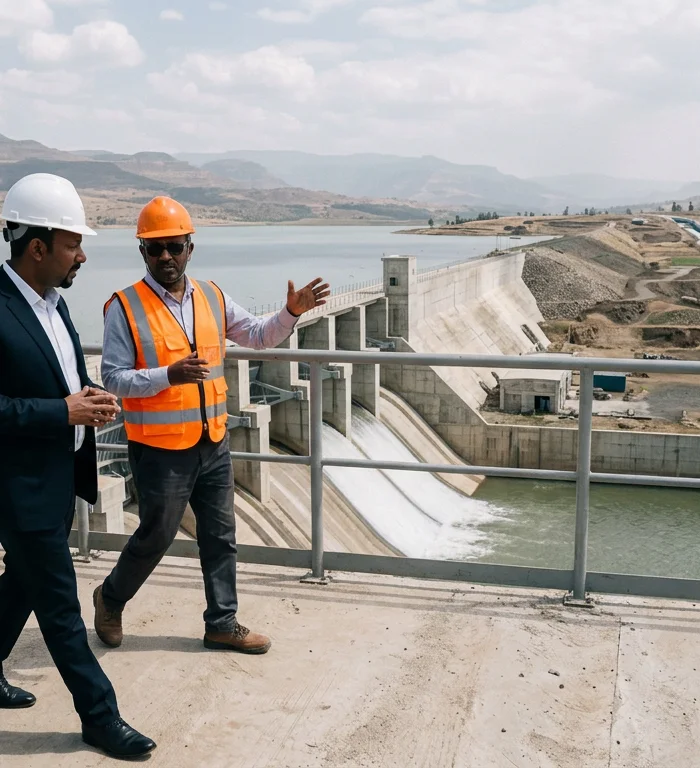
Ethiopian Prime Minister Abiy Ahmed used the Oct. 23 inauguration of the 185 million-cubic-meter Megech project to call for stronger national capacity, the Ethiopian News Agency reported.
The same state news report said the project took 19 years to complete and is expected to irrigate more than 17,000 hectares, or more than 170 square kilometers, according to Atlas360 calculations.
The Megech Irrigation and Water Supply Project sits on the Megech River, a major tributary of Lake Tana in the North Gondar Zone of the Amhara Region. ENA said it is intended to expand farming, improve drinking-water access and support local economic activity.
The dam’s 185 million cubic meters of storage works out to roughly 10,900 cubic meters for each planned hectare of irrigation, equivalent to about 1.1 meters of water spread across that area, according to Atlas360 calculations. The project is also expected to supply Gondar and neighboring towns.
Abiy linked the long delay to wider problems in public works delivery, including weak coordination and unfinished projects. He said the government replaced the contractor and reorganized implementation to complete the scheme.
The remarks give the Megech project a broader policy role: a demonstration of domestic execution capacity at a time when Ethiopia is managing pressure on several fronts. Atlas360 reported on Oct. 22 that ODI Global warned compliance gaps could put up to 60% of Ethiopia’s coffee smallholders at risk of exclusion from a European Union market that takes about 30% of the country’s coffee exports.
Security pressures also shape the development backdrop. Atlas360 reported on Oct. 13 that Ethiopian troops had reached Zalambessa on the Eritrean border, citing six sources, while diplomats sought to prevent war between the neighboring countries.
ENA did not report the project’s cost, identify the previous contractor or provide a timetable for when irrigation and drinking-water services will become fully operational.
More stories
- Russian war deaths top 460,000, Guardian says
- Monrovia mayor-designate seeks $14.5m city budget
- Iran's attacks hit 25 tankers near Strait of Hormuz
- Russia strikes Ukraine as Odesa faces electricity strain
- Bahrain reports two injuries after Iranian aerial attacks
- Baltic responders fight Sparta II fire after drone strike
- Portugal police remove 171 housing protest structures
- Serbia records higher turnout as students challenge Vucic
- US envoy Tom Barrack presses Gulf allies to rely less on US
- India leads IBSAMAR with cooperation across oceans in view
Latest news
- Nvidia board gets Trump input on Jensen Huang return as CEO
- Rwanda faces budget strain from 85% electricity access push
- ICE arrests at Seattle airport draw protests and scrutiny
- AI doubts leave Asian stocks facing a new investment test
- EU rejects COP31 deal as fossil fuel divisions block pact
- Deal Sheet: Fortis shutdown costs over 400 jobs
- Germany to pay about $11 a month into child pension accounts
- Laura Brand curbs prison messages after YouTube dispute