

A2-MEAS reaches 45.40% success on 100 robot tasks
The arXiv preprint reports stronger real-robot results than pi0.5, while leaving deployment claims subject to further validation.
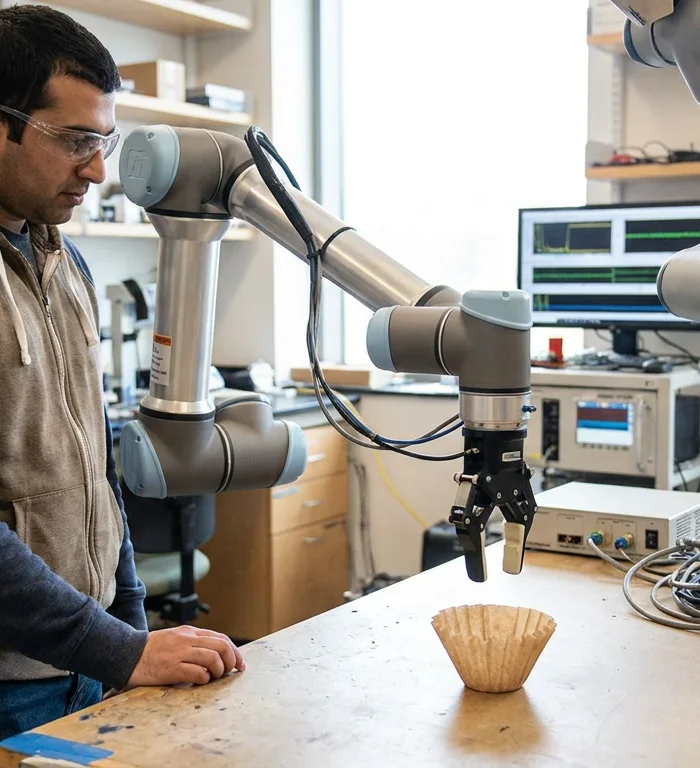
A2-MEAS achieved a 0.6411 Q-score and 45.40% task success on 100 BEHAVIOR 2026 public tasks, according to an arXiv preprint published Nov. 5 and posted by Hugging Face Daily Papers.
The result puts a measurable benchmark behind claims that multi-agent correction systems can improve robot autonomy; A2-WLA also reached 57.92% average success in real household tests versus 26.67% for pi0.5.
The authors describe A2-MEAS as “an embodied multi-agent framework built around code as a scaling interface.” In plain terms, the system turns feedback about a robot’s mistakes into correction codes that can guide the next action.
Those codes combine language feedback, spatial evidence, prior execution and proposed actions, according to the preprint. The system also uses MetaBrain for training supervision and runtime guidance, while the A2-WLA action model adds motion-aware history and a latent world model to a vision-language-action policy.
The paper said, “Surprisingly, this simple design with action pretraining and task specialization reaches 0.5755 Q-score” on a 50-task BEHAVIOR 2026 public subset before online correction. That score was 2.21 times the 2025 winner’s reported 0.2605, though across different benchmark editions and training configurations.
The authors reported further gains on other tests. On RoboTwin 2.0, A2-WLA reached 93.98% average success, rising to 95.05% for the full A2-MEAS system. In a long-horizon pour-over coffee task, a history-conditioned adapter raised post-failure completion at two filter-handling steps from 14% to 94% and from 8% to 82%, compared with A2-WLA retries.
Training efficiency is another part of the claim. The preprint said its infrastructure delivered 427.1 samples per second, or 4.03 times the throughput of a pi0.5 reference implementation on matched hardware.
The main caution is comparability. The BEHAVIOR benchmark comparison with the 2025 winner used different editions and training setups, according to the paper. As an arXiv preprint, the work is an early research release rather than a peer-reviewed journal article.
A paper author, Yufeng Sun, said in a Hugging Face comment that the entry placed fourth worldwide in the 2026 BEHAVIOR Challenge. Sun also said the frozen action policy completed 50 of 120 runs on its own and 63 of 120 runs with the correction interface.
The authors said they plan to release the system, models, training scripts and infrastructure, without giving a release date in the Hugging Face posting.
Source: arXiv preprint via Hugging Face Daily Papers, Nov. 5
More stories
- Europe faces attribution gap after 16 cyber, physical incidents
- PIF backs Grand Theft Auto as Saudi players embrace game
- Signal limits screenshots to curb AI access to messages
- Cognition runs Devin Mac workspaces on EC2 in 6 AWS regions
- Salesforce engineers cut 600-failure triage to 90 minutes
- Türkiye Desk: GTA 6 puts console access and network demand in focus
- Nvidia opens board inquiry into alleged foreign targeting
- Nvidia opens board inquiry into alleged foreign targeting
- Lévy backs a European AI fund to protect local startups
- China Is Considering a $295 Billion AI Buildout—and Nvidia May Be Left Out
Latest news
- Trump prepares tariffs on China and other major exporters
- New-car buyers pay record average $50,087 in October
- Banks face ECB reserve debate over liquidity and profits
- Investors see Anthropic debut gains fade below $83 a share
- Iraq orders federal control over Kurdish-area oilfields
- Germans oppose Ukraine aid as poll shows support slipping
- Kim Jong-un receives 10 envoys after constitutional shift
- Ukraine claims Libya strike sinks Russian naval corvette