

Autonomous Robotic System Completes First In-Space Structural Assembly
A DARPA-funded robot has performed the first independent in-space construction, marking a major shift toward large-scale orbital manufacturing.
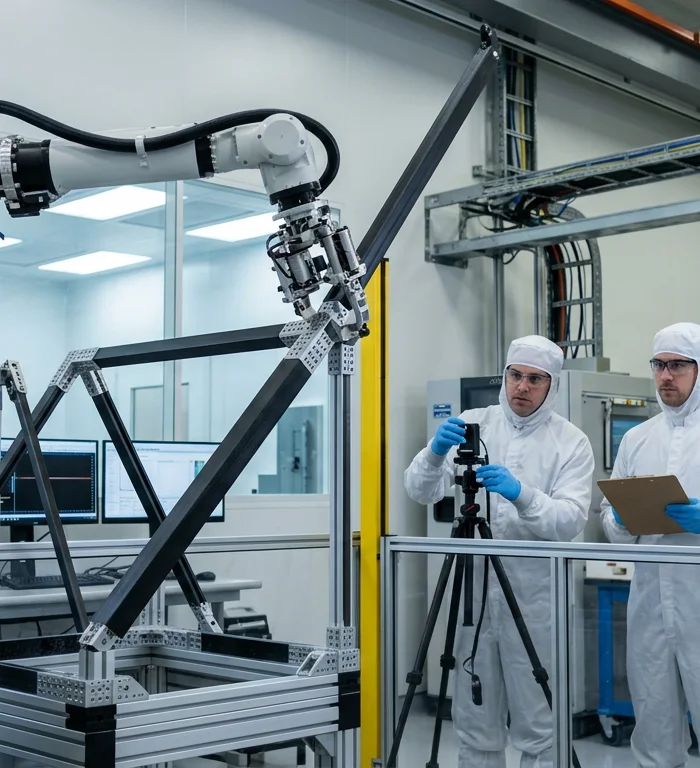
An autonomous robotic system has successfully completed the first independent construction of a structural component in Earth's orbit. The Autonomous In-Space Tensioned Reflector Assembly (ASTRA) utilized composite fiber tubes and aluminum joints to assemble a 1.4-meter segment of a reflector antenna without human intervention. This demonstration validates a new manufacturing paradigm that bypasses traditional launch constraints regarding payload volume and structural dimensions.
Developed under the Defense Advanced Research Projects Agency’s (DARPA) Novel Orbital and Moon Manufacturing, Materials and Mass-efficient Design (NOM4D) program, the technology addresses the physical limitations of current launch vehicles. By transporting modular components that are assembled on-orbit, the system enables the deployment of structures significantly larger than existing rocket fairing capacities. This capability is intended to support future large-scale infrastructure, including solar arrays, communication platforms, and orbital habitats.
The Autonomous In
The Autonomous In The success of this mission marks a transition from pre-built, unfurling designs to active in-space manufacturing. This shift is expected to reduce launch costs and increase the feasibility of complex, large-aperture instruments for astrophysics and telecommunications. The NOM4D program continues to explore complementary technologies, including the solidification of liquid materials in microgravity, to further enhance on-orbit production capabilities.
Institutional stakeholders should monitor the scalability of these robotic assembly techniques as they move toward larger, multi-kilometer structural projects. The ability to manufacture critical infrastructure in situ represents a strategic advancement in space-based logistics and long-term orbital presence. Future developments will likely focus on increasing the complexity of autonomous assembly and the integration of these systems into broader space-based manufacturing ecosystems.
More stories
- Europe faces attribution gap after 16 cyber, physical incidents
- PIF backs Grand Theft Auto as Saudi players embrace game
- Signal limits screenshots to curb AI access to messages
- Cognition runs Devin Mac workspaces on EC2 in 6 AWS regions
- Salesforce engineers cut 600-failure triage to 90 minutes
- Türkiye Desk: GTA 6 puts console access and network demand in focus
- FURSOY posts 500 MHz Linux-capable RISC-V core
- SpaceX catches Starship upper stage but loses its booster
- Anthropic IPO Target Signals AI’s Public Market Stress Test
- Employers turn AI internships into client-facing work sooner
Latest news
- Trump prepares tariffs on China and other major exporters
- New-car buyers pay record average $50,087 in October
- Banks face ECB reserve debate over liquidity and profits
- Investors see Anthropic debut gains fade below $83 a share
- Iraq orders federal control over Kurdish-area oilfields
- Germans oppose Ukraine aid as poll shows support slipping
- Kim Jong-un receives 10 envoys after constitutional shift
- Ukraine claims Libya strike sinks Russian naval corvette