

Uganda rice project lifts yields to 25 bags an acre
A Japan-funded programme in West Nile links improved rice farming with women’s livelihoods and cooperation between refugees and host communities.
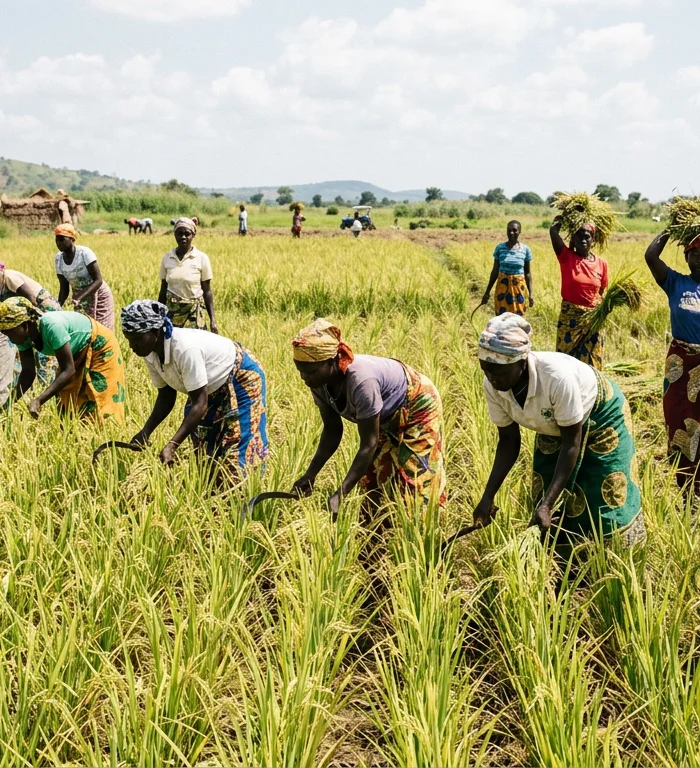
A Japan-funded rice project in Uganda’s West Nile raised one farmer’s harvest to 25 bags an acre from eight, The New Light Paper reported on Oct. 19 through AllAfrica.
The gain matters in Yumbe and Madi Okollo districts, where refugee settlements and host communities face food insecurity, dry weather and pressure over scarce resources; the same farmer’s earnings rose to about 2.5 million shillings from 800,000 shillings.
The programme, called the Implementation of the Women, Peace and Security Agenda in Refugee Settlements and Host Communities, is funded by Japan, with UN Women Uganda as the grant recipient. Peace Winds Japan is helping implement it with partners including Uganda’s National Agricultural Research Organisation, or NARO, which leads the agricultural livelihoods work.
Farmers are being trained in improved rice production, quality seed use and post-harvest handling. The intervention focuses on NERICA 4, a rice variety described in the report as tolerant of some rice diseases and some drought conditions.
Taban Rashid, a farmer from Pitia village in Kululu sub-county, Yumbe district, said training he joined in 2025 changed how he planted and managed rice. “I would usually use 50 kilogrammes of seed to plant an acre, and weeding one acre would take me 15 days,” he said.
Rashid said he had relied on broadcasting, a method that scatters seed across a field, before shifting to recommended practices. He said the change reduced inefficiencies and helped improve rice quality after milling.
“I used to blame the milling machine for breaking my rice. But with the knowledge I got from JICA, I came to learn that the quality is made in the garden, protected in the store, and the machinery only reveals the work you did from planting to storage,” Rashid said.
Natasha Butorac, Women, Peace and Security Specialist at UN Women, said the project links climate stress, resource competition and conflict risks in refugee-hosting areas. “Part of the aim of this intervention is to bring in drought-resilient and disease-resilient varieties of rice,” she said.
The initiative builds on lessons from the Japan International Cooperation Agency-supported Eco-PRiDe Rice project, which showed potential in improved rice production but needed greater participation by women, according to the report. “But by this project, I'm really happy to say that the vast majority of the farmers who are taking part are women,” Butorac said.
NARO is using a field-school model called “Musomesa,” built around shared demonstration plots and individual farmer plots. Dr Emmanuel Odama, a senior research officer at NARO, said farmers learn techniques together and apply them at the same time on their own land.
Under the approach, a group manages a demonstration plot called a “mother garden,” while participating farmers maintain “baby gardens” to repeat the practices. Participants need access to at least half an acre of land, according to the report.
The project also aims to improve relations between refugees and host communities. Odama said some host community members had offered parts of their land to refugees, expanding access beyond arrangements traditionally available through Uganda’s Office of the Prime Minister.
Officials inspected demonstration gardens during the Oct. 19 monitoring mission to assess implementation, progress, results and drought-related challenges. Project officials and farmers said NERICA 4 plots had performed well despite prolonged dry conditions.
“If we had local varieties of rice, we would not be able to see anything here,” Odama said, referring to the dry spell’s effect on the demonstration gardens.
NARO is tracking results against baseline data collected before implementation, using adoption of recommended farming practices and yield improvements as indicators. The findings are expected to show whether the project can deliver durable gains for participating households.
Source: AllAfrica article distributing The New Light Paper, Oct. 19, 2026
More stories
- Fire in Limoges leaves heritage loss and service disruption
- Senegal faces end-November ruling in AFCON title appeal
- Macron keeps interior minister after 2,400 France protest arrests
- UAE tops MENA disaster-readiness trust at 87%
- Rubio urges Ukraine peace as leaders' meeting stays open
- France unrest puts Macron's budget agenda under pressure
- Otzma Yehudit gains ground with 8 seats before Israel vote
- Philippine House passes under-13 social media curbs