

iShares Semiconductor ETF gains after SOX loses 15.7%
Cantor Fitzgerald’s C.J. Muse said equipment makers are sold out, countering worries over Chinese memory supply and AI funding constraints.
SOXX rose 2.8% in premarket trading Monday after the PHLX Semiconductor Index lost 15.7% over eight sessions ended October 16, according to a Benzinga market report citing TradingView data.
The slide was the benchmark's first eight-session losing run since October 10, 2008, when the index dropped 23.5% in eight days after Lehman Brothers collapsed, Benzinga reported.
The PHLX Semiconductor Index, or SOX, tracks 30 large US-listed chip companies. It ended October 16 at 11,137.29 after falling 11.4% for the week, its weakest weekly performance since April 2025, according to Benzinga.
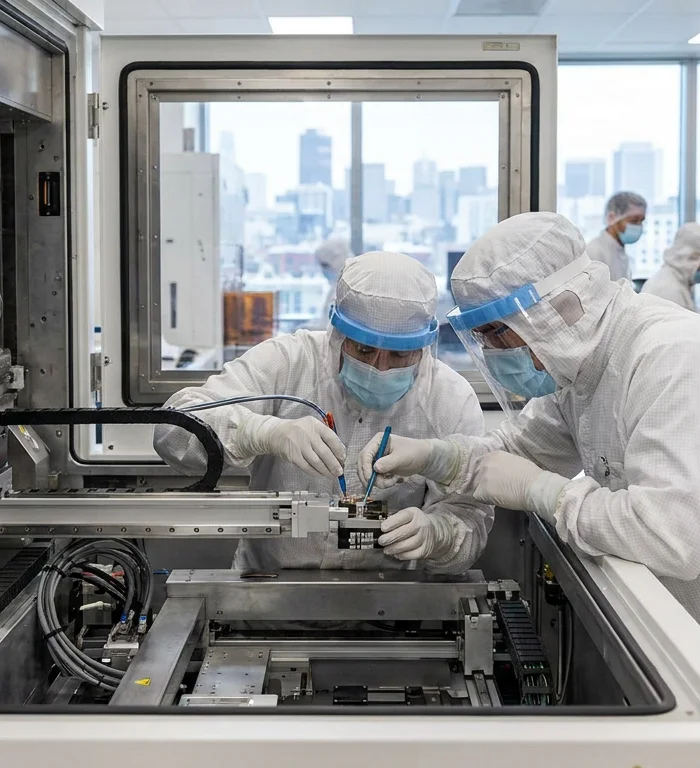
Cantor Fitzgerald analyst C.J. Muse wrote in a note published Monday after the SemiconWest trade show in San Francisco that demand on the equipment side remains stronger than recent share-price moves suggest. What he heard, Muse wrote, was that "we are short compute and equipment companies are being asked to expedite tool deliveries."
Muse said chip-equipment suppliers are effectively sold out, with customers giving them at least eight quarters of visibility. He also said ASML Holding is taking purchase orders reaching into 2029 and 2030.
Muse models wafer fab equipment spending, the money chipmakers pay for production tools, at $215 billion in 2027, up 39%. He said $225 billion is possible, according to the Cantor note cited by Benzinga.
The selling was concentrated in memory companies. Micron Technology fell 14.6% last week, SanDisk dropped 19% and SK Hynix lost 25%, Benzinga reported.
The pressure followed two industry developments. On October 10, China's ChangXin Memory Technologies, or CXMT, said it had advanced a denser memory design known as 4F², which fits more memory cells into the same silicon area, and plans to launch server memory using it by the end of 2026.
Server memory is the most profitable part of the memory market, Benzinga reported. More Chinese supply could challenge the shortage that has supported prices, though the source text did not report independent verification of CXMT's progress or quantify possible production volumes.
Two days later, Broadcom Chief Executive Officer Hock Tan told a conference in Singapore that capital, rather than wafers or memory, could become the industry's main constraint. He also compared some AI investors to "casino gamblers," according to Benzinga.
Muse argued Tan's comments had been misread. In his view, Tan was describing an easing of memory shortages rather than a coming oversupply, and Micron told Cantor it expects supply to be tighter in 2027 than in 2026, with constraints lasting through 2028.
Cantor's preferred equipment names include ASML, Applied Materials, Lam Research, KLA and Teradyne, according to the note. The next evidence point for investors is whether order visibility and memory pricing confirm Muse's view as CXMT moves toward its stated end-2026 server-memory launch.
Source: market report, Benzinga, Oct. 19, 2026
More stories
- OpenWorld signs Blocksight deal for $1.1bn tokenization plans
- Govil seeks 50% or full BBL stake to expand T20 portfolio
- Mynt prices $971m IPO in 2026's biggest Southeast Asia debut
- Bank of America backs 5 tech stocks before earnings
- Snabbit's Rs 195 crore spend tests instant househelp economics
- Hyperscalers face $1.2tn AI spending test after tech selloff
- Shopify price increases may add $40m revenue in JPMorgan call
Latest news
- Macron keeps interior minister after 2,400 France protest arrests
- You Can See Everything grosses $15m from 855 screens
- Rare FN1 mutation may limit brain-vessel damage in APOE ε4 carriers
- Sceye tests 4G service from 54,000 feet over Japan
- UAE tops MENA disaster-readiness trust at 87%
- MSCI warning weighs on Indonesia's currency and its bonds
- Rubio urges Ukraine peace as leaders' meeting stays open
- France unrest puts Macron's budget agenda under pressure