Trump-Xi Summit Delivers Pageantry, but the Hardest Questions Get Pushed to November
Trump and Xi left Washington with their trade truce intact but few new agreements.
Lauren Collins ·
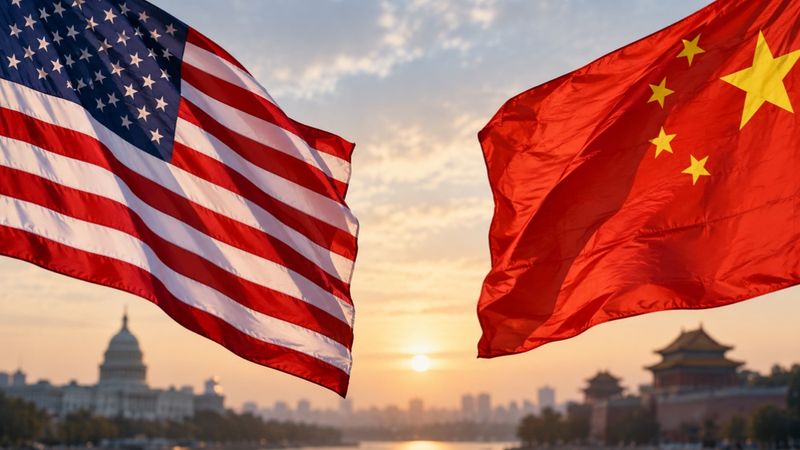
President Donald Trump and Chinese President Xi Jinping concluded a closely watched Washington summit with plenty of ceremony but limited evidence of a breakthrough on the issues dividing the world’s two largest economies.
The most immediate outcome was another extension of the US-China trade truce, according to the Atlantic Council’s post-summit analysis. But the bigger disputes — tariffs, rare earths, Taiwan and the rules governing the accelerating artificial-intelligence race — remain unresolved.
That makes the Washington meeting less a grand bargain than another waypoint in an increasingly leader-driven relationship.
The summit followed an elaborate state visit that included Trump personally welcoming Xi, a military arrival ceremony at the White House and a state dinner. The White House said the ceremony involved 479 military personnel and a flyover by a B-2 bomber and four F-22 fighters.
The diplomatic choreography was striking because Trump and Xi are already preparing for further face-to-face diplomacy.
According to Atlantic Council experts, Xi wants Trump to attend the Asia-Pacific Economic Cooperation summit in Shenzhen in November, while Trump wants Xi at the G20 summit in Miami in December. The two governments had already said after their May summit that they would support each other as hosts of the two gatherings.
That calendar helps explain why neither side appeared eager to force the hardest disputes to a conclusion in Washington.
Atlantic Council international economics chair Josh Lipsky described the trade extension as effectively buying time. His interpretation is that what both presidents need from one another in the immediate term may be continued engagement as much as a specific concession on tariffs or critical minerals.
The underlying economic relationship remains considerably more complicated.
At their May meeting, the two governments announced plans for bilateral trade and investment boards, Chinese purchases of American agricultural products and Boeing aircraft, and Chinese action addressing US concerns about access to rare earths and critical minerals. But implementation of several earlier commitments has been incomplete or slower than initially envisioned.
The Washington summit therefore preserved the economic ceasefire without resolving the structural competition underneath it.
Taiwan stayed off the deal sheet
One of the most consequential developments may have been something that did not happen.
According to Atlantic Council Indo-Pacific security director Markus Garlauskas, no public agreement emerged satisfying Beijing's push for Washington to halt arms sales to Taiwan.
But that does not mean the Taiwan question has disappeared.
Washington has yet to approve another major weapons package for Taipei, according to the Atlantic Council analysis, leaving the issue potentially hanging over the expected November Trump-Xi meeting.
The broader question is whether continued summit diplomacy creates room for managing tensions or causes difficult security decisions to be repeatedly deferred.
AI talks produced common language, not common rules
Artificial intelligence was another area where the two sides found limited conceptual overlap but little concrete policy agreement.
Atlantic Council China fellow Kenton Thibaut said public statements indicated some shared emphasis on keeping humans involved in AI decision-making and preventing misuse. But the summit produced no announced agreement covering specific mechanisms such as reporting major AI incidents, jointly evaluating frontier models or restricting development of increasingly capable systems.
That matters because AI has become one of the central dimensions of US-China strategic competition.
Ahead of the summit, officials and analysts were already discussing the possibility of an AI crisis-communication mechanism as both countries race to deploy increasingly powerful models.
For now, substantive cooperation may have to emerge below the presidential level through technical exchanges, expert dialogues and unofficial channels rather than a sweeping Trump-Xi accord.
The optics may matter as much as the agreements
The Washington visit also carried a broader geopolitical message.
Atlantic Council China director Melanie Hart characterized Trump's approach as an effort to build a stronger personal relationship with Xi, while arguing that Beijing ultimately responds more to strategic incentives than personal diplomacy.
Lipsky highlighted another consequence: the spectacle placed Washington and Beijing at the center of global diplomacy at the same moment world leaders were gathering in New York for the UN General Assembly.
That presentation fits a long-standing Chinese preference for being treated as Washington's principal peer rather than simply one power among a larger coalition of US allies.
Whether the symbolism translates into a more stable relationship remains uncertain.
The two governments have spent much of the past year maintaining what Atlantic Council analysts describe as an uneasy pause in confrontation rather than a genuine détente. Even before this week's summit, both sides continued testing each other's boundaries while trying to avoid an escalation that could derail trade or diplomacy.
The next test comes quickly.
Trump and Xi are expected to meet again around November's APEC summit, followed potentially by another encounter at the G20 in Miami in December.
By then, extending truces may become harder. Tariffs, rare-earth supply chains, Taiwan, technology controls and the emerging rules of AI competition will still be waiting.
For Washington and Beijing, the summit showed that keeping the relationship stable is currently possible.
It did not show that either side has figured out what comes after the pause.
Sources: Atlantic Council post-summit analysis provided to Atlas360; Atlantic Council pre-summit analysis; White House statements and fact sheets; Associated Press reporting.