

Bulakan residents face floods despite 12 DPWH projects
A Nov. 10 Rappler investigation found gaps in local drainage, dike construction and planning in a low-lying Philippine municipality.
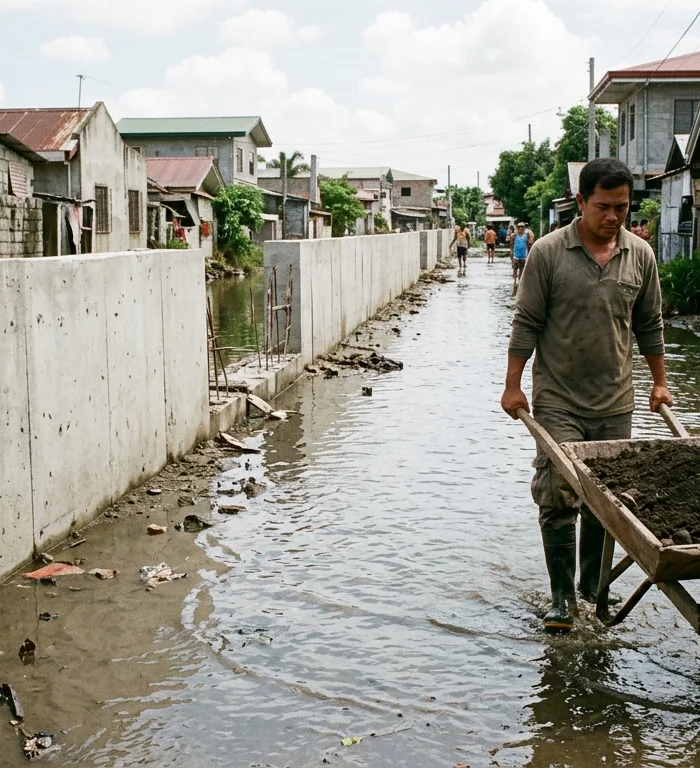
The Department of Public Works and Highways recorded 12 completed flood-control projects in Bulakan from 2022 to 2024, worth P722.8 million, according to a Rappler report published Nov. 10.
The contract cost was about 37 times Matungao’s P19.6 million 2026 National Tax Allotment, the barangay’s share of national revenue, according to Atlas360 calculations. Residents of Triple Junction Subdivision in Barangay Matungao still endured more than a week of flooding in August after successive typhoons.
The projects listed by the Department of Public Works and Highways’ 1st District Engineering Office included riverbank reinforcements, revetments, which are protective structures built to shield banks from erosion, and concrete works along waterways. Four were in Matungao, including structures near the Guiguinto River and Triple Junction.
Barangay captain Anthony Mark R. Cruz said some dike sections in Matungao remain unfinished and disconnected. He said barangay officials are not consistently consulted before construction or given enough opportunity to inspect projects before they are declared complete.
“Floodwalls are not enough,” Rosalyn, a Triple Junction homeowners association member who requested anonymity, said. “They are not sufficient. Water still gets in.
No matter how many dikes you build, if the river itself is not properly maintained, the first thing that needs to be done is to dredge it.”
Some residents had to add fill soil around their properties so nearby flood-control structures could work as intended. A P77-million flood wall project was identified at Triple Junction, where residents described uneven construction and openings that allow high-tide water to enter.
The flooding reflects both local engineering issues and the geography of coastal Bulacan. Fernando Siringan of the University of the Philippines Marine Science Institute said in social-media posts that parts of Bulacan, Pampanga and Camanava sit only 0 to 2 meters above sea level, limiting natural drainage toward Manila Bay.
Siringan also said narrowed channels, structural encroachments, upstream erosion and garbage accumulation can worsen flooding. Matungao has drainage channels without working outlets, including a closed outfall in Purok 2, while other lines pass through private subdivisions where blockages require coordination with property owners.
The barangay’s fiscal capacity is limited compared with the scale of the problem. Matungao’s National Tax Allotment rose to P19.6 million in 2026 from P13.9 million in 2024, but only about 1%, or roughly P200,000 to P250,000 a year, is allocated for infrastructure. About P150,000 is earmarked for drainage projects.
Residents differed on whether dredging would help. Rosalyn and Cruz identified it as necessary to improve water flow, while Nico, a resident identified by a pseudonym, said excavation may have worsened flooding because Matungao acts as a catch basin.
Department Order No. 23, series of 2015, requires flood-control and drainage projects to be based on a master plan or feasibility study for the covered river basin or urban area. It also requires engineering surveys and measures effectiveness through reductions in flood-prone areas, property damage and flood duration.
More stories
- US pauses Iran military action after 8 months of war
- Philippine DOJ revives Hontiveros cyber libel case against six people
- Netanyahu’s Rival Gadi Eisenkot Tasked With Forming New Israeli Government After Inconclusive Election
- Syria rejects Yemen role after 600-troop Saudi border report
- Pangilinan questions Davao assessor on 379 sqm SALN lot
- Ruling-family cases leave reform uncertain in 6 African states
- Lithuania probes Starlink arson as Russia-linked sabotage
- Brazil rivals rally before debate as runoff nears finish