Trump Backs Hegseth Following Disputed Munitions Report
President Trump defended Pete Hegseth after a weapons stockpile report revived scrutiny of Pentagon leadership and leak politics.
Lauren Collins ·
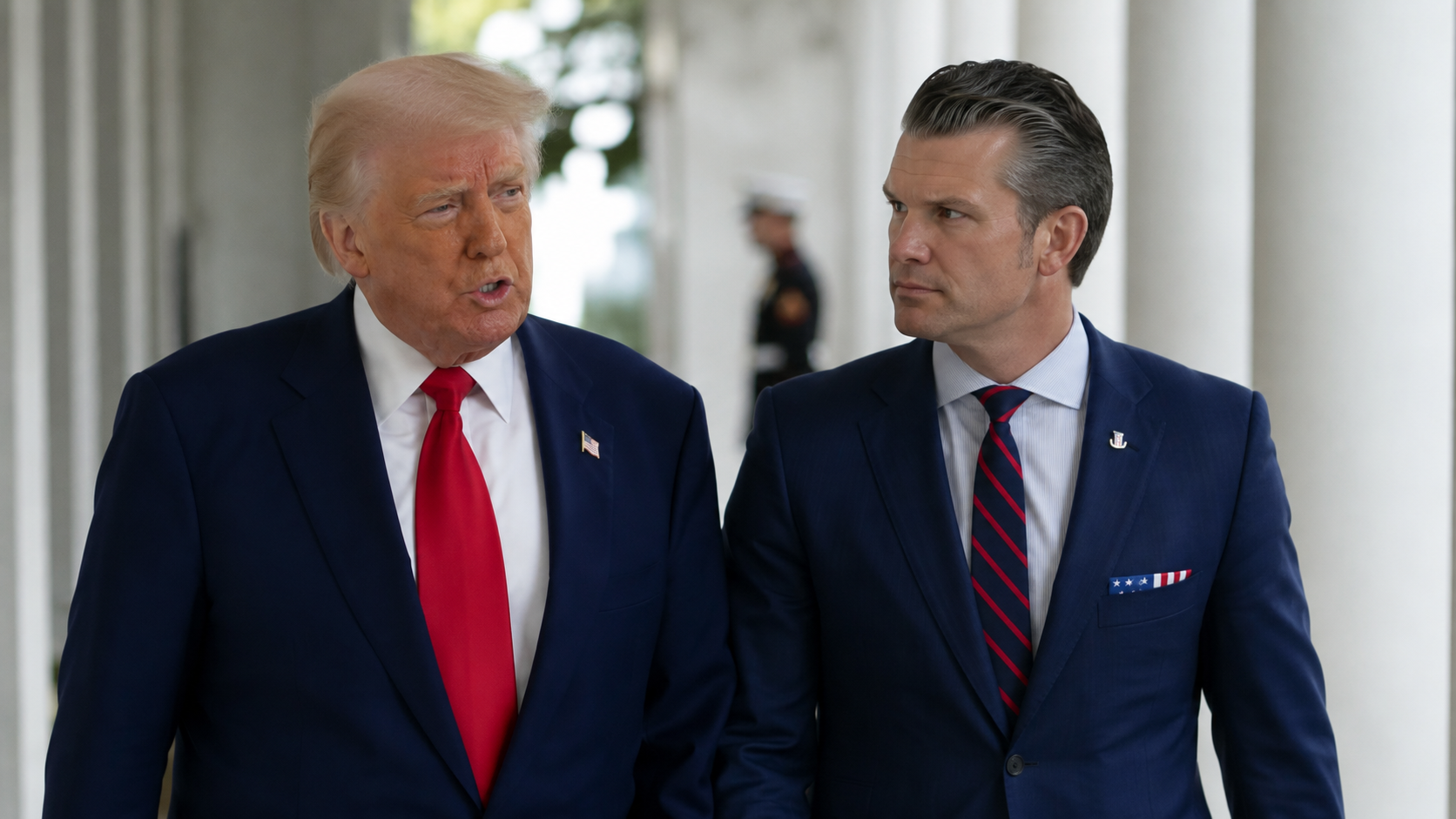
Trump Hegseth tensions over US weapons stockpiles drew a public denial from President Trump as he reaffirmed support for his Pentagon chief.
The statement came Thursday in a social media post, one day after a published account described a private disagreement over munitions supplies. Trump rejected the account and praised Hegseth’s stewardship of the Defense Department.
“I am extremely happy with the job that Pete Hegseth is doing,” Trump wrote. He added that “Everything has been extraordinary, including our attack on Venezuela” and, in Iran, “where the country has been decimated.”
Stockpile dispute reaches the Cabinet
The disputed account said Trump voiced anger at Hegseth on the sidelines of a Cabinet meeting last week, telling him he had been misled about weapons shortages. That claim remains attributed to the report; Trump has publicly denied it.
Trump also repeated his assertion that defense companies are building the largest number of plants and factories in US history. He did not provide figures for weapons inventories, factory openings, production capacity, or delivery schedules in the post.
The stockpile issue lands at the intersection of war planning, industrial capacity, and presidential control over national security messaging. If the White House sees shortages as overstated, Hegseth gains room to argue that procurement and military operations remain on track.
If internal warnings about munitions availability are accurate, the Defense Department faces a different problem: sustaining operations while avoiding public signs of constraint. That would put pressure on contractors, budget planners, and commanders who must match political commitments with available supply.
Leak threats sharpen the fight
Trump also threatened people he described as “leakers” of supposed “treasonous statements,” writing that “Long-term jail sentences will be sought!” The president did not cite evidence that laws were broken in connection with reporting on US weapons supplies.
The threat shifts part of the dispute from logistics to loyalty. For officials inside the national security bureaucracy, the risk is that disagreement over readiness becomes entangled with a criminalized language of leaks, even where the underlying facts remain contested.
That framing benefits Hegseth in the short term by keeping the president’s anger directed outward rather than at the Pentagon chief. It may also narrow the space for internal candor if officials conclude that warnings about stockpiles could be treated as political betrayal.
Hegseth’s Pentagon record
Trump’s defense of Hegseth fits a broader pattern dating to the secretary’s difficult confirmation process in January 2025. The president has stood by him through criticism over management, national security practices, and the pace of personnel changes at the Pentagon.
A December inspector general finding concluded that Hegseth exposed sensitive information about US military operations in Yemen when he shared details in a Signal group chat with senior national security officials. The chat inadvertently included a journalist, according to that finding.
Trump defended Hegseth after that episode as well, preserving a political alliance that has mattered more than the criticism around it. Hegseth has also removed scores of senior officers viewed as disloyal or misaligned with the administration’s objectives.
Those removals have changed the incentives inside the department. Civilian control of the military is a constitutional principle, but the policy question is how far an administration can push alignment before professional military advice becomes harder to surface.
The immediate implication is that Hegseth remains protected while Trump publicly denies friction over weapons supplies. The next test is whether the administration separates stockpile management from leak enforcement, or treats both as part of the same loyalty fight.
If production expands as Trump claims, the Pentagon can argue that current strains are temporary and manageable. If shortages persist, the pressure will move from social media defenses to appropriations, contractor output, and the operational choices commanders can support.