Trump Forces MBS to Choose Between Nuclear Ambition and Arab Legitimacy
Trump is conditioning a U.S.-Saudi nuclear deal on Abraham Accords participation, forcing MBS to weigh strategic gains against regional ties.
Lauren Collins ·
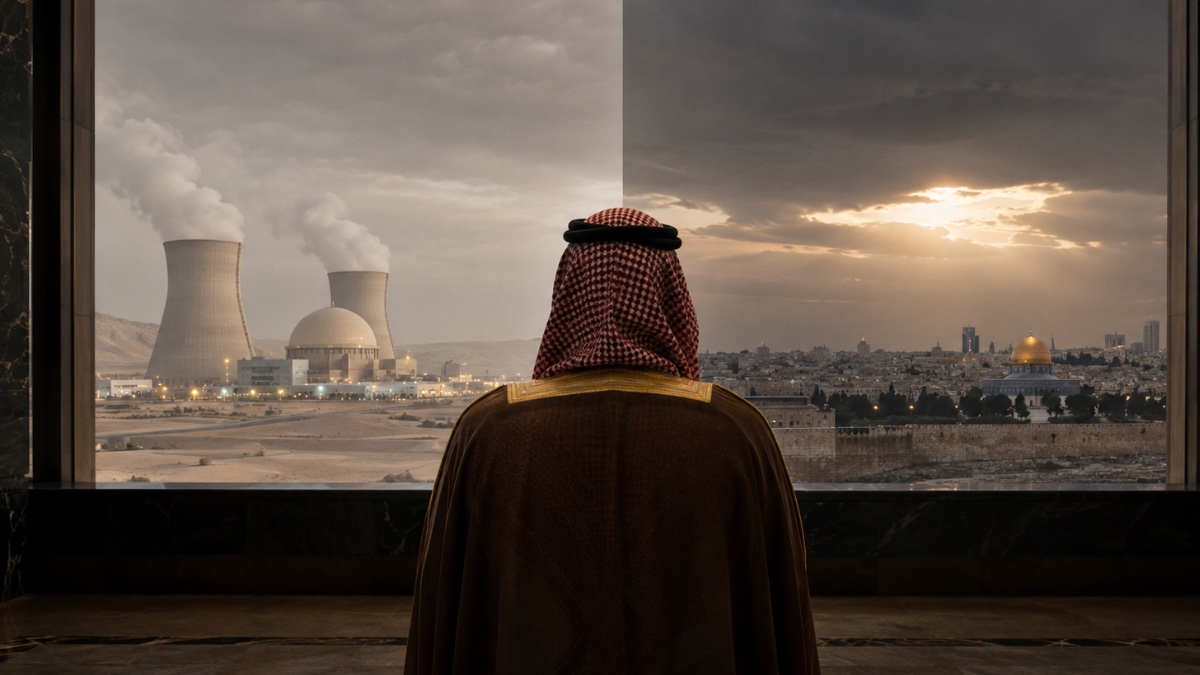
President Donald Trump placed Mohammed bin Salman at the center of a new Middle East test when he said the U.S.-Saudi civilian nuclear agreement would depend on the kingdom establishing relations with Israel through the Abraham Accords. The statement came one day after U.S. Energy Secretary Chris Wright and Saudi Energy Minister Prince Abdulaziz bin Salman signed a Section 123 cooperation agreement and an accompanying safeguards arrangement, creating the legal basis for what Washington described as a decades-long, multibillion-dollar nuclear partnership that must now go before Congress. Neither the Energy Department’s initial announcement nor the Saudi account presented recognition of Israel as part of the bargain, and the Saudi Embassy in Washington declined to say whether Riyadh had accepted Trump’s condition. That distinction is crucial: Trump’s political demand is explicit, but its legal force remains uncertain until the agreement’s unpublished text, its safeguards and the administration’s implementation plan are examined by Congress.
For MBS, the issue is therefore larger than whether Saudi Arabia wants nuclear reactors or diplomatic relations with Israel. He must decide whether to accept a negotiation in which Washington appears to have changed the terms after the signing ceremony, potentially reducing Saudi leverage before Israel has offered anything on the Palestinian question. An immediate Saudi endorsement would give Trump a major foreign-policy victory and provide Israel with recognition from the Arab world’s largest economy, but it would also allow Washington to define the transaction as nuclear access in exchange for normalization. Riyadh’s preferred structure has long been broader: American security commitments, advanced military and nuclear cooperation, Israeli concessions and a Palestinian political outcome would move together as one package rather than as separate Saudi payments to Washington and Jerusalem.
Riyadh’s Palestinian Line Is Public
Saudi Arabia has left little public ambiguity about the minimum political conditions it expects before recognizing Israel. In February 2024, the Foreign Ministry said there would be no diplomatic relationship unless an independent Palestinian state was recognized within the 1967 lines, with East Jerusalem as its capital, and unless the Gaza war ended and Israeli forces withdrew from the territory. Riyadh strengthened that position rather than quietly setting it aside: in 2025 it co-chaired a major two-state conference with France, backed a declaration endorsed by 142 members of the UN General Assembly and called for a permanent ceasefire, the release of hostages, a prisoner exchange, unrestricted humanitarian assistance, Israeli withdrawal and stronger Palestinian security institutions. By turning those demands into an international initiative, the Saudi leadership made Palestine part of its diplomatic record, not merely a bargaining position that could be abandoned when a more valuable American offer arrived.
This is where Trump’s condition collides with Israeli politics. Prime Minister Benjamin Netanyahu has publicly declared that there will be no Palestinian state west of the Jordan River, presenting his opposition as a security requirement and pledging continued settlement growth. Saudi Arabia is thus being asked to deliver the concession Israel wants—recognition by the most consequential Arab state—while the Israeli government rejects the outcome Riyadh says it needs to defend that recognition. Unless Trump is prepared to exert pressure on both sides, his condition is less a bridge to an agreement than a demand that MBS retreat from Saudi Arabia’s stated position. The crown prince could do that, but he would have to explain why American nuclear cooperation justified surrendering Palestinian conditions that his government had recently described as firm, historic and central to a just regional settlement.
MBS Commands the Saudi State
Mohammed bin Salman possesses the institutional authority to drive a decision of this magnitude. He is crown prince, prime minister and chairman of the Council of Economic and Development Affairs, while the political and administrative system built around Vision 2030 has concentrated economic strategy, foreign policy and national development under his direction. Research by the Carnegie Endowment describes the past decade as one of increasingly personalized authority, a restructured state capable of carrying out central directives quickly and tight restrictions on organized public dissent. There is no elected parliament with the power to defeat a normalization treaty, no competitive party system capable of turning the question into an election and no independent religious establishment with a formal veto over a decision endorsed by the royal leadership.
MBS could therefore instruct the Foreign Ministry to establish relations, direct Saudi media to emphasize security and economic benefits, authorize business and aviation links, and frame the agreement as an exercise of national sovereignty rather than a concession to Israel. He could also present it as a victory extracted from Washington: access to American nuclear technology, closer defense cooperation, investment opportunities and a stronger position against external threats. Yet control over the state does not provide control over how the decision is understood, particularly when it touches Palestine, Jerusalem and the monarchy’s role in the Islamic world. MBS can prevent organized opposition from blocking normalization, but he cannot guarantee that Saudi citizens, Arab publics or Muslim communities will regard the agreement as legitimate—or that they will separate it from images of Gaza and Israeli policy in the West Bank.
Eighty-One Percent Say No
The clearest domestic warning comes from Saudi public opinion, even allowing for the limitations of polling in an authoritarian political system. A nationally representative survey conducted in April and May 2025 found that 81% of Saudi respondents regarded normal, peaceful relations with Israel negatively, while only 1% viewed them positively and 16% considered them neutral; the share seeing the Abraham Accords as beneficial for the region had fallen from 41% shortly after their launch to 13% in 2025. When respondents were asked what could affect their view of official relations, 43% pointed to guarantees for Muslim rights at al-Aqsa Mosque and al-Haram al-Sharif, while 36% selected expanded Palestinian political rights in the West Bank and Gaza. Those figures indicate that the public obstacle is not an abstract hatred of diplomacy but the absence of an outcome that Saudis can identify as fair to Palestinians and protective of Jerusalem’s Islamic sites.
The same research offers MBS a narrow opening. Saudi respondents had become less supportive of Hamas, favored a more active Arab role in Israeli-Palestinian diplomacy and increasingly regarded peace between Israel and a Palestinian state as the most viable destination. The public could therefore accept a Saudi-led settlement more readily than a simple normalization ceremony, especially if Riyadh could show that its leverage produced reconstruction, Palestinian governance, protected access to holy places and a binding political horizon. Repression might limit demonstrations against an unconditional deal, but quiet resentment would still matter because MBS’s domestic project relies not only on fear or obedience but also on nationalist pride, confidence in his competence and the belief that Saudi Arabia negotiates from strength.
Al-Aqsa Sets the Regional Price
Saudi Arabia’s regional position makes its decision more sensitive than those taken by the United Arab Emirates, Bahrain or Morocco in 2020. Vision 2030 itself describes the kingdom’s place at the heart of the Arab and Islamic worlds as a foundational national asset, while the Saudi monarchy derives additional influence from Mecca and Medina and from its ability to convene Arab and Islamic governments around Palestine. The 2025 Arab Opinion Index found that 80% of respondents considered Palestine a collective Arab cause, while 87% opposed their own countries recognizing Israel; only 6% supported recognition, and half of that small group conditioned its support on the establishment of an independent Palestinian state. Saudi normalization would therefore be judged across the region not simply as another bilateral treaty but as a signal that the leading Arab power had decided whether Palestinian statehood remained a prerequisite for Israel’s full integration.
An agreement reached without visible Palestinian gains would not cause governments to sever relations with Riyadh. Saudi Arabia’s economic weight, energy influence, investments and security partnerships are too important, and several regional governments would privately welcome greater coordination among Washington, Riyadh and Israel. The loss would be less immediate but still consequential: Saudi mediation would attract greater skepticism, its rivals would depict the kingdom as having exchanged an Arab cause for American technology, and every subsequent Israeli settlement decision or military operation would be used to challenge MBS’s judgment. The crown prince could preserve formal alliances while losing some of the public legitimacy that distinguishes regional leadership from raw financial and military power. That is the support he is most at risk of losing—not necessarily the cooperation of rulers, but the belief among Arab and Muslim audiences that Saudi Arabia still speaks for interests larger than its own.
Nuclear Access Comes With Exposure
The American offer is substantial enough that MBS cannot dismiss it. A Section 123 agreement is generally required before major U.S. nuclear materials, equipment or components can be transferred, and the Saudi pact is expected to run for 30 years while opening the kingdom’s planned civilian program to American companies, technical expertise and supply chains. Nuclear power could help Saudi Arabia diversify electricity generation, conserve hydrocarbons for export or industrial use, and support the energy-intensive industries being developed under Vision 2030. A U.S. agreement would also deepen Saudi ties with Washington at a time when civilian nuclear technology, missile defense, advanced aircraft and political protection are increasingly connected in Gulf security calculations.
Washington does not possess unlimited leverage, however. Secretary of State Marco Rubio acknowledged that Saudi Arabia could seek assistance from China, South Korea, France or Russia, while arguing that the United States wants American companies selected instead. That competition gives Riyadh alternatives, even if those alternatives do not provide the same combination of technology, congressional legitimacy and strategic alignment. The agreement also faces separate uncertainty in Washington: its complete text has not been published, reports have raised questions about whether a future Saudi enrichment facility could be considered after a joint study, Trump has said enrichment will not be allowed, and the pact reportedly does not include the International Atomic Energy Agency’s Additional Protocol for expanded inspection and verification.
Normalization could bring real security advantages, including more open coordination on missiles, drones, maritime threats, cyberattacks and Iran’s regional capabilities. It could also make Saudi Arabia appear to be a formal member of an American-Israeli security bloc at a time of direct conflict involving Iran, increasing the political and potentially physical exposure of Saudi infrastructure, shipping and regional interests. Riyadh has spent years trying to combine American protection with sufficient diplomatic flexibility to avoid becoming the battlefield for every confrontation between Washington, Israel and Tehran. A public treaty with Israel would reduce that ambiguity, meaning MBS would need security guarantees strong enough to compensate for the additional risk rather than relying on promises that could change with a future U.S. administration.
A Phased Deal or No Deal
The most feasible route is not an immediate exchange of Saudi recognition for American nuclear cooperation. It is a phased agreement in which each Saudi step is matched by measurable American and Israeli commitments: a permanent end to major fighting in Gaza, release arrangements for hostages and prisoners, humanitarian access, Israeli withdrawal, reconstruction under a credible Palestinian administration, restrictions on settlement expansion and annexation, guarantees for Muslim access to al-Aqsa, and an internationally enforced timetable toward Palestinian self-government and eventual statehood. These measures would need deadlines, monitoring and penalties because a vague promise of future negotiations would require MBS to absorb the political cost immediately while allowing Israel’s obligations to be postponed. The Saudi-French framework already provides much of the diplomatic architecture, including Palestinian institutional reform, an international stabilization role and the principle that progress must be concrete and difficult to reverse.
Saudi Arabia could then move in stages: expanded air access and commercial contacts first, liaison offices and direct security mechanisms after initial compliance, and full diplomatic recognition only after agreed Palestinian milestones had been completed. The nuclear pact could follow the same sequence, with congressional review, technology transfers and project approvals linked to compliance by all parties rather than treating normalization as a one-sided Saudi obligation. This structure would allow MBS to tell Saudis that he had not abandoned Palestine but had used the kingdom’s greatest diplomatic asset—recognition of Israel—to obtain results previous negotiations had failed to deliver. It would also give Israel the benefits of gradual integration while preserving leverage until the political bargain was fulfilled.
The realistic assessment is that MBS can make the decision and maintain control of the Saudi state, but he cannot normalize on Trump’s present terms without sacrificing some domestic trust and regional standing. He is unlikely to face an organized challenge capable of removing him, yet an unconditional agreement could weaken the national and Islamic leadership narrative that supports Saudi influence beyond its borders. A phased settlement could be politically defensible if Palestinians receive changes that are visible, durable and attributable to Saudi pressure; without those gains, nuclear access will look less like a strategic victory than the price Riyadh paid for dropping its own conditions. The principal uncertainty is whether Netanyahu—or another Israeli government—will accept the Palestinian component, whether Palestinian institutions can govern effectively, whether Congress will approve the nuclear safeguards, and whether an American commitment can survive beyond Trump’s presidency.