Trump at the UN: Iran Faces a Choice Between a Deal and "Annihilation
President Donald Trump told the UN General Assembly on Tuesday, September 22, that he faces a "big decision" on whether to strike a deal with Iran or…
Lauren Collins ·
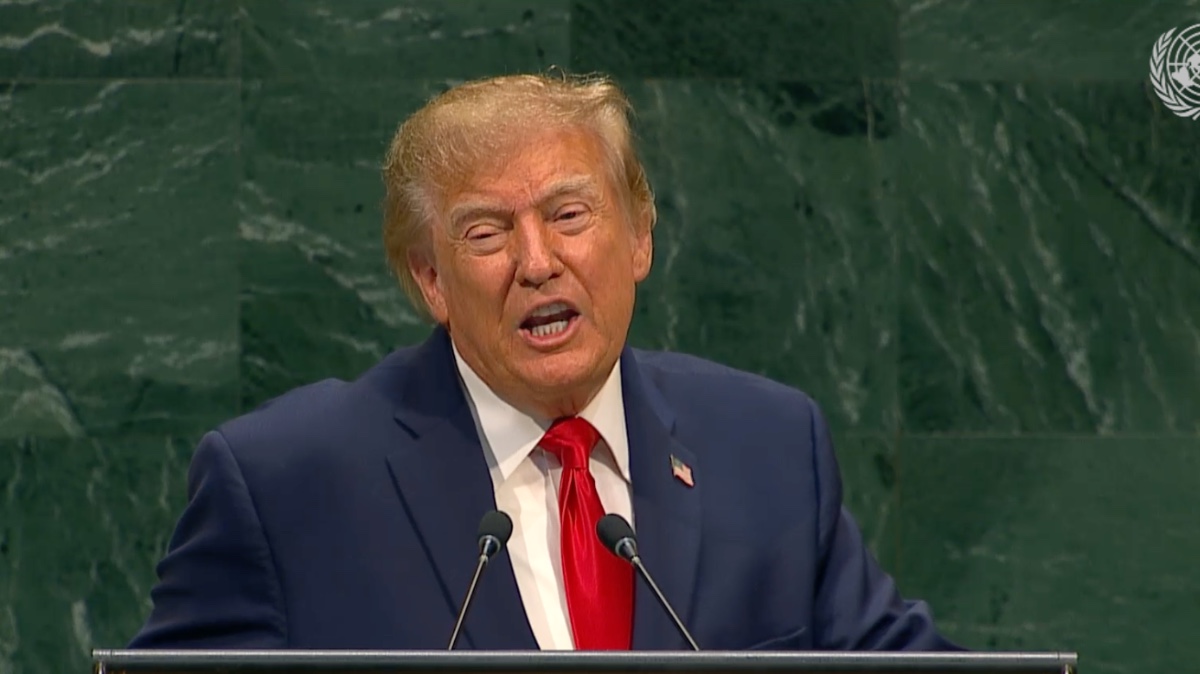
President Donald Trump told the United Nations General Assembly on Tuesday that the US war with Iran had broken Tehran's regional power, and said he faces a "big decision" on whether to negotiate an end to the conflict or destroy the Islamic Republic.
"They were the bully of the Middle East, but they are the bully no more," President Trump said, speaking in the traditional second slot of the general debate after Brazilian President Luiz Inácio Lula da Silva.
He framed the war's endgame as a binary choice. "Will a deal be made with Iran that lets them rebuild and create a far greater country than it ever was before," he asked, "or do I annihilate the Islamic Republic and do it quickly, never giving them a chance to kill and destroy people and countries again?"
The address came as the war, which began on February 28, entered its seventh month. The Strait of Hormuz has only partially reopened to commercial traffic. On Monday, September 21, Brent crude settled at $100.34 a barrel and West Texas Intermediate at $95.78, after the president signaled openness to diplomacy.
Iran and the midterm calendar
President Trump called Iran "the number one sponsor of terror" and cited it as the leading example of a threat the world had allowed to grow. He predicted a deal would come "right after the election," saying Tehran was waiting "to see how I do in the midterm election; what they don't realize is that I'm not running."
Secretary of State Marco Rubio said this week that the president was open to meeting Iranian President Masoud Pezeshkian, whose delegation is in New York. Iranian officials indicated no such meeting would take place.
Venezuela and Cuba
The president devoted a second major section to the Western Hemisphere. He defended the January operation in which US forces captured Venezuela's Nicolás Maduro. "Our actions in Venezuela are proof that the United States will no longer permit threats to America to gain a foothold anywhere in the Western Hemisphere," he said.
He described Cuba's government as "an absolutely failed state" under "great pressure" and said "it will fall." His prepared remarks accused Havana of coordinating with "left-wing radicals and Communist networks." Cuba's delegation, led by Foreign Minister Bruno Rodríguez Parrilla, walked out of the hall.
Energy claims
The president linked Venezuela to US energy strategy, saying: "When you add the United States and Venezuela together, we have more than 60% of the oil in the world." US Energy Information Administration data do not support the figure. The agency estimates Venezuela holds about 17% of global proven reserves and the United States 2–3%, a combined share of roughly 19–20%.
The administration also cited a US Central Command figure that the US Navy has escorted more than 1 billion barrels of oil out of the Strait of Hormuz. The number has not been independently verified.
A shift in tone
The speech marked a change from President Trump's September 2025 address, which ran 57 minutes, called climate change "the greatest con job ever perpetrated on the world," and told European leaders their countries were "going to hell" over migration and energy policy. This year's address centered on military and economic power.
Its signature passage summarized the theme: "While others have talked, I have acted. While others have spoken of peace, I have made it. While others have ignored threats, I have confronted them."
Guterres's farewell
UN Secretary-General António Guterres, delivering his final address to the General Assembly before leaving office on December 31, offered a contrasting view. He warned that "the fault lines in our world are widening" and said military power alone cannot secure peace.
The United Nations enters its 81st session under financial strain. The General Assembly approved a $3.45 billion regular budget for 2026 in December, after Guterres proposed cutting spending by 15.1% and eliminating 2,681 posts amid reduced US contributions and Washington's withdrawal from several UN bodies.
Market reaction
Oil traded lower intraday on Tuesday as traders weighed the prospect of a diplomatic opening with Iran and steady Hormuz flows. US equities were driven chiefly by a rally in artificial intelligence stocks. No market move could be directly attributed to the speech.
What comes next
President Trump is scheduled to hold sideline meetings this week with UK Prime Minister Andy Burnham, Japanese Prime Minister Sanae Takaichi and Venezuela's interim President Delcy Rodríguez. Denmark and Greenland are set to sign an agreement expanding the US military presence on the island. Gulf Cooperation Council states are seeking talks on Iran-backed attacks on Saudi infrastructure.
Watch the November 3 midterm elections, which the president has now explicitly tied to the timeline for ending the war with Iran.