

Traffic fears keep 1 in 6 Irish parents wary of play
The figure sits alongside Census data showing fewer than 20% of Irish primary pupils walk to school, down from 45% in 1986.
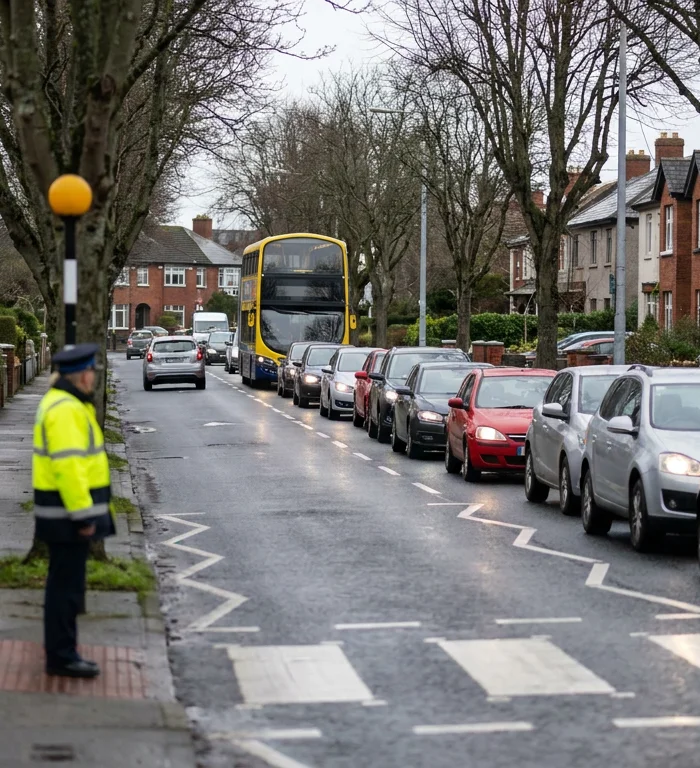
Growing Up in Ireland data cited in an Irish Times opinion article on Oct. 13 showed one in six Irish parents do not see daytime outdoor play at home as safe for five-year-olds.
Sadhbh O'Neill said the concern matters for children’s mobility and school travel: fewer than 20% of primary schoolchildren walked to school in the 2022 Census, compared with 45% in 1986.
The data also showed 30% of parents reported heavy traffic on their street or road. O'Neill said children were more likely to play outdoors in neighbourhoods their parents considered safe, including ball games, cycling and other informal activity.
The article frames the issue as a planning and transport question as well as a family decision. O'Neill described a feedback loop in which traffic increases parental concern, prompting more driving and adding to the number of cars on the road.
Current travel patterns differ sharply from the 1986 Census, when one in four pupils travelled by car. O'Neill also said that in the Netherlands about 75% of children walk or cycle to school, a European comparison for higher active-travel rates.
Ireland has a Safe Routes To School programme funded by the National Transport Authority, with 600 schools involved. That compares with nearly 4,000 schools in the country, leaving most schools outside the programme.
Walking rates remain higher in urban areas but do not exceed 40%, O'Neill said. She also said girls driving themselves to school now outnumber girls cycling, while An Taisce’s AndSheCycles campaign is working to reverse that pattern.
O'Neill linked the transport data to a wider change in childhood over recent decades, including less independent movement around neighbourhoods. She argued that focusing only on school journeys can miss children’s ability to play, meet others and spend time outdoors locally.
“Children do not get a say in how their environments are designed and shaped, but their lives are profoundly affected by those decisions – and non-decisions – nonetheless,” O'Neill said.
Dublin City Council previously had a play officer and a 126-page play strategy, O'Neill said. She said implementation, more parks and playgrounds, and support for cycle buses and walking buses would matter for children’s daily mobility.
O'Neill said road-safety messaging aimed at training children would not reduce injury or fatality rates without action on driver behaviour, speeding, road design and vehicle weight and size, citing numerous studies.
TU Dublin hosted an Open House Dublin event on Child-Friendly Cities at its Grangegorman campus on Oct. 12 from 6.30 p.m. to 8 p.m., the article said.
Source: Opinion article, The Irish Times, Oct. 13, 2026
More stories
- Marwynn lines up 18-month AI computing trial with OmniX
- Publicis Reports 5% Q3 Revenue Growth, Confirms Guidance
- Robert Hall and Michael Woodford Win 2026 Nobel Prize in Economics
- Goldman sees yuan reaching 6.40 as markets lag its outlook
- Dollar rises as EUR/USD hits 2026 low
- Aussie Dollar Slips Before RBA Minutes
- UK diesel price tops £1.99 per litre
- RBI completes 1 trillion-rupee net bond sale
Latest news
- TabMF may improve AI dataset retrieval across six tasks
- Turkish fruit exports put Russia trade back in Washington sanctions frame
- Xbox tests streak badge tied to 3 weekly plays
- Turkey’s Sub-30% Inflation Still Leaves Washington With a Sanctions Problem
- Nvidia's reported $1 billion Figure bet tests AI supply loop
- Robot method lifts benchmark success to 74.8%
- RBL Bank slides 8% as provisions temper Q2 profit jump
- Priority's $8.05 buyout draws shareholder-law review