

Robot method lifts benchmark success to 74.8%
The preprint targets catastrophic forgetting, a barrier to robots adding skills without losing earlier ones.
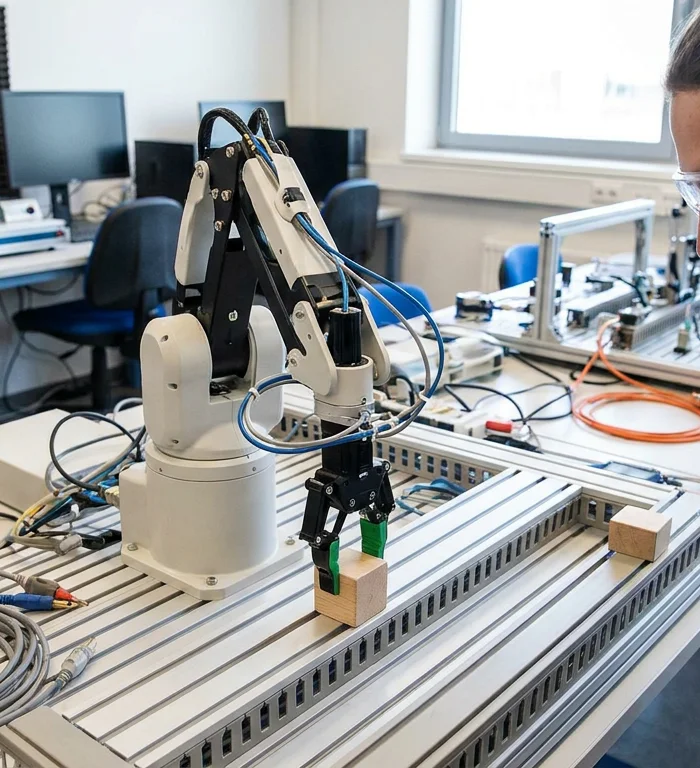
Bahey Tharwat and five co-authors reported in a Friday, Oct. 9, arXiv preprint that Dream to Remember raised average CALVIN robot-learning benchmark success to 74.8% from 63.7%.
The Oct. 9 arXiv preprint matters for robot-learning systems that must add skills over time. The authors said LoRA fine-tuning, or low-rank adaptation of model weights, fell to 11.7% on the same eight-task sequence.
Dream to Remember, or D2R, is aimed at generalist robot policies, meaning models built to perform multiple robot tasks rather than a single narrow routine. The authors said such policies are usually trained through imitation learning, in which a robot learns from demonstrations, leaving performance tied to the quality and breadth of those examples.
The paper’s central problem is catastrophic forgetting, the tendency of a learning system to lose earlier abilities after being trained on later ones. In sequential task settings, the authors said fine-tuning can weaken old skills, while steering a frozen generative policy can move the forgetting problem into the shared steering module.
D2R keeps the base generalist policy frozen and trains a smaller steering module toward new tasks. During that training, a frozen pretrained world model, a learned simulator of how the environment changes, generates imagined rollouts of earlier tasks so the steering module stays closer to its previous behavior.
The authors said that rehearsal process works without a replay buffer, which would store old training examples, and without collecting new data for past tasks. They also said D2R can train a new task fully in imagination when the world model is accurate enough for the task being optimized.
When the world model is not reliable enough for direct training, the method uses a different setup. The authors said D2R can learn the new task in the real or benchmark environment while still using the world model only to rehearse prior tasks.
The paper reported tests beyond CALVIN, including LIBERO-90, a robot-learning benchmark named in the preprint. Using a frozen off-the-shelf generalist policy called π0 and a world model called A2World, the authors said D2R learned previously unseen LIBERO-90 tasks in the environment.
In that LIBERO-90 setting, the authors said D2R preserved π0’s performance on the LIBERO suites on which π0 had already been fine-tuned. They said this held even though A2World was not accurate enough to optimize the policy directly.
The paper also included a physical-robot result on a Franka robot arm. The authors said D2R improved three tasks in sequence through imagined training and retained the earlier improvements.
The evidence remains preliminary. The arXiv preprint, categorized under Robotics and also linked to Computer Vision and Pattern Recognition and Machine Learning, has not been peer reviewed, and the abstract does not provide confidence intervals, compute costs, task-by-task scores or comparative real-robot baselines.
The method’s practical limits also follow from the authors’ own framing. D2R depends on the usefulness of the world model, and when that model cannot support policy optimization, the system still needs environment interaction for the new task.
The preprint was submitted as arXiv:2610.13816v1 by Tharwat, Iman Nematollahi, Marvin Alles, Xingyuan Zhang, Akshay L Chandra and Abhinav Valada, according to the arXiv record.
Source: arXiv preprint, arXiv, Oct. 9, 2026
More stories
- TabMF may improve AI dataset retrieval across six tasks
- Xbox tests streak badge tied to 3 weekly plays
- IDW starts Sonic road to issue 100
- NBC’s Tomlin avoids Henry name, cites 4.2-yard average
- Anthropic cuts web access after AI testing incidents
- EA brings AFC Richmond Women to EA Sports FC 27
- Computational Breakthrough Enables Predictive Modeling of Quantum Material Behavior
- Quantum Vacuum Engineering Increases Superconductor Critical Temperature
Latest news
- Traffic fears keep 1 in 6 Irish parents wary of play
- Marwynn lines up 18-month AI computing trial with OmniX
- Turkish fruit exports put Russia trade back in Washington sanctions frame
- Publicis Reports 5% Q3 Revenue Growth, Confirms Guidance
- Turkey’s Sub-30% Inflation Still Leaves Washington With a Sanctions Problem
- Nvidia's reported $1 billion Figure bet tests AI supply loop
- RBL Bank slides 8% as provisions temper Q2 profit jump
- Priority's $8.05 buyout draws shareholder-law review