

Vulcan Rocket Failure Investigation Focuses on Propellant Systems
A Vulcan rocket failure due to booster issues will ground the vehicle for six months, impacting national security and commercial launch schedules.
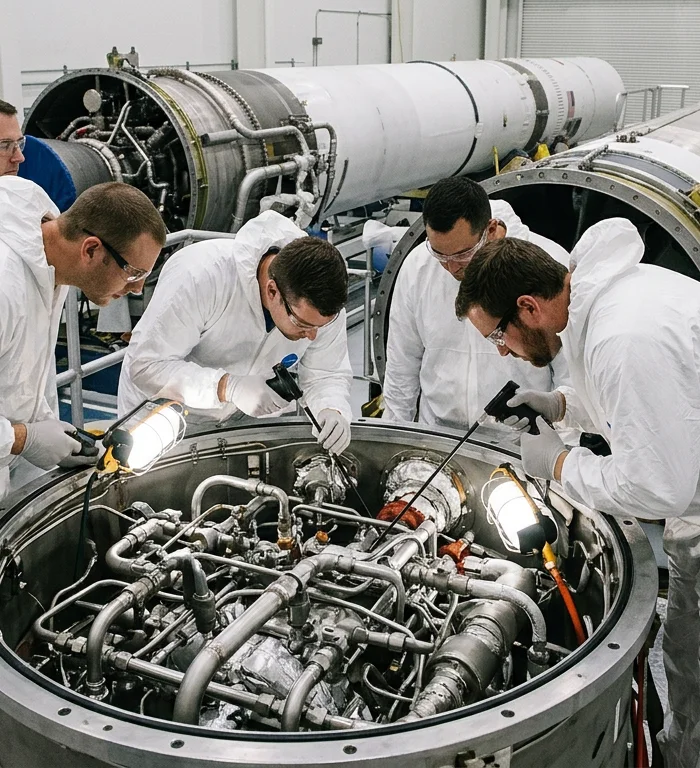
The recent failure of the United Launch Alliance (ULA) Vulcan rocket during its return-to-flight mission has been traced to low booster performance shortly after liftoff. While the mission was lost approximately 10 minutes into flight, preliminary data suggests the issue originated within the launch vehicle's systems rather than the BE-4 engines themselves. Engineers are currently investigating potential malfunctions in the propellant feed systems responsible for delivering methane and liquid oxygen to the engines.
Although the BE-4 engines, manufactured by Blue Origin, are under scrutiny, initial observations indicate that the engines may have experienced thrust discrepancies due to external system failures. Video analysis suggests one engine operated at a lower intensity following the jettisoning of solid rocket boosters, potentially causing the asymmetric thrust and attitude instability observed in telemetry data. The Federal Aviation Administration is overseeing the investigation, which remains in its early stages.
United Launch Alliance
This incident marks the fifth flight of the Vulcan platform and is expected to result in a launch hiatus of at least six months. The delay poses significant risks to the United States Space Force, which relies on the vehicle for national security payloads, and threatens the deployment schedule for the Amazon LEO constellation throughout 2027. The failure exacerbates existing constraints within the domestic launch sector.
For Blue Origin, the outcome of this investigation carries substantial institutional risk. The company is currently preparing for the return-to-flight of its New Glenn rocket, which utilizes a variant of the BE-4 engine. Should the investigation ultimately identify a flaw within the engine hardware, it would likely force a suspension of New Glenn operations. Such a delay would disrupt NASA’s long-term logistics planning for the Artemis Program and associated lunar infrastructure development.
More stories
- Europe faces attribution gap after 16 cyber, physical incidents
- PIF backs Grand Theft Auto as Saudi players embrace game
- Signal limits screenshots to curb AI access to messages
- Cognition runs Devin Mac workspaces on EC2 in 6 AWS regions
- Salesforce engineers cut 600-failure triage to 90 minutes
- Türkiye Desk: GTA 6 puts console access and network demand in focus
- Microsoft plans Project Helix as Xbox console for PC games
- OpenAI buys travel startup Odessia
- Adobe stock faces fresh Wall Street downgrades on AI risk
- Kimi K3 subscription pause tests Moonshot AI capacity
Latest news
- Trump prepares tariffs on China and other major exporters
- New-car buyers pay record average $50,087 in October
- Banks face ECB reserve debate over liquidity and profits
- Investors see Anthropic debut gains fade below $83 a share
- Iraq orders federal control over Kurdish-area oilfields
- Germans oppose Ukraine aid as poll shows support slipping
- Kim Jong-un receives 10 envoys after constitutional shift
- Ukraine claims Libya strike sinks Russian naval corvette