Squid's Hidden Sensory System Offers Clues to Human Hearing Loss
Researchers discovered squids have sensory hair cells across their entire body. This finding could open new avenues for regenerative hearing loss research.
Mei Lin ·
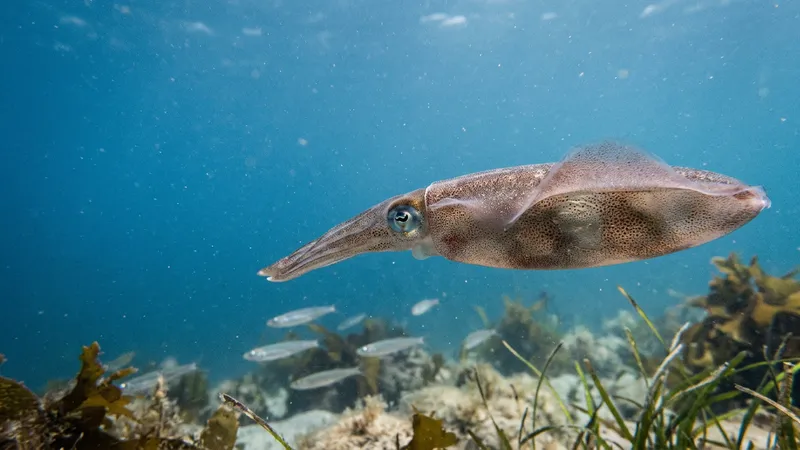
Squid's Hidden Sensory System Offers Clues to Human Hearing Loss A new study published in eLife reveals that longfin squids possess a previously unknown sensory system of hair cells distributed across their bodies. Researchers from the University of Queensland and Taiwan's Academia Sinica discovered these cells form a network that helps the squid detect water movements, a finding that could open new research avenues for treating human hearing loss. ## Background In humans and other vertebrates, mechanosensory hair cells are the cornerstone of hearing and balance. Located deep within the inner ear's cochlea and vestibular system, these delicate, bristle-like cells convert physical forces—sound vibrations and head movements—into electrical signals that the brain can interpret. Damage to these cells is irreversible in mammals, leading to permanent sensorineural hearing loss, a condition affecting hundreds of millions worldwide. Unlike mammals, many other animals, such as fish and amphibians, possess a remarkable ability to regenerate these vital cells throughout their lives. Until now, scientists believed that hair cells in cephalopods like the longfin squid ( Doryteuthis pealeii ) were confined to small, paired organs called statocysts. These organs function much like the human vestibular system, providing a sense of gravity and acceleration to help the squid maintain balance and orientation in the water. The primary senses for navigating and hunting were thought to be their highly developed camera-like eyes and chemosensory suckers. This new research dramatically upends that view, revealing an extensive, previously undetected system of hair cells covering the squid's skin. ## Why it matters The discovery of this widespread sensory network, which forms a system analogous to the lateral line found in fish, fundamentally changes how we understand squid perception. The research team, led by Dr. Le-Sheng Yeh of Academia Sinica and Dr. Wen-Sung Chung of the University of Queensland, demonstrated that these lines of cells are sensitive to water flow at specific frequencies. This ability allows squids to form a "hydrodynamic image" of their surroundings, aiding in precise maneuvering, evading predators, detecting prey, and coordinating their dynamic skin camouflage with minimal visual input. The implications for human health are profound. This finding introduces an entirely new and evolutionarily distant model organism for studying hair cell biology. While researchers have long studied regeneration in fish and birds, squids offer a fresh perspective from the invertebrate world. By decoding the genetic and molecular toolkit that squids use to develop, maintain, and potentially repair their expansive hair cell network, scientists may uncover novel biological pathways absent in vertebrates. If squids also possess regenerative capabilities, their unique evolutionary path could provide an entirely new blueprint for bio-inspired therapies aimed at coaxing human inner ear cells to regrow, offering hope for restoring hearing. ## What to watch The next major step will be to map the precise genetic and molecular mechanisms governing the development, function, and potential for regeneration in these squid hair cells. Researchers will focus on identifying any unique pathways that differ from those in mammals and could be targeted for therapeutic intervention. By August 31, 2024, watch for publications that attempt to model these squid-based processes in mammalian systems or detail specific regenerative gene networks, which would signal a significant advance toward clinical application.