

SpaceX spectrum deal sends T-Mobile down 12%
The Grain Management licences could strengthen Starlink Mobile, but SpaceX still needs FCC approval, ground infrastructure and larger satellites launched by…
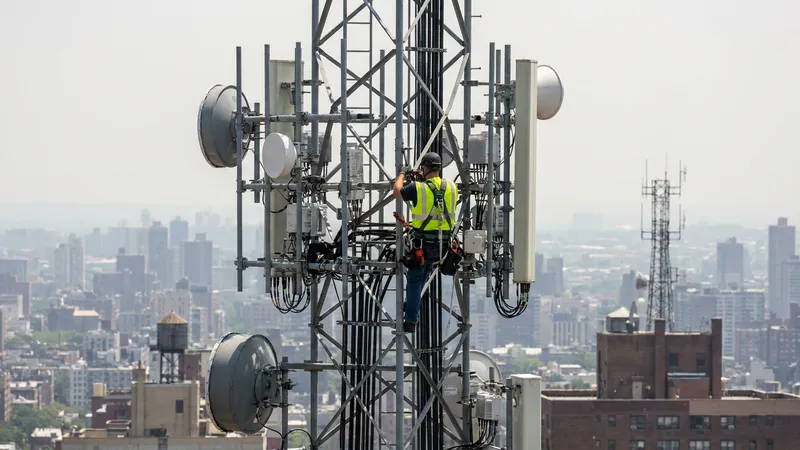
SpaceX’s agreement to acquire 800 MHz-band spectrum from Grain Management hit US telecom stocks on Friday, with T-Mobile down 12% at midday in New York, Business Standard/Bloomberg reported Oct. 12.
The licences would add low-band airwaves to SpaceX’s more than 11,000 Starlink satellites, while AT&T and Verizon each fell about 11% on Friday as investors weighed a stronger wireless challenger.
Deal pressures carriers
The spectrum would help SpaceX send mobile service from its Starlink network to phones indoors and support a broader satellite-to-cell service. The transaction still needs approval from the Federal Communications Commission, according to Business Standard/Bloomberg.
Elon Musk framed the purchase as a missing input for Starlink Mobile. In a post on X on Thursday, he said the low-band spectrum is “the last critical piece of the spectrum puzzle needed for SpaceX to provide complete phone coverage in America.”
David Barden, an analyst at New Street Research, said the move increases pressure on US wireless incumbents. “This spectrum acquisition is a doubling down on their commitment or threatened commitment to go it alone in the absence of finding a carrier that’s willing to work with them,” he said.
Cost of coverage
SpaceX already provides direct-to-phone connectivity in areas not served by existing ground networks. It does not have its own terrestrial mobile network, a land-based system of towers and related equipment that carries most phone traffic today.
Morgan Stanley analysts Sean Diffley and William Tackett wrote in a Friday note that SpaceX would probably need tower sites to build a competitive ground network. They said they would not be surprised if the Grain transaction were valued at $6 billion to $8 billion, although SpaceX and Grain did not disclose a price.
For scale, that estimate equals a large infrastructure wager but remains far below the more than $100 billion in spectrum deal flow that FCC Chairman Brendan Carr said the agency has seen. Carr also said the FCC expects more than $100 billion of spectrum to enter the market over the next two years.
Piper Sandler analysts Alexander Potter and Ben Johnson wrote on Friday that SpaceX may use the spectrum for early satellite and terrestrial service, while treating the purchase mainly as leverage in talks with carriers. They cited the time and money needed to construct a rival national network.
SpaceX has considered deeper ties with existing operators. Musk said last year that he had not ruled out buying a telecom company to support Starlink Mobile, according to Business Standard/Bloomberg.
Starship link
The mobile plan also depends on Starship, SpaceX’s large reusable rocket, because the company has said its bigger next-generation Starlink mobile satellites are designed to launch on that vehicle. SpaceX said the new satellites will be ready to fly on Starship by next year and will “deliver more than 100 times the bandwidth of our current generation.”
The FCC recently approved SpaceX to launch 15,000 next-generation Starlink mobile satellites, Business Standard/Bloomberg reported. That proposed fleet would exceed Starlink’s current network of more than 11,000 satellites by at least 4,000 spacecraft, according to Atlas360 calculations based on the reported figures.
Starship reached orbit for the first time in September and deployed upgraded Starlink broadband satellites. The rocket also had engine issues during that flight, and the effect on future launches was not clear from the reported material.
The Grain licences became available after an August spectrum swap with T-Mobile that was approved by the FCC. Under that order, Grain had to seek bids to develop underused spectrum, according to the commission order cited by Business Standard/Bloomberg.
The licences cover nearly the entire US population and are viewed as useful for a network pilot, a ground link that can support voice services. A person familiar with Grain’s thinking told Bloomberg in August that the company believed satellite and terrestrial services could coexist in the 800 MHz band.
Carr said in a CNBC interview on Friday that the agency is seeing “a lot of new competition and investment” in spectrum. He said he expects new spectrum supply to benefit consumers through lower prices.
SpaceX President Gwynne Shotwell said during the company’s debut quarterly earnings in August that SpaceX intends to “build out the terrestrial component.” She also said, “I anticipate us being able to acquire quite a few of their customers, because I think our service will be better.”
What to watch
- By next year: SpaceX has said its larger Starlink mobile satellites will be ready to launch on Starship; the observable is whether Starship can carry them after its September engine issues.
- Over the next two years: Carr said the FCC expects to bring more than $100 billion of spectrum into the market; the observable is the pace and size of future spectrum releases.
- Pending FCC review: SpaceX still needs commission approval for the Grain spectrum acquisition before it can combine the licences with its satellite-to-cell plans.
More stories
- Orion's $59.3 million fraud charge spotlights wire scams
- EA buyout lifts games M&A to $57.8 billion in Q3
- BIG 4 cities plan 2027 summit with supply-chain groups
- Wells Fargo cuts Adobe to Underweight, target to $225
- FG Communities buys 49-site North Carolina housing asset
- Malaysian Banking Sector Faces Exposure to Nature-Related Credit Risks
- Harvard Business Review: Başarı İçin Kendinizi Değil, Ortamınızı Değiştirin
- TPG’s $10bn climate fund tilts decarbonization deals toward performance contracts
Latest news
- Anthropic cuts web access after AI testing incidents
- Ukraine says Russia hits six energy targets after Trump ceasefire
- Orange board weighs Amazon drones, $3,498 refunds
- Russia rejects 60-day Ukraine truce, offers election-day pause
- Russian Strikes Test Trump's Energy Ceasefire
- EA brings AFC Richmond Women to EA Sports FC 27
- Allison Transmission stock compounds at 26% over five years
- Federal officers search Ilhan Omar home as midterms near