

South Africa loses 209,000 base-sector jobs since 2008
Stats SA figures cited by Daniel Meyer show services absorbed employment growth while manufacturing output stayed below 2008 and 2019 levels.
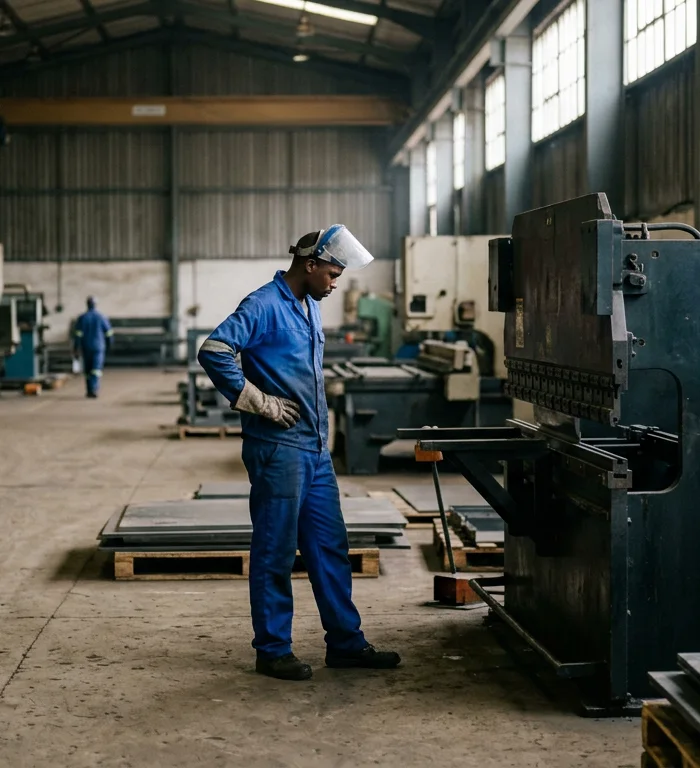
South Africa's agriculture, mining and manufacturing sectors employed 209,000 fewer people in the third quarter of 2026 than in 2008, according to Stats SA figures cited in a Nov. 19 Daily Maverick opinion article.
Stats SA released the third-quarter labour-force survey and September manufacturing data on Nov. 10. The official unemployment rate rose to 33.7%, up 1.8 percentage points from a year earlier, while manufacturing output fell 3.5% year on year in September.
Daniel Meyer, a University of Johannesburg professor and economic-development specialist, used the figures to argue that South Africa’s jobs problem is tied to a weakening productive base. Basic sectors, in his framing, are industries such as agriculture, mining, manufacturing and tourism that sell beyond the local economy and bring income in.
The base-sector share of employment fell to 17.8% in the third quarter of 2026 from 22% in the third quarter of 2008, according to Meyer’s calculations from Stats SA data. Total employment rose by 2.29 million over the same period, but finance and business services added 1.29 million jobs and community and social services added 1.02 million.
"In my view, South Africa does not have an unemployment problem that can be solved with labour market policy alone," Meyer wrote. "We have an economic base problem."
Manufacturing is the largest drag in Meyer’s account. The sector employed about 1.60 million people in the third quarter of 2026, down from about 2.06 million in 2008, a loss of 451,000 jobs, or 22%. Production volumes between January and September 2026 were 15.6% below the same period in 2008 and 10% below 2019 levels, according to the article.
The weakness was not uniform. Meyer said beverages were 22% above 2019 production levels, plastics 9% higher and household appliances 22% higher. He contrasted those gains with declines of 40% in basic iron and steel, 36% in refined petroleum products and 25% in motor-vehicle parts compared with 2019.
Gauteng accounted for most of the manufacturing employment decline cited in the article. The province had 514,000 manufacturing workers in the third quarter of 2026, down from 800,000 in 2008, a loss of 286,000 jobs that Meyer said represented 63% of the national manufacturing decline.
Mining was the exception among base sectors, employing 481,000 people, 7% more than a year earlier. Meyer cautioned that mining is capital-intensive and geographically concentrated; Mpumalanga’s mining employment rose 29% over the year, while its unemployment rate increased by 3.8 percentage points, the largest provincial rise cited.
Daily Maverick labelled the article as opinion, making Meyer’s policy recommendations his own analysis rather than an official Stats SA assessment.
Source: Daily Maverick Opinionista article citing Stats SA labour-force and manufacturing data, Nov. 19, 2026
More stories
- Rwanda faces budget strain from 85% electricity access push
- AI doubts leave Asian stocks facing a new investment test
- Singapore core inflation eases to 1.5% in October
- Greece targets 2.3% growth in 2027 budget
- US stocks face Goldman warning on further forced selling
- Bitcoin falls below $57,742 as investors seek other bets
- US jobs report to test Fed inflation focus in September
- Boeing 737 MAX flaw prompts FAA review of landing safety
Latest news
- ICE arrests at Seattle airport draw protests and scrutiny
- EU rejects COP31 deal as fossil fuel divisions block pact
- Deal Sheet: Fortis shutdown costs over 400 jobs
- Germany to pay about $11 a month into child pension accounts
- Monrovia mayor-designate seeks $14.5m city budget
- Laura Brand curbs prison messages after YouTube dispute
- Nigeria's family-planning budget falls 97%
- Peter Attia reviews cold therapy claims on longevity