

Singapore sets five-year power buildout for up to 13 GW demand
The Energy Market Authority says peak power demand could rise from 8.6 gigawatts in August to as much as 13 gigawatts by 2031.
Singapore set a five-year energy infrastructure plan on Oct. 26, including five new gas-fired power plants, as peak demand may reach 13 gigawatts by 2031, the Energy Market Authority said in a release.
The Energy Market Authority said peak demand was 8.6 gigawatts in August, making the top of its 2031 range about 51% higher, according to Atlas360 calculations. The increase is tied to semiconductor manufacturing, data centres and wider electric-transport use.
The plan covers power generation, natural gas, the electricity grid, solar deployment, energy storage and low-carbon electricity imports. It also sets higher solar ambitions and provides for a larger transmission network.
Minister for Energy, Trade and Industry (Energy and Industry) Tan See Leng described the programme at Singapore International Energy Week 2026 as the “most significant build-up of our energy infrastructure in decades”.
EMA said the timing of demand growth would depend on when new industrial and transport projects enter service.
The announcement came after Indonesia began cutting gas supplies to Singapore over the past weekend. Dr Tan said the reduction was less than 2% of Singapore’s total daily gas demand and that Singapore had managed similar past disruptions without incident because of resilience measures built over many years.
“Our households and our businesses can be assured that our energy security is always at the top of our minds,” Dr Tan said. He said Singapore would maintain and expand its options, deepen partnerships and build resilience.
Singapore relies on imported energy and cannot fully shield itself from regional or global shocks, Dr Tan said, citing the Strait of Hormuz as one possible source of disruption. During supply crunches, countries may prioritise domestic needs, he said.
“This trend of resource nationalism is particularly concerning, especially if it undermines established contractual agreements,” Dr Tan said. “Such moves will increase business risks and deter investments in the energy sector, with negative long-term implications.”
EMA said Singapore has installed 2.3 gigawatt-peak of solar capacity, a measure of maximum solar output, and is on track to meet its existing 3 gigawatt-peak target by 2030. The authority now aims for 4 gigawatt-peak by 2035.
Dr Tan said solar energy remains Singapore’s “most viable indigenous renewable energy source”. Even with larger deployment, he said solar can meet no more than 10% of Singapore’s projected electricity demand in 2050.
Grid investment is projected at up to S$5.3 billion, or US$4.15 billion, from 2025 to 2029, according to the report. That would be 11 times the spending over the previous five years.
The investment is intended to support seven new transmission substations by 2031, compared with four in the previous five years. Transmission substations help move high-voltage electricity from generators into the wider grid.
Singapore’s high-voltage transmission cable network is planned to expand from about 7,700 kilometres now to about 9,100 kilometres by 2030. The distribution network, which carries lower-voltage electricity to homes, industries and organisations, will also be strengthened for solar panels and electric-vehicle charging.
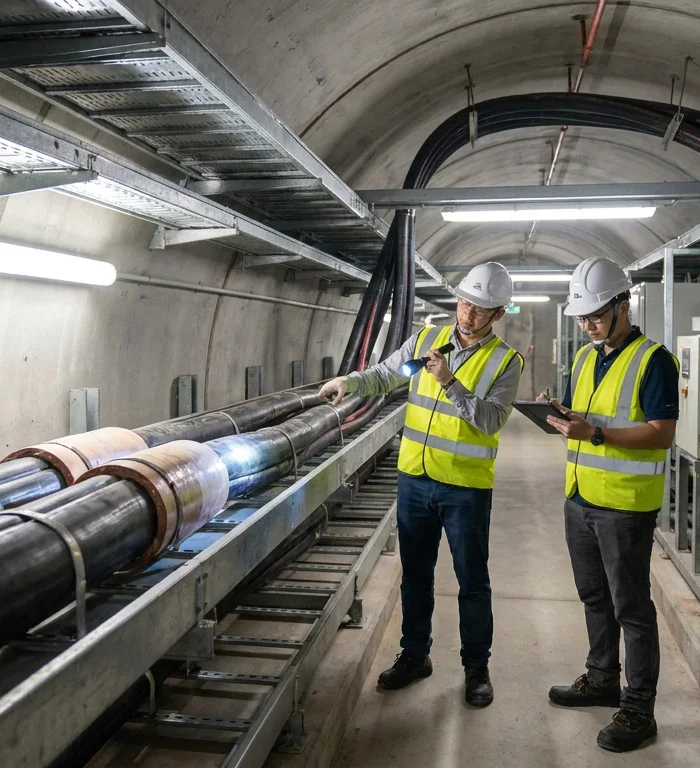
The government is studying whether to more than triple cable tunnels from about 50 kilometres now to support longer-term transmission needs. Cable tunnels can allow faster grid expansion, easier maintenance access and less road disruption, according to the report.
By 2029, the checkable marker is whether projected grid spending of up to S$5.3 billion from 2025 is being deployed at the scale EMA outlined.
By 2031, the grid test is whether Singapore completes seven new transmission substations while managing peak demand that EMA says could reach 9.9 gigawatts to 13 gigawatts.
By 2035, the solar benchmark is whether Singapore reaches the expanded 4 gigawatt-peak target, after the authority said it had already achieved 2.3 gigawatt-peak.
Source: Energy Market Authority media release and Singapore Energy Lecture reported by Channel NewsAsia, Oct. 26, 2026
More stories
- South African parties split over Cape Town's 30,000-home annual gap
- Ruto seeks Russian investment in Kenya's $380m trade push
- Sudan teachers seek 20% budget share with 8m children outside school
- Spain rail network faces scrutiny after 64 killed near Toledo
- Spain reports at least 30 dead in high-speed train crash
- Villa Vie disembarks 203 passengers in Cambodia over fuel costs
- Lula wins fourth term in Brazil election upset result
- SpaceX’s AI buildout adds $40 billion in GPU debt
- Belgium seeks EU sanctions after West Bank attack on diplomats
- Macron vows prosecutions after 400 arrests at France protests