

SiliconGym finishes RL batch 21.9% faster than ChipSeek
The arXiv preprint describes a reinforcement-learning environment for chip-design agents, with claims spanning functional checks, PPA tasks and…
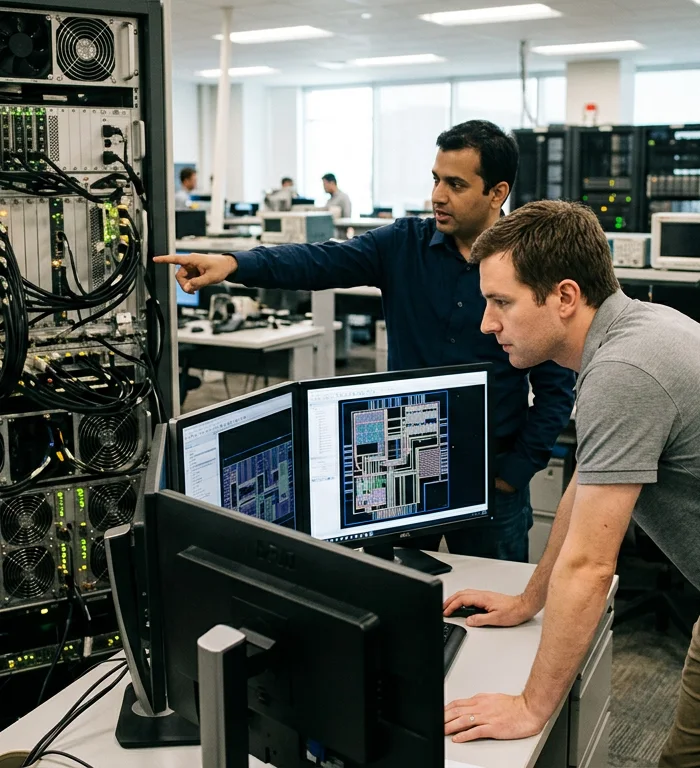
SiliconGym, a reinforcement-learning environment for chip-design agents, finished a 256-answer RL batch 21.9% faster than native ChipSeek, its authors said in an arXiv cs.AI preprint published Nov. 20.
The reported speedup compares a 256-answer reinforcement-learning batch with native ChipSeek, giving the paper a scale test beyond a single generated answer or one isolated tool call.
Hejia Zhang, Sheng Lu and six co-authors wrote that reinforcement learning, a training method that rewards useful outputs, is being applied to large language models for hardware design and verification. They said agents need environments that can retain state across tool calls, run multiple attempts in parallel and handle large design hierarchies.
“We present SiliconGym, the first versatile, cross-task and cross-toolchain RL environment for hardware design and verification,” the authors wrote in the abstract.
The preprint says SiliconGym separates versioned workspaces, budgeted execution and acceptance-gated scoring. The authors said that design lets it support module-level RTL, or register-transfer level code, testbench generation, PPA tasks covering power, performance and area, multi-round repository repair and full-hierarchy system-on-chip flows.
That range gives the workload a broader chip-engineering scope than module-only evaluation: the authors describe SiliconGym as scaling from individual RTL, testbench and PPA tasks to full-hierarchy SoC flows.
The authors also said SiliconGym can use both open-source and commercial backends. In their reported tests, open-source-trained functional correctness transferred to commercial simulation, while paired netlist evaluation showed when open-source PPA improvements carried over to commercial synthesis.
Source: preprint, arXiv cs.AI, Nov. 20, 2026
More stories
- Europe faces attribution gap after 16 cyber, physical incidents
- PIF backs Grand Theft Auto as Saudi players embrace game
- Signal limits screenshots to curb AI access to messages
- Cognition runs Devin Mac workspaces on EC2 in 6 AWS regions
- Salesforce engineers cut 600-failure triage to 90 minutes
- Türkiye Desk: GTA 6 puts console access and network demand in focus
- Portable Computer brings Perplexity AI to Nvidia desktops
- Waymo robotaxi rides target Munich in 2027 EU push
Latest news
- Trump prepares tariffs on China and other major exporters
- New-car buyers pay record average $50,087 in October
- Banks face ECB reserve debate over liquidity and profits
- Investors see Anthropic debut gains fade below $83 a share
- Iraq orders federal control over Kurdish-area oilfields
- Germans oppose Ukraine aid as poll shows support slipping
- Kim Jong-un receives 10 envoys after constitutional shift
- Ukraine claims Libya strike sinks Russian naval corvette