

Researchers Develop Biological Computing Architecture Utilizing Bacterial Processing
Scientists have developed a biocomputer using bacteria to perform parallel processing, potentially offering a low-RAM alternative for solving complex…
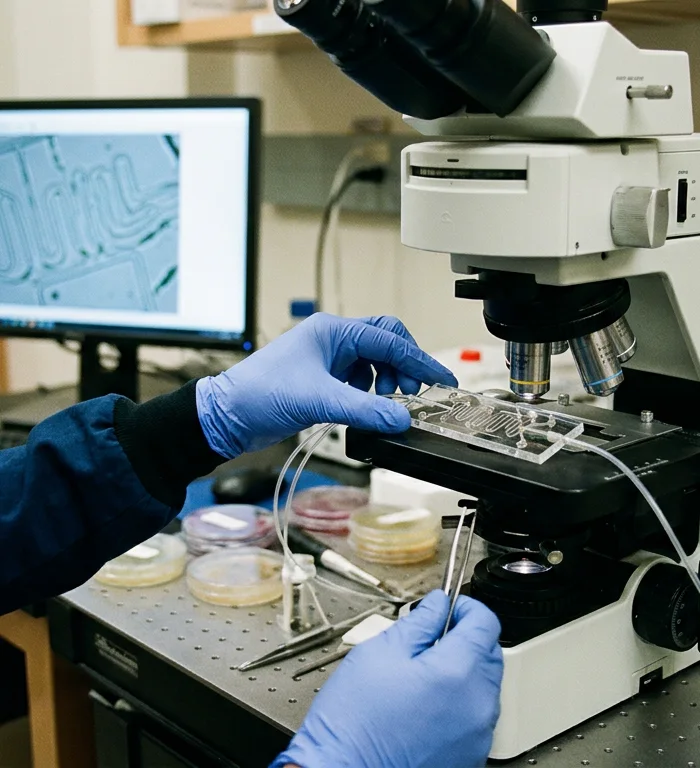
An international research team has successfully demonstrated a biocomputing architecture that utilizes living bacteria to perform complex computational tasks. The system, which leverages Escherichia coli and Vibrio natriegens , is designed to address specific mathematical challenges that typically require significant random-access memory (RAM) in traditional electronic, sequential computing environments.
The architecture functions by mapping mathematical problems, such as the Subset Sum Problem, into physical networks of micro-tunnels. Bacteria are introduced into these structures, where their movement through branching paths represents the simultaneous exploration of multiple potential solutions. This parallel processing capability allows the system to bypass the sequential limitations of standard microchips.
Operational efficiency is maintained through the biological reproduction of the bacteria, which effectively scales the number of processing units as the complexity of the task increases. Researchers utilize automated image analysis to track bacterial movement through the tunnels, identifying paths that satisfy specific problem constraints. Environmental factors, such as temperature, are modulated to manage bacterial density and prevent system overcrowding.
While this biological approach offers a potential alternative to high-RAM consumption in traditional computing, the technology remains in the experimental stage. Current limitations include the slow processing speed of individual bacteria compared to digital processors, necessitating large-scale physical infrastructure for complex operations. Future development may focus on scaling these systems to address computational bottlenecks that currently hinder traditional hardware performance.
More stories
- Europe faces attribution gap after 16 cyber, physical incidents
- PIF backs Grand Theft Auto as Saudi players embrace game
- Signal limits screenshots to curb AI access to messages
- Cognition runs Devin Mac workspaces on EC2 in 6 AWS regions
- Salesforce engineers cut 600-failure triage to 90 minutes
- Türkiye Desk: GTA 6 puts console access and network demand in focus
- Türkiye Desk: e2vc opens $150m growth fund for games and tech
- Cash App and Block pursue banking shift as profit grows
- SK Hynix eyes Intel Ohio plant for U.S. memory output
- Anthropic secures 2.16GW Australia AI data center lease
Latest news
- Trump prepares tariffs on China and other major exporters
- New-car buyers pay record average $50,087 in October
- Banks face ECB reserve debate over liquidity and profits
- Investors see Anthropic debut gains fade below $83 a share
- Iraq orders federal control over Kurdish-area oilfields
- Germans oppose Ukraine aid as poll shows support slipping
- Kim Jong-un receives 10 envoys after constitutional shift
- Ukraine claims Libya strike sinks Russian naval corvette