SK Hynix eyes Intel Ohio plant for U.S. memory output
SK Hynix is discussing U.S. memory-chip production with Intel, potentially using Intel's delayed Ohio site as AI demand strains supply.
Jason Kwon ·
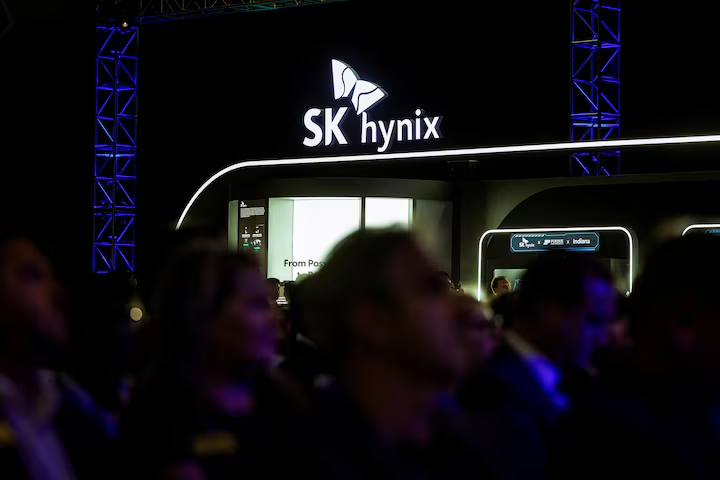
SK Hynix is discussing a U.S. memory-chip manufacturing deal with Intel, a move that could put its production on American soil for the first time.
Intel's Ohio site enters talks
The discussions include at least two possible structures, according to three people familiar with the matter. SK Hynix could lease part of Intel's planned Ohio manufacturing complex, or it could join Intel and large cloud companies in a venture designed to secure memory-chip supply.
The talks remain exploratory, one of the people said, and no decision has been made. The people said SK Hynix may consider other transaction structures, while details of which chips might be produced in Ohio were not learned.
SK Hynix said it is reviewing measures, including additional production bases, to strengthen its memory business, but added that no matter has been determined. Intel declined to comment on what it called speculation and said it was still investing to prepare the Ohio site.
The South Korean company's portfolio includes DRAM chips used in servers, personal computers and smartphones, NAND flash used for long-term storage, and high-bandwidth memory used in AI processing units. The potential U.S. move comes as AI data-center spending has tightened availability of advanced memory chips.
Seoul review looms over HBM
A U.S. production agreement involving HBM or DRAM could face resistance from South Korea, the three people said, because those technologies are treated as sensitive. South Korea's trade ministry said any company decision involving a national core technology would be reviewed under the Industrial Technology Protection Act.
Cost is another barrier. Two people said semiconductor manufacturing in the United States is more expensive than in South Korea, with higher labor and construction expenses and a supply chain still concentrated across Asia.
SK Hynix also faces pressure from customers and governments to expand supply. Chey Tae-won, chairman of SK Group, said in July: "I think we need to build a factory in the United States. If possible, I believe we should build it."
The report landed alongside share gains in both markets. Intel shares were quoted 5.5% higher at Wednesday's open, while SK Hynix finished 4.1% higher in Seoul.
Washington pressure meets Korean leverage
President Trump's administration has been pressing chipmakers to increase U.S. production as AI investment raises demand for memory and logic chips. U.S. Commerce Secretary Howard Lutnick has threatened tariffs of up to 100% on South Korean and Taiwanese companies unless they commit to more American production.
The talks also overlap with a broader U.S.-South Korea investment negotiation. South Korea made a $350 billion investment commitment last year in exchange for lower U.S. tariffs; about $150 billion has been earmarked for shipbuilding, leaving $200 billion unresolved.
Intel has its own reason to seek a partner. The company announced in 2022 that it would invest up to $100 billion in Ohio, with production initially scheduled to begin in 2025, but completion of the two plants has been pushed to 2030 and 2031.
A deal with SK Hynix could help Intel put part of the delayed site to work and reduce financial pressure on a company now partly owned by the U.S. government. It could also complicate South Korea's push for SK Hynix and Samsung Electronics to accelerate a new domestic chipmaking cluster in the country's southwest.
If the talks produce a lease, SK Hynix would gain a faster U.S. manufacturing route while Intel would improve utilization of its Ohio project. For cloud companies and the memory sector, that structure would create another channel for contracted supply, although higher U.S. costs could limit the price benefit.
If Seoul slows or blocks production of sensitive memory technologies, the global supply chain would remain more concentrated in Asia for longer. Intel would keep looking for ways to fill Ohio capacity, while SK Hynix would have to balance customer demand, U.S. tariff pressure and South Korea's technology-security review.