

Researchers urge wider mental-health systems for African schools
The review frames mental health as education quality, learner safety and inclusion, with schools linked to families, communities and specialist care.
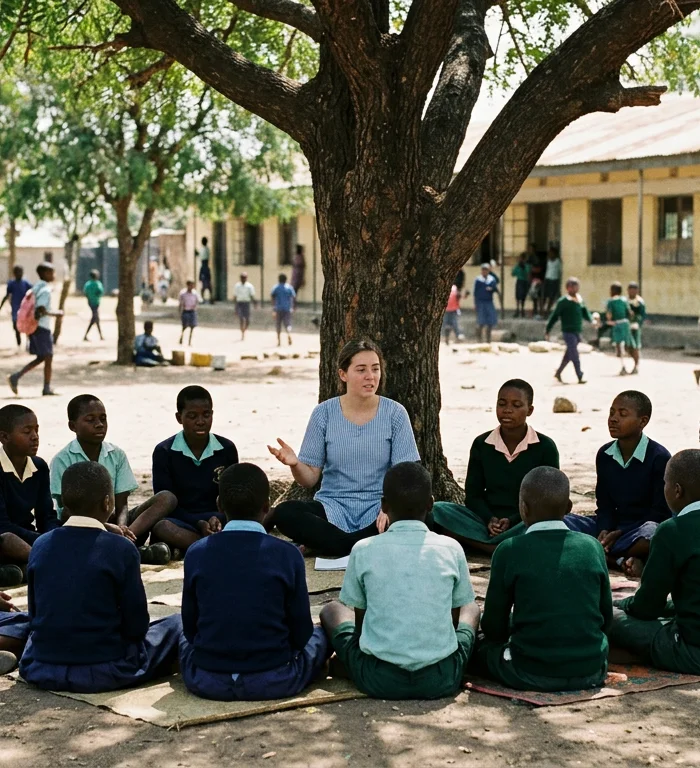
Education and Youth Empowerment researchers reviewed 122 scholarly studies, after screening 1,759 records, in an article in The Conversation published Oct. 21, saying African schools need broader mental-health systems.
The argument carries policy weight because children under 18 accounted for 46% of Africa’s population in 2024, according to the article, or 4 percentage points below half, according to Atlas360 calculations.
The researchers said schools are often where distress first becomes visible, including when learners miss lessons, pull back from peers or begin to perform worse in class. They said school-based action can reach large numbers of children and adolescents because it uses institutions already central to their lives.
The review found the strongest promise in short, structured programmes that teach coping, emotional and problem-solving skills, when trained non-specialists deliver them. “These approaches show that school mental health does not have to mean therapy,” the authors wrote in The Conversation article.
The evidence base narrowed sharply from the initial search: the 122 studies used in the review represented about 7% of the 1,759 records screened, according to Atlas360 calculations. The article said most studies came from Ghana, Uganda, Tanzania, South Africa and Kenya.
One example was Shamiri, a four-week group programme tested in Kenyan secondary schools. In a trial of 413 adolescents, students who joined the programme had larger reductions in depression and anxiety symptoms than those in a study-skills programme, with benefits still evident seven months later.
The article said other approaches included improving awareness among learners and staff, using teachers or peer facilitators to build skills such as emotional regulation and empathy, and using games, music, dance, creative work and movement to support wellbeing. It also cited an approach among refugee children in Uganda using movement, dance, breathing exercises and group activities, with evidence pointing to gains in wellbeing and social connectedness.
The researchers cautioned that counselling alone is too narrow. They said individual counselling may help learners discuss grief, anxiety or family problems, but it cannot by itself address bullying, violence, poverty, family stress or unsafe school settings.
The review also placed limits on what teachers should be asked to do. Because specialist mental-health professionals are scarce, schools may use task-sharing, meaning defined support roles for teachers and other non-specialists, but the authors said teachers should not diagnose conditions, manage serious cases or act as psychologists.
The article said evidence was thinner from francophone and lusophone Africa, north and central Africa, and rural, remote, pastoralist and conflict-affected settings. That uneven coverage limits how far findings can be applied across different school systems and communities.
The researchers said effective school mental-health work requires links beyond the classroom, including families, health facilities, child-protection services, community organisations and social protection systems. Implementation across the studies depended on leadership, cultural adaptation, financing, confidentiality, safeguarding, supervision, referral pathways and coordination across sectors.
Source: Article, The Conversation – Africa, Oct. 21, 2026
More stories
- Musk pledges $10.7bn SpaceX stake to US children
- Lebanon families face $700 autism-care bill as war disrupts routines
- France plans troop deployment ahead of Saturday protests
- SpaceX explores Tesla merger as Musk backs company talks
- EU lawmakers back Muslim Brotherhood resolution by 381 votes
- Nigeria traces 44 contacts after Abuja Ebola case
- Bangladesh faces 1,147 deaths in measles outbreak
- Washington and Moscow in Talks on Data Centers, Nuclear Energy, Putin’s Envoy Claims
Latest news
- Indian Hotels lifts FY 2027 revenue outlook to 15%-17%
- Jason Molina documentary revisits his nearly 20-album legacy
- Türkiye Desk: Flow Games’ $49m funding line sharpens mobile focus
- Excess RNA was linked to cell energy disruption in poxvirus study
- Astronauts tolerate simulated Mars gravity after 6 months in space
- US-Mexico tariff talks stall over downstream metal duties
- Galderma targets Ozempic face with new treatment testing