

Enterprises Shift Toward Private AI Infrastructure to Manage Costs and Data Control
Enterprises are adopting private AI infrastructure for cost and security, requiring a hybrid approach integrating power, connectivity, and networking.
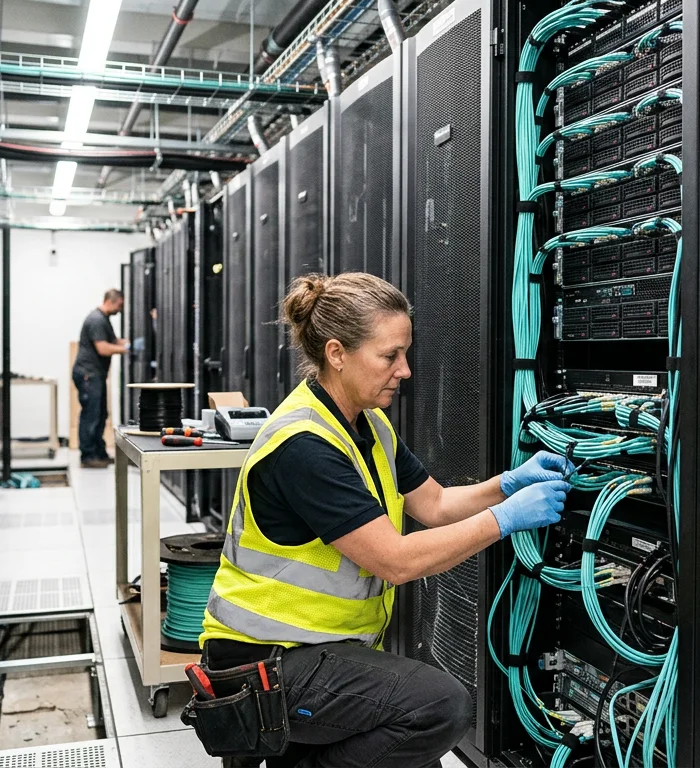
Enterprises are increasingly transitioning from reliance on external API-based frontier models to private AI environments. This shift is driven by the need to maintain proprietary data security, mitigate dependence on single-service providers, and manage the rising costs of inference at scale. Approximately 63% of organizations have already adopted open-weight models to facilitate these internal operations.
Moving AI workloads in-house transfers the responsibility for physical infrastructure—specifically power, cooling, and compute density—from cloud providers to the enterprise. Standard data centers often lack the necessary power capacity to support high-density AI hardware, necessitating significant capital investment or specialized colocation facilities. Research indicates that 37% of organizations now cite power availability as the primary determinant for the physical location of their AI inference workloads.
To optimize capital expenditure, organizations are adopting a hybrid infrastructure model. This strategy involves maintaining private, on-premises capacity for predictable, steady-state workloads while utilizing external cloud resources to manage demand spikes and high-intensity tasks. The primary operational challenge lies in ensuring that both environments function as a unified system, maintaining consistent data access and security controls across distributed locations.
Connectivity has emerged as a critical bottleneck, particularly as the rise of agentic AI increases the frequency of data transfers between models and disparate systems. Because agents require constant, low-latency access to multiple data sources, infrastructure must be programmable to allow for dynamic configuration of network paths. Organizations are increasingly prioritizing the integration of power, connectivity, and compute into a single procurement and deployment strategy to avoid the complexities of managing these elements in isolation.
Future-proofing these systems requires the adoption of standardized protocols that allow agents to interface with new data sources and models without requiring manual re-engineering. As workloads evolve, the ability to programmatically manage the boundaries between private environments and external resources will be a key factor in maintaining operational efficiency and regulatory compliance.
More stories
- Deal Sheet: Fortis shutdown costs over 400 jobs
- The Week in Games: GTA 6 turns attention into cash
- US data centres emit 25.7m tonnes of CO2, Harvard says
- German founders need 3,942 hours to open small business
- Leaked Deutsche Bank files test Sewing's reform narrative
- UAE employers plan 2.8% pay rises for 2027
- Deal Sheet: Unity talks put $25 billion on game-tools table
- SoftBank faces leverage test after 60% share drop
- Meta gains 2.15% despite weaker credit outlook
- Progressive posts 4% premium growth with AI shopping tests
Latest news
- Trump prepares tariffs on China and other major exporters
- New-car buyers pay record average $50,087 in October
- Banks face ECB reserve debate over liquidity and profits
- Investors see Anthropic debut gains fade below $83 a share
- Iraq orders federal control over Kurdish-area oilfields
- Germans oppose Ukraine aid as poll shows support slipping
- Kim Jong-un receives 10 envoys after constitutional shift
- Ukraine claims Libya strike sinks Russian naval corvette