Pakistan airstrikes kill 28 militants near Afghan border
Pakistan airstrikes killed at least 28 militants, Islamabad said, while Kabul accused it of killing civilians and threatened a response.
Lauren Collins ·
Pakistan airstrikes killed at least 28 militants, the government said, ending a three-month lull and reviving a dispute with Kabul.
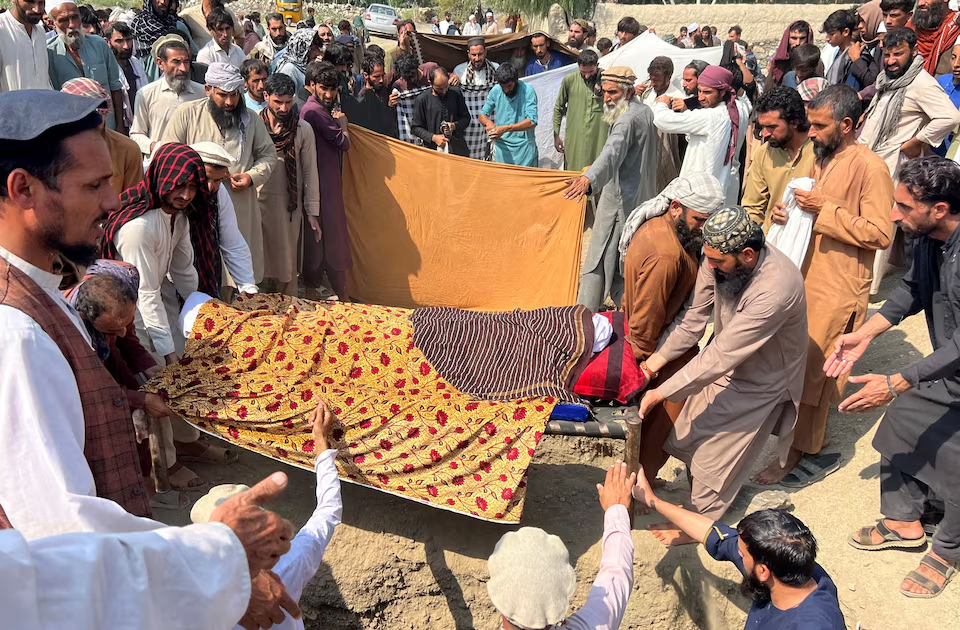
Afghan Taliban officials gave a different account, saying at least three civilians were killed overnight on Afghan territory. Hamdullah Fitrat, a deputy Taliban spokesperson, said one house in Kunar was hit, killing three members of one family and injuring four others, while two sites in Paktika were bombed without casualties.
Zabihullah Mujahid, chief spokesperson for the Taliban-run Afghan government, said Afghanistan would "will respond appropriately to this aggression." Pakistan's military did not immediately comment, while a Pakistani security official, speaking anonymously, said the strikes hit Paktika and Kunar.
Kohat attack resets pressure
The strikes followed a Friday attack on a police facility in Kohat, a northwestern Pakistani district, that killed at least 24 people. On Sunday, a separate exchange in nearby Hangu killed six Pakistani soldiers and eight militants, according to a Pakistani army statement.
Pakistan has often answered militant raids with strikes across the frontier, according to Pakistani officials. This sequence places Monday's operation inside a familiar cycle: an attack on Pakistani security forces, a cross-border response, and a Taliban denial that Afghan territory shelters anti-Pakistan fighters.
The relationship between Islamabad and Kabul has been strained for years over that accusation. The Taliban government says militancy is Pakistan's internal problem, while Islamabad says armed groups use Afghan areas to plan and launch attacks across the border.
Bahadur network complicates border
Pakistan's insurgencies involve rival Islamist groups with different bases and histories, but each has treated the Pakistani state as an enemy. Last week's Kohat attack was claimed by Shura Ittehad-ul-Mujahideen, a group led by Hafiz Gul Bahadur.
Abdul Basit, an analyst at Singapore's S. Rajaratnam School of International Studies, said Bahadur had once hosted al Qaeda and Arab Islamist fighters in the border region. The group initially focused on attacks against US and NATO forces in Afghanistan, unlike Tehreek-e-Taliban Pakistan, which fought Islamabad in the northwest.
Basit said Bahadur's group shifted against Pakistan after a major military offensive around 2015 targeted its North Waziristan haven and pushed fighters into Afghanistan. He described the network as "an umbrella of different militant groups where al Qaeda is the architect and Gul Bahadur is the face."
Pakistani officials say cross-border strikes since late last year have targeted both TTP and Bahadur-linked hideouts in Afghanistan. In July, Afghanistan launched drones toward Pakistan, which Islamabad said its forces intercepted and shot down.
Paktika choices narrow
The military balance favors Pakistan in the air. The International Institute for Strategic Studies lists Pakistan with 422 combat aircraft and more than 260 helicopters, compared with Afghanistan's lack of fighter jets, at least six aircraft, 23 helicopters and drones used in prior fighting.
The worst reported single incident this year came in March, when the Afghan Taliban said more than 400 people were killed in a Pakistani strike on Kabul that it said hit a drug rehabilitation center. Islamabad denied that account and said it had targeted military installations and terrorist support infrastructure.
If Pakistan limits further strikes to alleged militant positions after major attacks, the global macro effect would probably stay confined to border risk rather than wider markets. For Islamabad, that path keeps pressure on armed groups while testing whether the Taliban can restrain militants without appearing to accept Pakistani operations on Afghan soil.
If Kabul instead answers with drones, artillery or raids, the mechanism changes: border trade, aid logistics and local transport would face the first disruption before any broader regional spillover. Aviation, insurance and security providers serving frontier routes would then price a longer cycle of retaliation into operations.
If the Taliban moves against Bahadur-linked and TTP networks, Pakistan would gain a security dividend without expanding the air campaign. The open question is whether Monday's strikes weaken those networks or give them a new recruitment argument in the border districts where both states already have limited room to maneuver.