Pacific security tops Peters' pitch for US engagement role
Winston Peters urged deeper US engagement in Pacific security, citing missile activity, naval exercises and crime risks before New Zealand's November 7…
Atlas Newsdesk ·
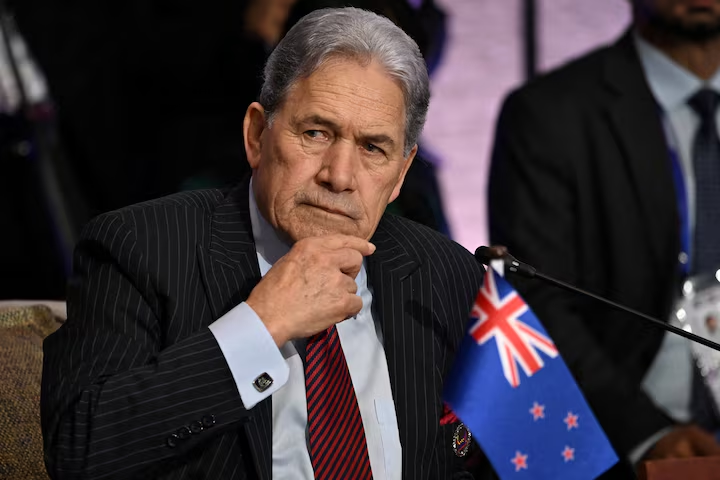
Pacific security framed Winston Peters' call for a more active United States role before the November 7 election. He said the region is more unsettled.
The New Zealand foreign minister used his final major foreign policy address before the vote to argue that Washington remains central to regional prosperity and security. Peters said the current environment was no longer benign, citing missile activity, naval movements and organized transnational crime.
Peters seeks an engaged America
Peters said the United States is a "Pacific power" and should remain closely involved in the region. His remarks put security policy into New Zealand's election debate while also signaling Wellington's preference for a larger American role in Pacific affairs.
The speech came as New Zealand's center-right government has adopted more direct language on strategic competition in the Pacific. Wellington has tried to reinforce its position through aid, defense cooperation and diplomatic engagement while pressing larger partners to pay closer attention to island governments' priorities.
Missiles, ships and drug routes
Peters pointed to missile launches carried out without consent or sufficient warning, naval exercises moving farther south and criminal networks that he said threaten Pacific neighbors and New Zealand. He did not name China in the speech.
He had previously criticized China's test firing of an intercontinental ballistic missile into the South Pacific. China described that launch through official state media as part of annual military training and said it was not aimed at a specific country or target.
Peters also linked US engagement to the region's capacity to disrupt drug trafficking. He called the trade an "evil scourge" reaching Pacific shores and said Washington had a role in helping governments build the capacity to counter it.
Palau pledge gives Wellington an example
Peters said the United States had responded during the government's term to concerns raised by Wellington and other regional partners. He pointed to announcements made by Washington in Palau, including $150 million in support for Pacific Islands.
The Palau package gave Peters a concrete example for his argument that regional pressure can produce a US response. He said New Zealand had spoken often with Washington about Pacific challenges and described the announcements as evidence that the United States had listened.
The wider setting for the speech was a global economy Peters described as disrupted, uncertain and affected by a return of trade protectionism. That framing tied Pacific security to economic stability rather than treating it as a narrow defense issue.
Coalition politics before November 7
Peters, 81, is seeking re-election as leader of New Zealand First, the junior partner in the governing coalition. He is serving his third stint as foreign minister, a role that has given him long experience in Pacific diplomacy.
Although Peters is not expected to campaign for the premiership, his party has often mattered in government formation. Since New Zealand adopted proportional representation in the 1990s, he has played a decisive role in coalition outcomes on several occasions.
If US engagement follows the Palau pledge with sustained funding and coordination, the mechanism for the region would be capacity-building in policing, maritime monitoring and diplomatic support. For the global economy, that path would reduce one source of policy uncertainty in a region Peters described as exposed to disruption; for New Zealand, it would support Wellington's Pacific strategy; for the wider security sector, it would shift attention toward enforcement and training.
If US attention weakens instead, New Zealand would face more pressure to carry diplomatic and aid commitments with fewer large-partner resources. In that scenario, Peters' warning on trade protectionism would matter through confidence and investment channels, while Pacific governments would have fewer options for countering criminal networks and managing strategic competition.
If missile testing and naval activity continue to move southward, Wellington's next decisions would likely center on how visibly to align with larger partners while preserving Pacific relationships. The main open question is whether Peters' call for an engaged America translates into durable US policy after the election and beyond the Palau announcements.