

NVIDIA Unveils GR00T 2 Robotics Model for Human-Video Learning
NVIDIA’s new GR00T 2 robotics model enables cross-embodiment skill transfer using human video data, with industrial testing currently underway for…
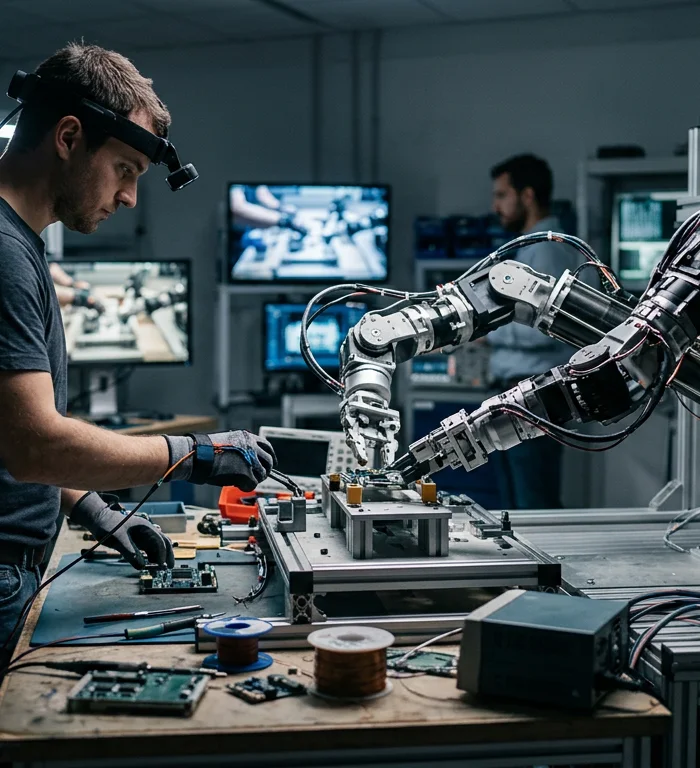
NVIDIA has introduced GR00T 2, a 2-billion-parameter transformer model designed to enable robots to learn tasks by observing human video demonstrations. The model, built on the Cosmos-Predict2.5-2B architecture, utilizes a combination of first-person human video, handheld-gripper demonstrations, and robot teleoperation data to generate action sequences. Initial testing indicates a 40% zero-shot success rate on tasks absent from the robot’s original training data.
To support broader adoption, the company released the Human-1M-100K dataset, providing 100,000 hours of human motion and video data under a CC BY 4.0 license. While the model is categorized as open, full code availability is scheduled for December. Performance metrics show significant improvement when using corrective demonstrations; for instance, toy assembly success rates increased from approximately 23%–69% with supervised fine-tuning to 97%–98% when utilizing an integrated reasoning agent for error recovery.
Supporting infrastructure includes the Isaac Lab 3.0 simulation environment, which reports up to 2.5 times the training throughput of previous versions. The AlphaNIST framework, utilizing Success-Guided Sampling, demonstrated 98.2% training success on complex assembly tasks in simulation, significantly reducing required GPU compute time compared to per-task policy training. These tools are intended to address industrial variation through modular, repeatable evaluation frameworks like Isaac Lab-Arena and DexBench v1.0.
Industrial entities, including Nexuni, Foxconn, and Siemens, are currently evaluating the technology for applications ranging from laundry handling to server manufacturing. Despite these trials, the technology remains in the testing and evaluation phase with no formal production rollout announced. Policymakers and industry stakeholders should note that while the model demonstrates high success rates in controlled environments, the operational efficiency is currently constrained by the latency of agent-based oversight and the requirement for task-specific corrective data.
More stories
- Europe faces attribution gap after 16 cyber, physical incidents
- PIF backs Grand Theft Auto as Saudi players embrace game
- Signal limits screenshots to curb AI access to messages
- Cognition runs Devin Mac workspaces on EC2 in 6 AWS regions
- Salesforce engineers cut 600-failure triage to 90 minutes
- Türkiye Desk: GTA 6 puts console access and network demand in focus
- Nvidia opens board inquiry into alleged foreign targeting
- Nvidia opens board inquiry into alleged foreign targeting
- NASA Swift orbit boost aims to avert reentry this year
- Hollow-core fiber trial sets 51.3Tb/s benchmark
Latest news
- Trump prepares tariffs on China and other major exporters
- New-car buyers pay record average $50,087 in October
- Banks face ECB reserve debate over liquidity and profits
- Investors see Anthropic debut gains fade below $83 a share
- Iraq orders federal control over Kurdish-area oilfields
- Germans oppose Ukraine aid as poll shows support slipping
- Kim Jong-un receives 10 envoys after constitutional shift
- Ukraine claims Libya strike sinks Russian naval corvette