Hollow-core fiber trial sets 51.3Tb/s benchmark
A hollow-core fiber field trial in China delivered 1.2Tb/s per wavelength and 51.3Tb/s over 128 miles without repeaters.
Jason Kwon ·
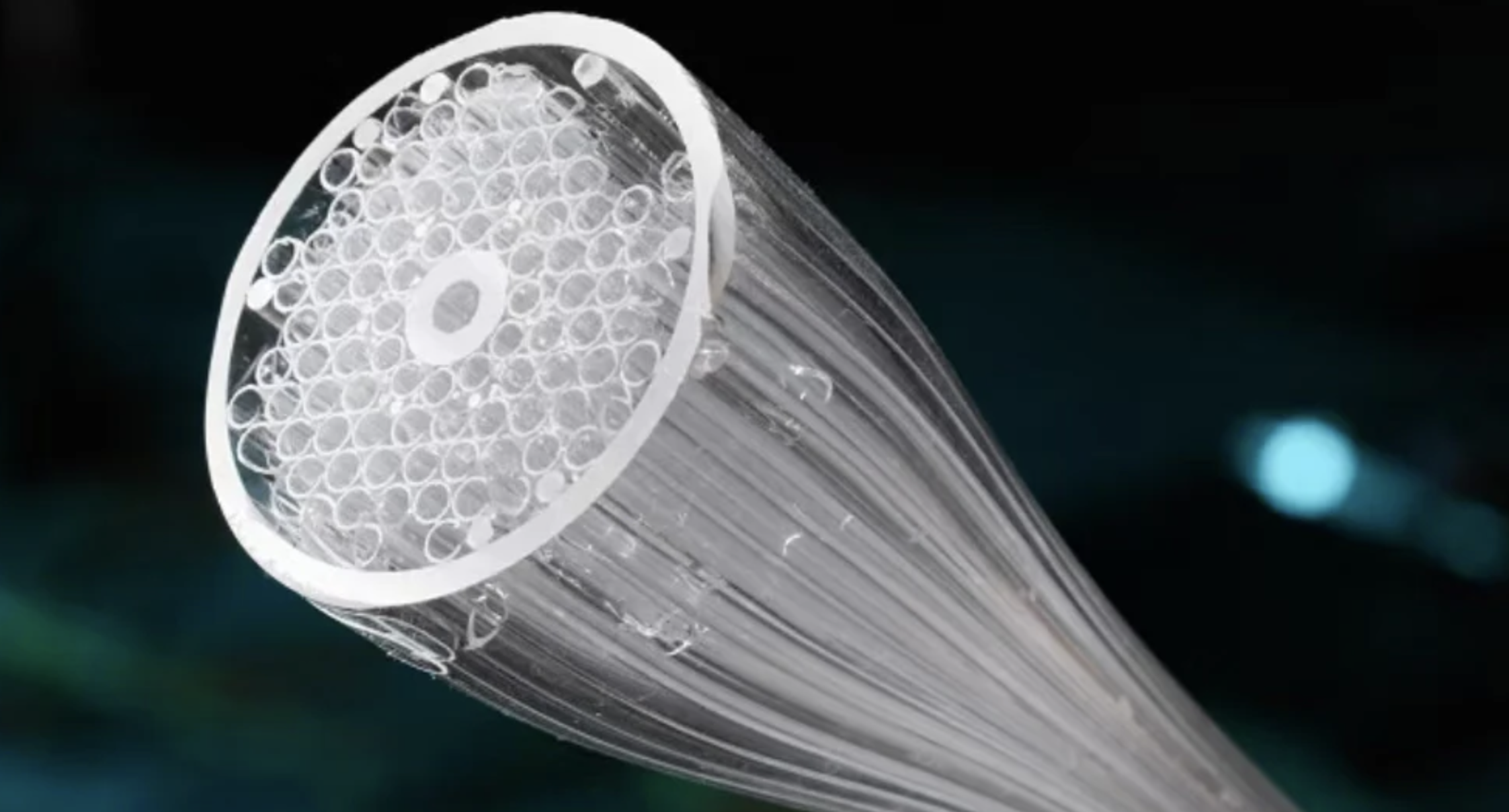
A hollow-core fiber field trial in China delivered 1.2Tb/s per wavelength and 51.3Tb/s over 128 miles without repeaters. The test signals progress toward higher-capacity, lower-latency optical backbones.
The demonstration brought together China Telecom, Yangtze Optical Fibre and Cable Joint Stock Limited Company (YOFC), and Dekoli. It was conducted under a national research program aimed at advancing optical fiber and transmission technologies.
The companies said the experiment took place on what they described as the longest commercially deployed cross-border hollow-core fiber cable. The trial moved beyond laboratory setups by validating performance on an in-service style route.
Record field performance on a commercial cross-border route
Using an optimized transmission system, the team achieved an aggregate throughput of 51.3Tb/s across the link. The span covered about 128 miles (roughly 206 kilometers) and did not rely on signal repeaters along the route.
Per-wavelength performance reached 1.2Tb/s, which the participants characterized as a first-of-its-kind field test for a hollow-core fiber transmission system at that rate. In optical networks, higher per-channel rates can reduce the number of wavelengths needed to meet traffic demand, potentially simplifying system design.
Operating without repeaters is significant because repeaters add cost, power consumption, and operational complexity. Longer unrepeated distances can also broaden deployment options in areas where intermediate sites are hard to secure or maintain.
Why hollow-core fiber changes the latency and capacity equation
Conventional fiber carries light through solid glass, which introduces a propagation delay and can constrain performance as operators push toward higher powers and denser modulation. Hollow-core fiber instead guides most of the optical signal through air, changing the physical environment the light travels through.
The project partners highlighted two expected advantages of this approach: lower signal delay and improved headroom for capacity. Those characteristics are drawing attention as networks expand to support cloud computing, large-scale data centers, and backbone traffic growth.
Hollow-core designs have been under active research for years, but field deployment has been limited compared with standard single-mode fiber. Demonstrations on commercial routes are therefore closely watched by carriers and equipment suppliers evaluating practical upgrade paths.
Solving high-power transmission challenges outside the lab
According to the team, a key technical hurdle addressed in the trial was maintaining stable high-power signal transmission in a real-world hollow-core fiber network. Achieving dependable operation at high data rates under field conditions is often harder than in controlled lab environments, where temperature swings, mechanical stresses, and network integration issues are minimized.
By reporting stable, high-speed performance over a long unrepeated span, the project strengthens the case that hollow-core fiber could be used beyond niche trials. The results may be especially relevant for long-haul and backbone builds where operators seek both higher throughput and tighter latency budgets.
Next steps will likely focus on repeatability across additional routes, interoperability with existing optical transport equipment, and scaling manufacturing and installation practices. Industry attention will also center on whether cost, durability, and operational procedures can match the reliability expectations set by today’s conventional fiber networks.