

Northwestern traps single positron for months in antimatter test
The Physical Review Letters experiment could improve positron measurements about 30-fold, but researchers have not found unexpected electron-positron…
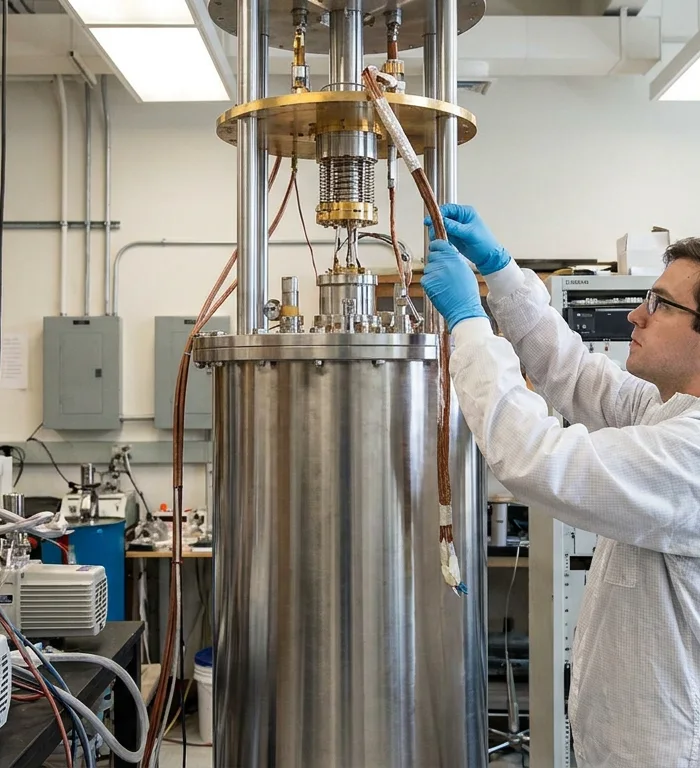
Northwestern University physicists trapped a single positron for months in a Physical Review Letters experiment reported by WIRED on Oct. 25, using electric and magnetic fields inside a near-zero-temperature vacuum device.
The result matters because the American Physical Society said the device could make antimatter-particle measurements about 30 times more precise than prior methods, according to WIRED.
The team, led by Gerald Gabrielse, used a device called a single-positron quantum cyclotron. A positron is the antimatter counterpart of an electron, carrying the opposite electric charge while having the same mass.
The apparatus held the positron in a vacuum with electric and magnetic fields and cooled it close to absolute zero, the lowest possible temperature. WIRED reported that the setup allowed researchers to control the particle’s quantum states, meaning measurable energy and motion conditions, without destroying it.
That is the practical advance. Antimatter particles disappear when they contact ordinary matter, releasing energy, so laboratories use vacuum chambers and electromagnetic fields to isolate them. Keeping one positron available for months allowed repeated measurements rather than a one-time observation.
The physics question is larger than the device. Mathematics predicts that every matter particle has an antimatter partner, and experiments have verified that relationship. Yet the observable universe is made mostly of ordinary matter, and the supplied report said scientists still do not know why.
Researchers want to compare the magnetic properties of electrons and positrons more closely. WIRED reported that electron measurements are already highly precise, while positron measurements have been harder to perform at the same standard.
The experiment has not shown any unexpected difference between the electron and the positron, according to the report. Its significance is instead the improved ability to look for such differences.
If future measurements show that a positron responds to magnetic fields differently from an electron, WIRED reported, physicists would need to revise parts of the framework used to describe matter and antimatter.
Source: Article, WIRED, Oct. 25, 2026.
More stories
- Europe faces attribution gap after 16 cyber, physical incidents
- PIF backs Grand Theft Auto as Saudi players embrace game
- Signal limits screenshots to curb AI access to messages
- Cognition runs Devin Mac workspaces on EC2 in 6 AWS regions
- Salesforce engineers cut 600-failure triage to 90 minutes
- Türkiye Desk: GTA 6 puts console access and network demand in focus
- The Signal: BioWare reportedly closes after 31 years
- Grok picks Republicans in 92% of forced API election prompts
- Anthropic Mythos AI model exposes systemic blockchain risks
- AI Just Became Your Boss and It’s Hiring Humans
Latest news
- Trump prepares tariffs on China and other major exporters
- New-car buyers pay record average $50,087 in October
- Banks face ECB reserve debate over liquidity and profits
- Investors see Anthropic debut gains fade below $83 a share
- Iraq orders federal control over Kurdish-area oilfields
- Germans oppose Ukraine aid as poll shows support slipping
- Kim Jong-un receives 10 envoys after constitutional shift
- Ukraine claims Libya strike sinks Russian naval corvette