

New Private School Policy Enforces Lottery Admissions and Strict Fee Caps
The Ministry of Education has introduced a standardized 2027 admission policy for private schools, featuring mandatory lottery systems, strict fee caps, and…
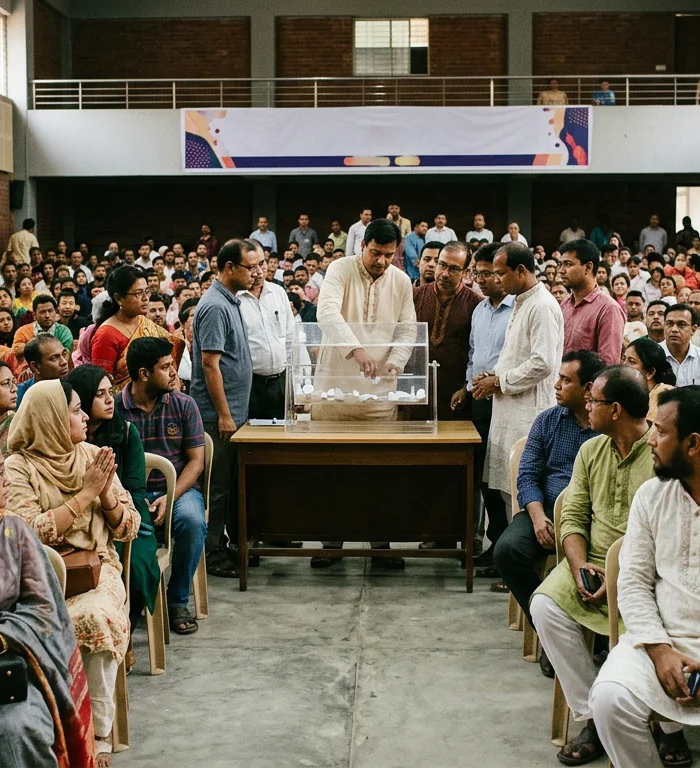
The Ministry of Education has finalized the Student Admission Policy-2027, establishing standardized procedures for private educational institutions. Effective for the 2027 academic year, the policy mandates a lottery system for Class 1 admissions, while admissions for Classes 2 through 9 will be determined by written examinations in Bangla, English, and Mathematics. These measures are intended to increase transparency and administrative discipline within the private education sector.
The policy introduces strict caps on application and admission fees, tiered by geographic location and institutional status. In the Dhaka metropolitan area, maximum admission fees are capped at $5,000 for MPO-listed institutions, while non-MPO and partially MPO-listed schools are limited to $8,000 for Bangla-medium and $10,000 for English-version students. Development fees are restricted to a maximum of $3,000. Institutions found in violation of these fee structures or admission protocols face potential legal consequences, including the revocation of their Monthly Pay Order (MPO) status.
Mandatory seat quotas have been implemented to regulate student demographics. Private schools in the Dhaka metropolitan area must reserve 40 percent of seats for students residing in the immediate catchment area. Additional quotas are reserved for specific groups, including children of freedom fighters (5 percent), students with special needs (2 percent), orphans (1 percent), and children of Ministry of Education employees (2 percent). Siblings and twins are allocated 3 percent and 2 percent quotas, respectively.
Eligibility criteria for Class 1 applicants require children to be between six and seven years of age as of January 1, 2027, with a five-year age relaxation available for students with special needs. The government's enforcement of these regulations signals a shift toward centralized oversight of private school operations, aiming to mitigate financial exploitation and ensure equitable access to education.
More stories
- ICE arrests at Seattle airport draw protests and scrutiny
- EU rejects COP31 deal as fossil fuel divisions block pact
- Staff notice in Commission cyberattack tests EU response
- Britain-EU deal eases food checks and youth travel rules
- European troops in Poland drill near reported missile crash
- Brooklyn collapse kills eight as city orders site sweeps
- Massie revives Hegseth impeachment bid over war authority
- Secret Service arrests man after White House weapons find
Latest news
- Trump prepares tariffs on China and other major exporters
- New-car buyers pay record average $50,087 in October
- Banks face ECB reserve debate over liquidity and profits
- Investors see Anthropic debut gains fade below $83 a share
- Iraq orders federal control over Kurdish-area oilfields
- Germans oppose Ukraine aid as poll shows support slipping
- Kim Jong-un receives 10 envoys after constitutional shift
- Ukraine claims Libya strike sinks Russian naval corvette