

Malawians drink faecal-contaminated water at 74.6% rate
The gap between source and household testing puts attention on transport, storage and rural water systems rather than access statistics alone.
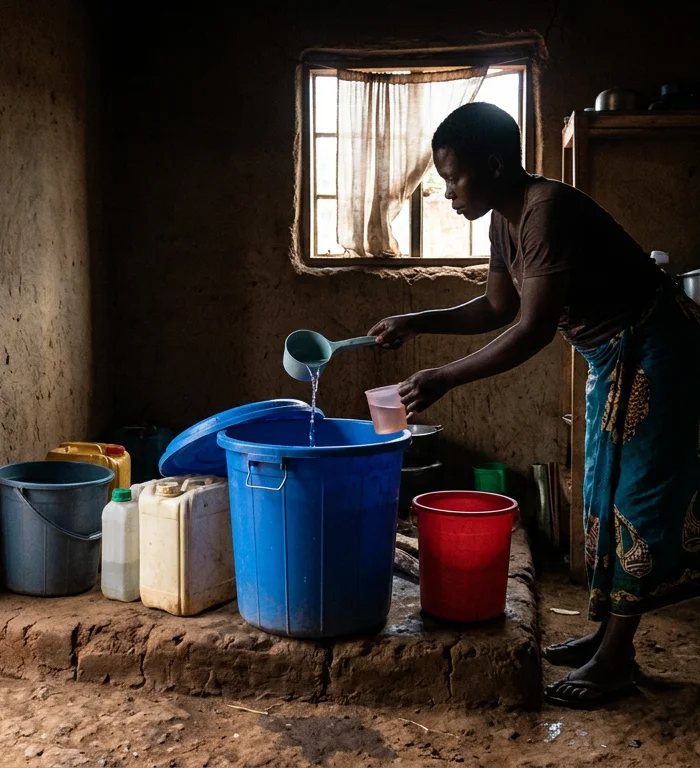
Malawi’s National Statistical Office found in a survey published Nov. 19 that household drinking water for 74.6% of the population showed faecal contamination.
The NSO’s Nov. 19 report said contamination was 35.0% at the source, exposing a large break in water safety after collection even as 91.2% of households use improved sources.
“Faecal contamination, which shows that water may have come into contact with human or animal waste, was found in drinking water of 74.6 percent of the population when it was tested in the household, compared with 35.0 percent when it was tested at the source,” the report says.
The report identified transport, handling and storage as the points where water quality deteriorates between supply points and the home. It said only 8.9% of the population had safely managed drinking water services.
The result complicates how Malawi measures access to clean water. Improved sources such as boreholes, protected wells and piped taps reach much of the country, but household testing showed those systems do not guarantee water remains safe to drink.
Rural areas are more exposed, according to the report. Basic service reaches 93.2% of urban residents, compared with 68.9% in rural communities, where women and girls often carry the burden of collecting water from distant sources.
Water Services Association of Malawi executive director Vitumbiko Mkandawire said the report should push authorities to separate improved access from safe consumption. He called for more investment in piped and reticulated systems in rural areas and stronger water safety plans across the country.
Horizon Action executive director Mwandira said the figures were alarming and urged stricter measures to prevent contamination between collection and consumption. The report drew on the Integrated Household Survey 2025 and the Malawi Demographic and Health Survey 2024 and was released for African Statistics Day.
Source: National Statistical Office survey reported by Nyasa Times via AllAfrica, Nov. 19, 2026.
More stories
- Nigeria's family-planning budget falls 97%
- Peter Attia reviews cold therapy claims on longevity
- Dietitians advise small swaps for plant-based eating
- TikTok dementia videos mislead in 66.4% of sample, researchers say
- Aberdeen Royal Infirmary faces police inquiry call over 19 deaths
- Bariatric surgery group loses 28.2% after GLP-1 use
- GSK wins FDA approval for Nelkarmi after 49% response rate
- Europe faces 35,000 drug-resistance deaths a year
Latest news
- Rwanda faces budget strain from 85% electricity access push
- ICE arrests at Seattle airport draw protests and scrutiny
- AI doubts leave Asian stocks facing a new investment test
- EU rejects COP31 deal as fossil fuel divisions block pact
- Deal Sheet: Fortis shutdown costs over 400 jobs
- Germany to pay about $11 a month into child pension accounts
- Monrovia mayor-designate seeks $14.5m city budget
- Laura Brand curbs prison messages after YouTube dispute