Joshua Wong faces life term after collusion guilty plea
Joshua Wong pleaded guilty to collusion with foreign entities, exposing the Hong Kong activist to a potential life sentence under the city's security law.
Lauren Collins ·
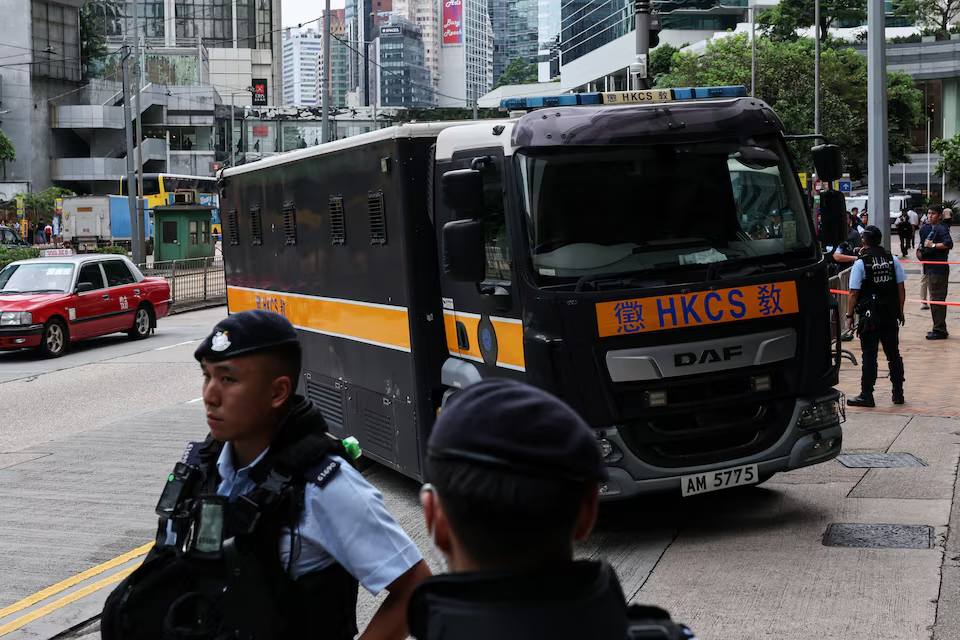
Joshua Wong pleaded guilty to one national security charge in Hong Kong, exposing the activist to a potential life sentence under the 2020 law.
At a High Court hearing in Admiralty on Wednesday, the 29-year-old admitted collusion with foreign entities before William Tam, a judge approved to hear national security cases. Several Western diplomats attended the proceeding, reflecting outside attention on a case tied to Beijing's security overhaul of the city.
Demosisto allegations reach court
Prosecutors said Wong's former political group, Demosisto, ran an international media and political campaign in 2019 and 2020 that sought sanctions and other hostile measures against Hong Kong and China. Demosisto, which has since disbanded, once counted Wong among its leaders and supported a referendum on Hong Kong's sovereignty.
An earlier charge sheet accused Wong of conspiring with exiled activist Nathan Law and others to ask governments, institutions, organizations or people outside China to impose sanctions or blockades. The alleged conduct ran from July 1 to November 23, 2020, beginning one day after the National Security Law took effect on June 30, 2020.
Wong is already imprisoned on an earlier national security case involving conspiracy to commit subversion after an unofficial primary election held by democratic activists in 2020. His current sentence is scheduled to end in January, making the new sentencing decision central to how long he remains in custody.
A security law reshapes dissent
Wong became known outside Hong Kong as a teenage democracy campaigner before the city's protest movement was narrowed by the national security system imposed by Beijing. The law followed months of sometimes violent pro-democracy demonstrations in 2019, a period that officials in Hong Kong and China have cited when defending the measure as necessary for stability.
International human rights groups and some Western governments have criticized the law as excessive, pointing to the high degree of autonomy promised to Hong Kong after the 1997 handover from British to Chinese rule. Hong Kong and Chinese officials have said the law restored order after unrest and targets threats to national security rather than lawful expression.
The case also follows convictions last month involving Lee Cheuk-yan, 69, and Chow Hang-tung, 41, who were found guilty of inciting subversion after using a slogan against one-party rule in political work. Both were associated with a group known for organizing annual vigils marking the 1989 Tiananmen Square crackdown in Beijing.
Chan seeks lower-band sentence
In mitigation, Wong's lawyer Derek Chan urged Tam to treat the conduct as falling short of the gravest form of the offense. Chan asked the court to consider a term at the upper end of the lower sentencing band, which he described as three to 10 years, compared with the maximum penalty of life imprisonment.
Chan also said Wong had already spent nearly six years in prison, had read hundreds of books while detained and hoped eventually to care for his aging parents. Tam said he would deliver sentence as soon as possible but ended the hearing without setting a date.
Three sentencing paths narrow stakes
If Tam accepts the mitigation argument and keeps the sentence within the three-to-10-year range, Wong's personal stake turns on whether the new term overlaps with time already served or extends custody well beyond January. For Hong Kong's democracy movement, that outcome would still confirm the reach of the security law, while leaving the harshest penalty unused in this case.
If the court imposes a longer term above that range, the mechanism would be different: Wong would face a more extended removal from public life, and activists weighing overseas advocacy would have a clearer sentencing benchmark. For foreign governments and global companies, the channel is legal and diplomatic confidence in Hong Kong's autonomy, rather than a near-term macroeconomic data shock.
If the sentence approaches the maximum available under the law, the case would become a stronger signal to rights groups and Western governments already tracking national security prosecutions. The immediate open questions are the sentencing date, the range Tam selects and how Hong Kong authorities apply similar charges in later cases involving overseas lobbying or sanctions advocacy.