

Israel seizes drilling equipment in Hebron water enforcement operation
Authorities confiscated four trucks used for unauthorized water drilling, signaling an increase in infrastructure regulation within the West Bank’s contested…
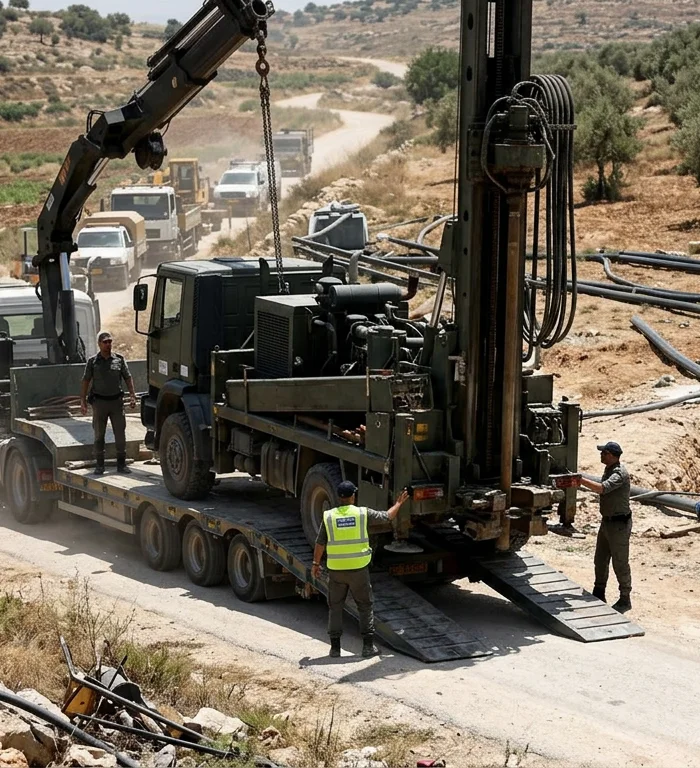
Enforcement action in Hebron
Israeli authorities confiscated four trucks involved in unauthorized water drilling operations near Hebron within the last 48 hours. The operation was conducted following intelligence reports regarding illegal well construction, according to information provided by the civil administration responsible for overseeing regional utility regulations.
The seizure represents a tactical tightening of resource management in the West Bank. Israeli officials maintain that the crackdown aims to preserve the integrity of shared water basins, while local agricultural committees report increasing administrative pressure on unauthorized infrastructure.
Resource governance and the aquifer
Hebron Israeli
The Mountain Aquifer serves as the primary transboundary water source for both Israel and the Palestinian territories, making its management a central component of the region's environmental security. Access to the reservoir was formalized under the 1995 Oslo II Accord, which mandated the creation of a Joint Water Committee to oversee infrastructure permits and distribution rights. The legal framework requires formal approval for all new drilling activities, a process that has become a recurring point of contention. Frequent delays in permit issuance, combined with rising water demand from agricultural and municipal sectors, have led to a proliferation of unsanctioned wells throughout the West Bank. Security and territorial control The current enforcement push reflects a broader strategy by the civil administration to assert administrative oversight in Area C, where Israel retains full control over planning and construction. Disrupting unauthorized drilling serves as a mechanism to limit decentralized water extraction that bypasses the established regulatory apparatus.
This trend toward stricter utility enforcement carries secondary risks for regional stability. Resource insecurity and the loss of access to infrastructure can exacerbate localized tensions, creating friction between authorities and rural communities reliant on private wells for irrigation and livestock.
Regional water security stakes
The potential for these infrastructure disruptions to impact larger political negotiations remains a significant uncertainty.
If the current enforcement trend persists through the end of the year, the increased frequency of seizures may shift from an administrative matter into a broader diplomatic flashpoint over resource access and sovereignty.
Market analysts monitoring the region note that consistent water scarcity typically drives up production costs for local agriculture, potentially impacting supply chains. Observers will track whether the current focus on infrastructure disruption evolves into a systematic policy shift or remains a localized effort to curb specific unlicensed activity.
More stories
- Germans oppose Ukraine aid as poll shows support slipping
- Kim Jong-un receives 10 envoys after constitutional shift
- Ukraine claims Libya strike sinks Russian naval corvette
- COP31 climate talks collapse over fossil fuels and funds
- Russian military faces 1,087 recorded suicides in Ukraine war
- US faces China, Russia in Africa minerals contest
- Batangas State's 23 new doctors face rural service requirement
- DR Congo starts Ebola vaccine trial in 9,700-case outbreak
Latest news
- Trump prepares tariffs on China and other major exporters
- New-car buyers pay record average $50,087 in October
- Banks face ECB reserve debate over liquidity and profits
- Investors see Anthropic debut gains fade below $83 a share
- Iraq orders federal control over Kurdish-area oilfields
- Nvidia shares retreat as AI rally cools before PCE data
- Macy’s parade faces balloon limits as storm winds approach