

Israel election turnout reaches 74.3% before polls close
Israel election turnout reached 74.3% by 8 p.m., exceeding the final 2022 voting rate, the Central Elections Committee reported.
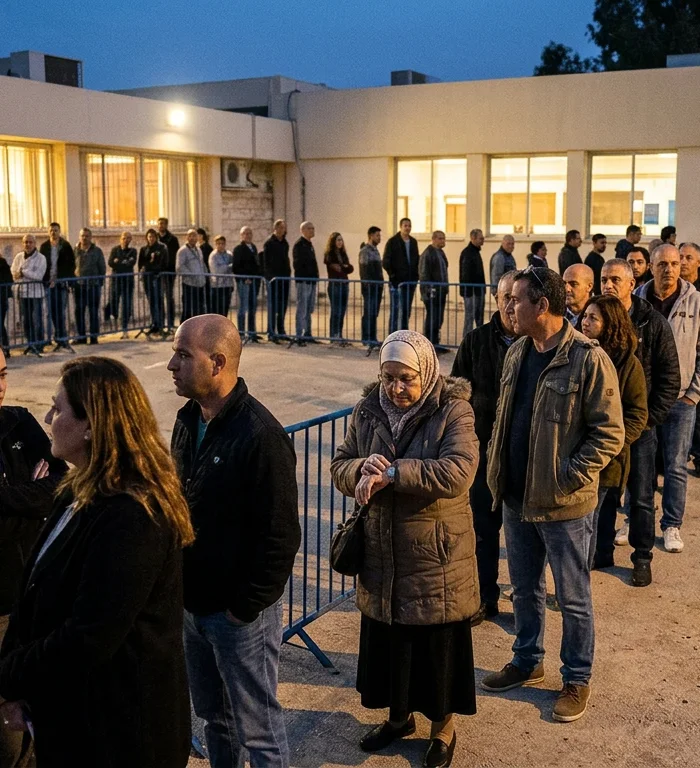
Israel election turnout reached 74.3% by 8 p.m., exceeding the final 2022 voting rate, the Central Elections Committee reported.
The committee put participation above the 70.6% recorded over the whole voting day in 2022, with two hours remaining before the scheduled close. Separately, voters in Segev Shalom described queues lasting more than four hours, with some people leaving without casting ballots.
The turnout figures establish the scale of participation, not the distribution of support among parties. No party seat estimates or official vote totals by political bloc were included in the supplied election update.
Participation exceeds the 2022 benchmark
The committee reported 5,449,277 ballots cast by 8 p.m., approximately 655,000 more than during the entire 2022 election. It described the turnout rate at that hour as the highest since comparable hourly records began.
The same-hour comparison also showed greater participation than in the preceding elections listed in the committee's figures. Turnout stood at 66.3% at 8 p.m. in 2022, against 60.9% in 2021 and 65.6% in 2020.
Those comparisons distinguish an evening checkpoint from a completed election: the 2026 figure was already above both the equivalent 2022 reading and that election's final rate. The supplied update did not include a final 2026 turnout figure or a breakdown showing which communities accounted for the increase.
Segev Shalom voters describe delays
In Segev Shalom, a Bedouin town in the Negev, voters reported on Tuesday that hundreds of people were waiting to vote. Some said the delays had prompted others to abandon the queue and return home.
Polling locations in the town also accommodate residents from unrecognized Bedouin villages, according to the supplied account. Some voters had traveled tens of kilometers to reach them, adding a journey to the time spent waiting.
The account did not establish how many people left without voting or whether they subsequently returned. Nor did it include an explanation from election officials for the reported delays, leaving their cause and effect on participation unresolved.
Exit estimates precede official counting
Voting was scheduled to end at 10 p.m., when television channels were also expected to publish their initial exit-poll projections. Those estimates would indicate the seats attributed to individual parties and competing political blocs, rather than constitute an official count.
The Central Elections Committee said an initial release of official results was expected at about 1 a.m. It also cautioned that counting might continue into Friday, citing the volume of absentee ballots.
If counting follows that extended timetable, the first overnight figures would leave the result incomplete while additional ballots are processed. The next distinction for readers is therefore between the broadcasters' seat projections and the committee's reported count; the turnout update alone provides no basis for identifying a winning party or bloc.
More stories
- Ruto seeks Russian investment in Kenya's $380m trade push
- Sudan teachers seek 20% budget share with 8m children outside school
- Spain rail network faces scrutiny after 64 killed near Toledo
- Spain reports at least 30 dead in high-speed train crash
- Villa Vie disembarks 203 passengers in Cambodia over fuel costs
- NEITI faces methane data questions over 18 incomplete records
- Trump questions Brazil election as Liberal Party accepts
- Israel votes as Netanyahu faces first post-attack election
- Putin gets G-20 summit invite to Trump's Doral resort site
- Iran's President Defies U.S. at U.N.; Russia Says Ukraine War Will Continue During Talks