Iran's President Defies U.S. at U.N.; Russia Says Ukraine War Will Continue During Talks
Speeches at the General Assembly hardened public positions on both conflicts, while side meetings kept the door open to narrower deals
Lauren Collins ·
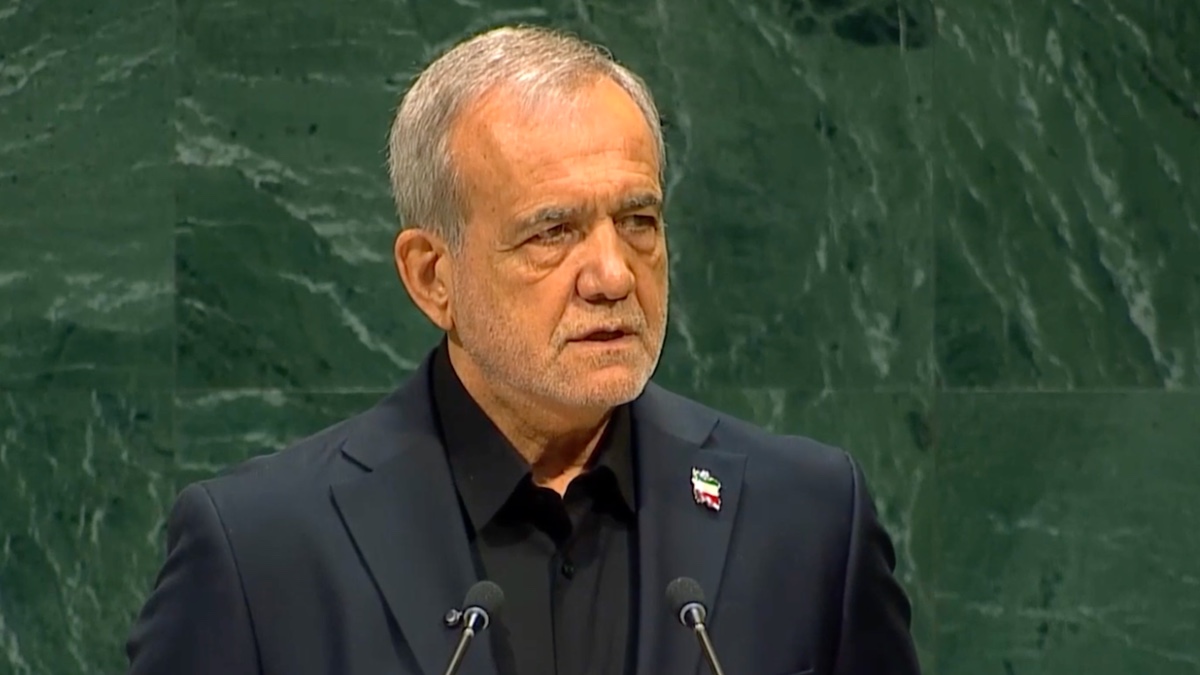
Iran's president told world leaders Wednesday that his country would never "bend at the knee" to American pressure, and the U.S. delegation walked out of the hall. A few hours earlier, Russia's top diplomat told the Security Council that Moscow would keep fighting in Ukraine even as talks proceed.
The second day of the General Assembly's annual debate showed how far apart the parties to the world's two most consequential wars remain in public. Behind the scenes, the picture was different. Secretary of State Marco Rubio met Russian Foreign Minister Sergei Lavrov for about an hour. Afterward he said both Russia and Ukraine had signaled interest in limited ceasefires covering grain shipments and energy infrastructure. "That won't be easy either," Rubio said.
For businesses and investors, the gap between rhetoric and bargaining matters. The U.S.-Israeli war with Iran is in its seventh month and has disrupted traffic through the Strait of Hormuz. Before the war, roughly a fifth of global oil consumption and a large share of liquefied natural gas moved through the strait. In the Black Sea, Ukrainian officials say millions of tons of grain risk spoiling because of shipping disruptions. That matters most for food importers in the Middle East, Africa and Asia.
Tehran's message
Pezeshkian opened by answering President Trump, who told the Assembly on Tuesday that Iran faced a choice between a deal and annihilation. The Iranian leader rejected the U.S. description of his country as a terrorist state. He said pressure and sanctions would only harden Iranian resistance. Iran, he said, was open to negotiations but not under threat of force.
On the nuclear question, his formula was brief: no nuclear weapons, and no limits on peaceful nuclear technology. That position clashes with Washington's demand for curbs on uranium enrichment. The International Atomic Energy Agency's board referred Iran to the Security Council earlier this month over safeguards violations, the first such referral in two decades.
Pezeshkian also complained that Iran was being shut out of the Hormuz trade on which other countries depend, and he warned that the continued presence of foreign navies would widen the war.
He did not mention the indirect U.S.-Iran contacts that U.S. envoy Steve Witkoff said had taken place on the sidelines Tuesday. That separation between public defiance and private channels has long been a feature of Iranian diplomacy.
Ukraine: no pause, but talk of truces
At a Security Council session on Ukraine, Lavrov said Russia remained ready to negotiate but would not halt what it calls its special military operation. He accused European governments of seeking a ceasefire in order to rearm Kyiv.
The foreign ministers of Britain, France and Denmark pushed back and pointed to rising civilian casualties over the summer. French Foreign Minister Jean-Noël Barrot said Paris supported moratoriums on strikes against energy infrastructure and on fighting in the Black Sea as a first step.
Addressing the General Assembly later, Ukrainian President Volodymyr Zelensky urged governments to keep squeezing Russia's export earnings. He argued that trade with Moscow effectively extends the war, and he cast Russian President Vladimir Putin as the source from which the conflict keeps spreading. Earlier, at a sideline summit, Zelensky said Kyiv was ready for a Black Sea maritime truce along lines proposed by Egypt, India and Turkey, and was waiting for Moscow's answer.
Rubio's account of the Lavrov meeting was the day's clearest hint of diplomatic movement. It came with caveats. Strikes on energy targets are central to both sides' military strategies, and Moscow has not said publicly that it would accept sector-specific truces. A truce on energy strikes announced last week collapsed within a day.
A skeptic at the lectern
Argentine President Javier Milei, one of Trump's closest allies in the region, used his speech to attack the U.N. itself. He called it a useless organization and pressed Argentina's claim to the Falkland Islands. He denounced a British-licensed offshore oil project near the islands and urged London to reopen sovereignty talks. Trump has said the U.S. could reconsider its neutrality on the dispute, which raises the diplomatic stakes for Britain.
Ecuador's Daniel Noboa called for cross-border cooperation against organized crime, arguing that criminal networks now coordinate better than governments do. Venezuela's acting president, Delcy Rodríguez, was scheduled to speak in the afternoon. She is the first Venezuelan leader to address the Assembly since Nicolás Maduro in 2018, before U.S. forces captured him in January.
AI reaches the Security Council
France, which holds the Council presidency this month, convened a high-level briefing Wednesday on artificial intelligence and international security. Scheduled speakers included OpenAI Chief Executive Sam Altman, Anthropic CEO Dario Amodei, Hugging Face CEO Clément Delangue and AI researcher Yoshua Bengio. The session is not expected to produce binding outcomes. It came a day after Trump dismissed international AI oversight as a globalist scheme, a split that puts Washington at odds with some of the U.S. companies building the technology.
The backdrop
The debate is unfolding under financial strain and a leadership transition. The U.N. is carrying out cost cuts under its UN80 reform drive. The race to succeed Guterres continues through secret Security Council straw polls, in which Costa Rica's Rebeca Grynspan has led so far, according to diplomats. Chinese leader Xi Jinping arrived in Washington on Wednesday for a state visit, with talks at the White House scheduled for Thursday.
Oil prices have eased from recent highs on hopes for U.S.-Iran diplomacy and restored Saudi pipeline flows, but trading was choppy Wednesday, with Brent hovering near $100 a barrel.
What comes next
Israeli Prime Minister Benjamin Netanyahu addresses the Assembly on Thursday. Palestinian Authority President Mahmoud Abbas is expected to appear by video after the U.S. again refused him a visa. Lavrov speaks to the Assembly on Saturday. That will be the next test of whether Moscow publicly accepts any energy or Black Sea arrangement.
For now, the week has followed a familiar pattern: maximal positions from the podium and narrower bargaining in the hallways. Whether any of it yields a verifiable deal, such as a halt to energy strikes, reopened grain corridors or another round of U.S.-Iran contacts, is likely to matter more to markets than anything said in the hall.
Editor's note: I left out claims that weren't confirmed by wire services or primary sources. That includes the reported joint ceasefire statement by 52 countries (sourced only to RT), the report of a G20 invitation to Putin, and the contents of Rodríguez's speech and the AI briefing. Check these, along with Brent's settlement price, against UN press releases before publication.