

IBM Nighthawk experiments cut logical error rate to 0.22%
The arXiv preprint points to circuit-level gains, while showing correlations and device variation still limit fault-tolerant quantum computing.
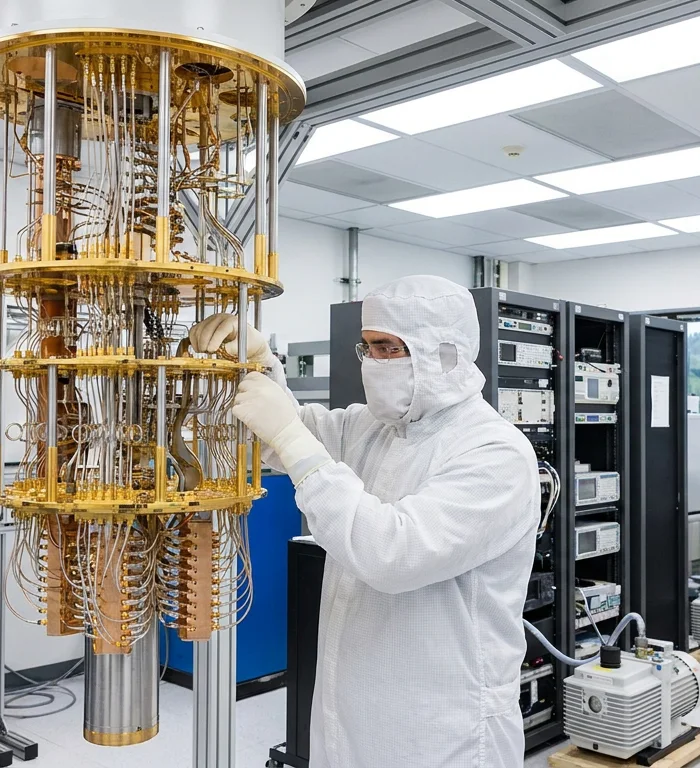
An arXiv preprint submitted Oct. 16 reported that experiments on IBM’s Nighthawk r2 quantum processor reduced a surface-code memory’s X-memory logical-error rate to 0.22% per round.
The result matters because fault-tolerant quantum computers require logical errors to fall as codes grow; in the same tests, Z-memory errors declined to 0.24% from 0.53% when protected distance rose to 6 from 3.
Shuwen Kan and 10 co-authors studied rotated surface-code memory, a quantum error-correction approach that spreads information across physical qubits so errors can be detected without directly measuring the protected state. The preprint is not yet peer reviewed.
The authors said performance changed across different placements on the processor, which they attributed to differences in qubit quality. Their optimized circuit combined shorter readout, fused measurement and reset, and an XX echo applied to data qubits during ancilla readout.
Against a baseline using standard readout without reset or echo, the optimized syndrome-extraction circuit reduced median logical errors per round by a factor of 3.8 in the X basis and 1.4 in the Z basis, according to the preprint. Syndrome extraction is the repeated measurement routine used to infer where errors occurred.
The distance result was more modest than the optimization gain. When the protected distance increased to 6 from 3 while the other distance was held fixed, X-memory errors fell to 0.22% per round from 0.52%, and Z-memory errors fell to 0.24% from 0.53%.
Using maximum-likelihood decoding, a statistical method for choosing the most probable correction, the authors reported error-suppression factors of 1.85 for X memory and 1.68 for Z memory. The figures show that larger code distance improved protection, but not at the exponential rate that ideal quantum error correction seeks when physical noise is below threshold.
The limits are central to the finding. In memory experiments running as long as 150 rounds, the authors said the advantage from higher distance weakened and that long-lived correlations “may reflect a persistent error component.” Such correlations matter because error-correction codes assume noise can be detected and managed across repeated cycles.
The preprint frames the work as evidence that circuit compilation and hardware tuning can change surface-code memory performance on current cloud-accessible superconducting hardware. It also argues for closer codesign between quantum processors and error-correction circuits, rather than treating hardware noise and coding choices as separate problems.
Source: preprint, arXiv, Oct. 16, 2026
More stories
- Europe faces attribution gap after 16 cyber, physical incidents
- PIF backs Grand Theft Auto as Saudi players embrace game
- Signal limits screenshots to curb AI access to messages
- Cognition runs Devin Mac workspaces on EC2 in 6 AWS regions
- Salesforce engineers cut 600-failure triage to 90 minutes
- Türkiye Desk: GTA 6 puts console access and network demand in focus
- DeepSeek updates AI model as speed and cost rivalry grows
- CoreWeave bond yields hit 15% as AI funding doubts deepen
- The Signal: Roblox falls about two-thirds in 12 months
- The Signal: Micron warns RAM shortages may persist into 2028
Latest news
- Trump prepares tariffs on China and other major exporters
- New-car buyers pay record average $50,087 in October
- Banks face ECB reserve debate over liquidity and profits
- Investors see Anthropic debut gains fade below $83 a share
- Iraq orders federal control over Kurdish-area oilfields
- Germans oppose Ukraine aid as poll shows support slipping
- Kim Jong-un receives 10 envoys after constitutional shift
- Ukraine claims Libya strike sinks Russian naval corvette