

HALO authors report 91% success in robot home trials
The arXiv preprint describes a simulation-trained humanoid system tested across 360 trials in six unmapped real-world environments.
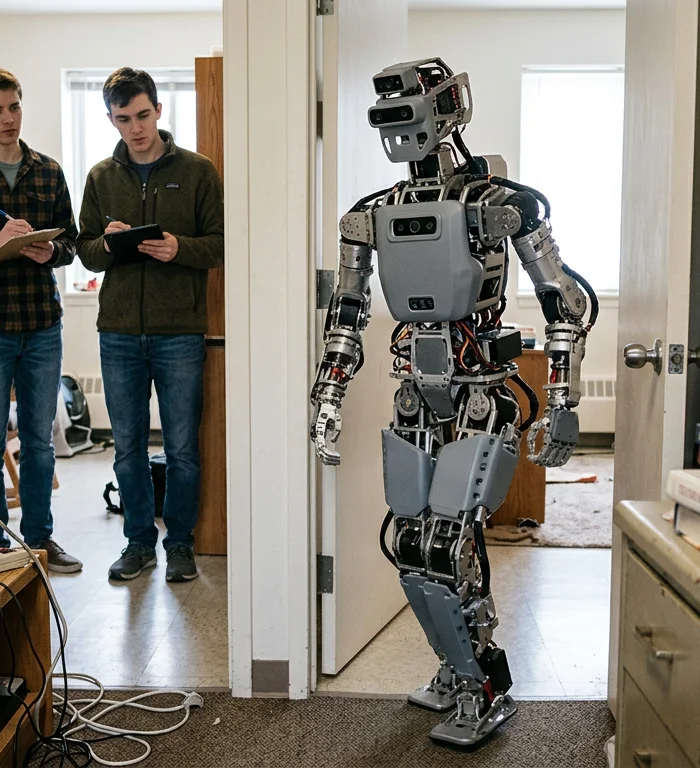
HALO, a humanoid autonomy system described in an arXiv preprint submitted on Nov. 4, achieved a reported 91% success rate across 360 real-world trials in six unmapped environments.
The result matters because the authors say HALO was trained without exposure to a real home, while some existing data-collection methods need at least one hour of human operation to produce one hour of robot data.
The paper, titled “Perceptive Humanoid Motion from Simulation,” was written by Siyuan Hu, Abulikemu Abuduweili, Yue Meng, Shipeng Liu, Quentin Leboutet, Chen Chen, Matthias Müller and Vladlen Koltun. It appears under arXiv’s robotics category and is also listed for artificial intelligence, computer vision and machine learning.
The authors describe HALO as using synthetic vision-language-motion data, meaning paired visual inputs, language instructions and motion commands, generated across 1,000 algorithmically created homes. “The corpus scales with compute rather than human labor,” the abstract says.
According to the preprint, HALO learned tasks including sitting on chairs, moving toward named objects, passing sideways through partly open doors, crouching and crawling below tables, and pushing boxes. The authors said the system combined those abilities to complete longer tasks made up of several steps.
The reported zero-shot transfer, a test in which a system is deployed on new real-world settings without training on them, is the central claim. If replicated, the approach would point to a way of reducing reliance on expensive human teleoperation and wearable capture systems for humanoid robot training data.
The findings are still early.
The authors said code and videos are available through a project page linked from the arXiv record. The paper was first submitted as version 1 at 18:55:33 UTC on Nov. 4.
Source: arXiv preprint, arXiv, Nov. 4, 2026.
More stories
- Europe faces attribution gap after 16 cyber, physical incidents
- PIF backs Grand Theft Auto as Saudi players embrace game
- Signal limits screenshots to curb AI access to messages
- Cognition runs Devin Mac workspaces on EC2 in 6 AWS regions
- Salesforce engineers cut 600-failure triage to 90 minutes
- Türkiye Desk: GTA 6 puts console access and network demand in focus
- Türkiye Desk: e2vc opens $150m growth fund for games and tech
- Cash App and Block pursue banking shift as profit grows
- Tesla Megapack 3 starts production at new Texas site
- AI chatbot bill clears Senate panel as state fight grows
Latest news
- Trump prepares tariffs on China and other major exporters
- New-car buyers pay record average $50,087 in October
- Banks face ECB reserve debate over liquidity and profits
- Investors see Anthropic debut gains fade below $83 a share
- Iraq orders federal control over Kurdish-area oilfields
- Germans oppose Ukraine aid as poll shows support slipping
- Kim Jong-un receives 10 envoys after constitutional shift
- Ukraine claims Libya strike sinks Russian naval corvette