Greenland dispute deepens as Denmark rejects Trump call
Greenland is not for sale, Denmark's prime minister said, rejecting Donald Trump's renewed call for U.S. control of the Arctic territory.
Lauren Collins ·
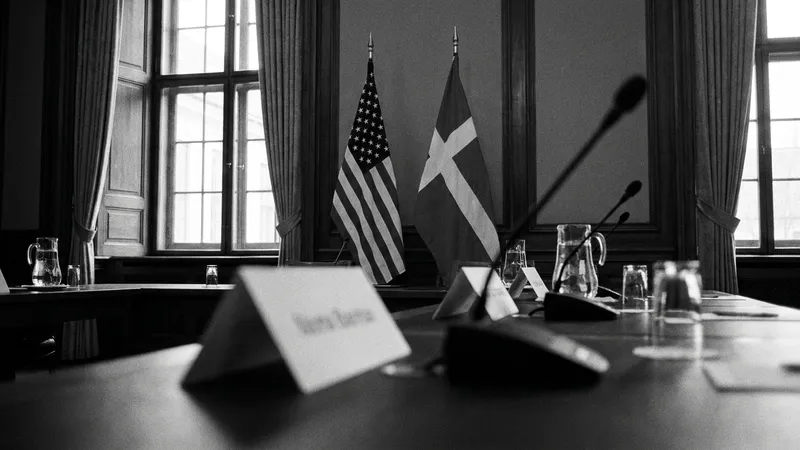
Greenland is not for sale, Denmark's prime minister said, rejecting Donald Trump's renewed push for U.S. control of the Arctic territory.
Prime Minister Mette Frederiksen made the remarks to reporters before a NATO summit in Turkey, saying Washington's position had become harder to miss. Her comments put sovereignty and alliance discipline at the center of a dispute that has returned months after Trump revived his interest in acquiring Greenland.
Frederiksen draws sovereignty line
Frederiksen said she had listened to Trump's latest remarks and concluded that the U.S. stance was now explicit. Denmark's answer, she said, had not changed: "Greenland is, of course, not for sale."
The Danish leader also tied the issue to Greenland's own political rights, not only to Copenhagen's authority. She said Denmark and Greenland expected allies to "respect the Greenland people right for self-determination."
Frederiksen then framed the dispute as a question of territorial integrity inside an alliance built on collective defense. "We are sovereign states and we need everybody to respect our territorial integrity and our sovereignty," she said.
Her NATO message was pointed: Denmark was ready to defend alliance territory, including its own, and expected the same commitment from other members. The remark turned a bilateral disagreement into a test of how allies handle security claims that touch another member's territory.
Pituffik visit sharpened the clash
The latest exchange follows a March visit by JD Vance to the U.S. military's Pituffik Space Base in Greenland. Plans for a broader trip were narrowed after criticism from Greenland's leaders, according to the source account.
During that visit, Vance accused Denmark of spending too little on Greenland's security. He also argued that the Arctic territory had strategic value because of Russian and Chinese activity in the region.
Trump has repeatedly argued that the U.S. should control Greenland for national and international security reasons. Denmark and Greenland's leaders have rejected any suggestion that the territory could be transferred to Washington.
The dispute is therefore not only about ownership language, but about competing definitions of security responsibility. Washington is presenting Greenland as an Arctic security asset, while Copenhagen is treating the matter as a sovereignty issue that cannot be negotiated away.
Arctic security meets alliance politics
Greenland matters to this debate because Pituffik already gives the U.S. a military presence on the island. That presence makes the dispute more complicated: Washington has a strategic foothold, but Denmark remains the sovereign state rejecting any change in control.
The immediate effect falls on Denmark's government and Greenland's leaders, not on a company. Their challenge is to preserve a united public position while keeping defense cooperation with the U.S. from being pulled into a political argument over territory.
The wider defense sector is also exposed to the tone of the dispute. If the argument stays rhetorical, the practical impact is likely to remain concentrated in diplomacy and alliance messaging; if it turns into formal pressure, Arctic defense planning, base access and infrastructure priorities could become more contested.
At the global level, the mechanism is NATO cohesion. If allies reaffirm sovereignty and self-determination at the summit, Denmark gains diplomatic cover, Greenland's transfer question stays closed, and the Arctic security sector continues to operate inside existing alliance arrangements.
If Washington instead keeps pressing the control argument, the macro effect would come through alliance friction rather than trade or markets. Denmark would face more political pressure, Greenland's leaders would have to answer renewed external attention, and defense planners would have to separate cooperation at Pituffik from the ownership dispute.
The open questions are concrete: whether Trump turns the remarks into policy, whether Greenland's leaders issue a fresh response, and whether NATO members publicly back Denmark's sovereignty language. Those signals will show whether this remains a recurring diplomatic irritant or becomes a deeper alliance problem.