Global Contractors Eye India’s Massive Regional Airport Buildout
Atlas Newsdesk ·
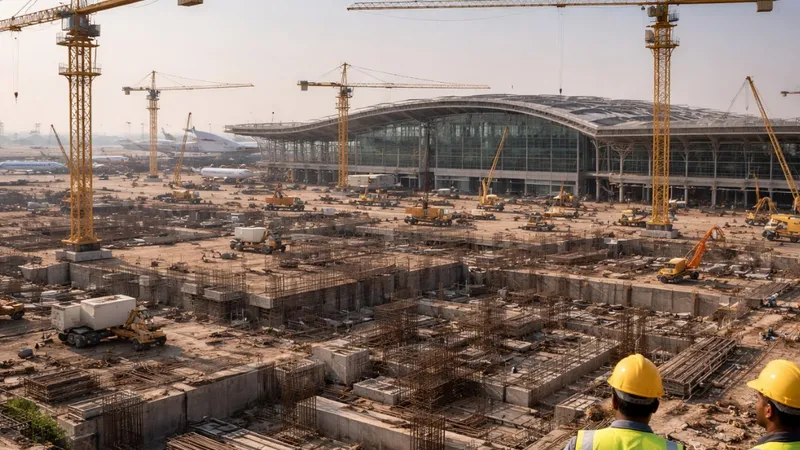
India is entering a new phase of aviation-led infrastructure expansion, creating one of the most significant multi-year opportunities for contractors globally. The government has announced plans to build 100 new airports and 200 helipads across smaller cities, part of a broader strategy to boost regional connectivity, trade, and tourism.
While the headline numbers are striking, the deeper implication is more important: this is not a one-off infrastructure push, but the foundation of a long-term aviation ecosystem that will require sustained investment across construction, technology, operations, and services.
The inauguration of the $1.2 billion Noida International Airport illustrates both the scale and ambition of this effort. Backed by Zurich Airport International , the project will initially handle 12 million passengers annually and is designed to expand into a six-runway mega hub spanning 7,200 acres.
It is expected to support extremely high traffic density, with projections of one flight every two minutes at full capacity. However, Noida is less an isolated flagship project than a signal of what is to come. India has already doubled its airport count from 74 in 2014 to more than 160 today, and the government has committed approximately $3 billion to a revamped regional connectivity program running from fiscal 2026–27 over a ten-year horizon.
Opportunities for Contractors
For contractors, the opportunity extends far beyond traditional runway and terminal construction. The expansion will generate a broad pipeline of projects across engineering, procurement, and construction (EPC), particularly in Tier-2 and Tier-3 cities where smaller, faster-cycle airport builds are expected to dominate.
These projects, while individually less capital-intensive than major hubs, will collectively represent tens of billions of dollars in contracts over the next decade. Mid-sized contractors, especially those capable of delivering modular and cost-efficient infrastructure, are likely to find a particularly strong foothold in this segment.
At the same time, the higher-margin opportunities are emerging in areas where India’s domestic capabilities remain less developed. Airport systems and digital infrastructure—including air traffic management, biometric passenger processing, and AI-driven operational tools—are expected to see significant demand as India leapfrogs toward more technologically advanced airport models.
Similarly, the maintenance, repair, and overhaul (MRO) segment represents a major structural gap. With Indian airlines placing large aircraft orders, the country is under pressure to localize MRO capacity, opening the door to joint ventures and investments that could scale into a multi-billion-dollar market.
Competitive Landscape
The competitive landscape for these opportunities is uneven. Domestic Indian firms such as Larsen & Toubro , Adani Group , and GMR Group hold a structural advantage in large-scale EPC work, supported by policy alignment and cost competitiveness.
For foreign contractors, direct entry into major construction contracts is unlikely without local partnerships. Instead, international players are better positioned to compete in specialized segments or through joint venture structures. European firms, particularly from Switzerland, France, and Germany, are well placed in airport design, operational management, and advanced engineering systems, as demonstrated by Zurich Airport’s involvement in Noida.
American companies are likely to capture value in the technology layer rather than in physical construction. Their strengths in aviation software, security systems, and data-driven optimization tools align with India’s push toward digitized airport operations.
Meanwhile, contractors from Turkey and the United Arab Emirates, with extensive experience in large-scale infrastructure delivery across emerging markets, are positioned as credible competitors in EPC—particularly if they align with Indian partners. Chinese firms, despite strong technical capabilities and cost advantages, are expected to remain largely excluded due to geopolitical constraints.
Future Deals and Structures
Looking ahead, several types of deals are likely to define the next phase of this expansion. One of the most probable structures is the bundling of regional airport projects into clusters, with Indian developers leading and foreign contractors participating as technical or minority EPC partners.
These bundled contracts could range from $500 million to $2 billion and will favor consortia that combine local execution with international expertise. In parallel, the MRO segment is expected to see the emergence of platform investments backed by strategic operators and private capital, with deal sizes ranging from a few hundred million dollars to over $1 billion .
Airport digitization is another area where contracts are likely to accelerate quickly. Nationwide deployments of biometric systems, passenger flow management, and integrated airport IT platforms could generate contracts in the $50 million to $300 million range per rollout, creating a steady pipeline for technology providers.
Additionally, the development of 200 helipads signals an early-stage push into regional air mobility, where smaller but scalable contracts could provide first-mover advantages in what may evolve into a significant future market.
Public-private partnership (PPP) concessions for Tier-2 airports are also expected to expand, offering long-term revenue streams tied to passenger traffic, retail, and cargo operations. Over time, major airport developments such as Noida are likely to anchor broader “aerotropolis” ecosystems, including logistics hubs, commercial real estate, and hospitality infrastructure, extending the opportunity set well beyond aviation itself.
Strategic Takeaway
For contractors evaluating entry into this market, the strategic takeaway is clear. India’s aviation expansion should not be approached as a conventional construction cycle. The real value lies in embedding across the full lifecycle of airport development—combining infrastructure delivery with technology, operations, and recurring service models.
Firms that rely solely on EPC contracts risk margin pressure and limited differentiation, while those that build integrated capabilities and local partnerships stand to capture sustained, multi-phase growth.
In this sense, India is not just building airports. It is constructing a long-term platform for aviation-driven economic expansion. Contractors that recognize this early—and position themselves accordingly—will define the competitive landscape over the next decade.