G7 Leaders Gather in France With Ukraine, Iran and AI on the Table
France hosts G7 summit in Évian June 15-17. Leaders focus on Ukraine, Middle East, economic imbalances, partnerships & AI.
Andreas Keller ·
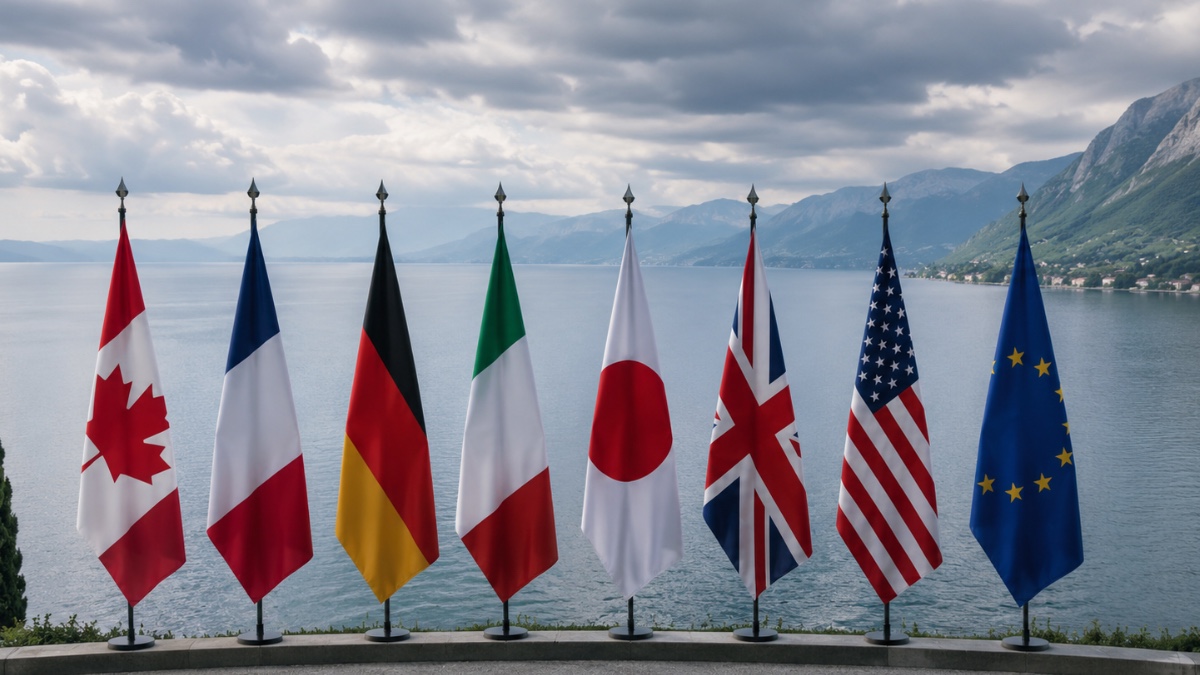
G7 leaders will open talks Monday in Évian, France, with a formal agenda built around wars, economic coordination and artificial intelligence, but the summit’s real measure may be whether the group can still act as a common front. The June 15-17 meeting is being hosted by France’s G7 presidency, with the European Union represented by European Council President António Costa and European Commission President Ursula von der Leyen. The official working sessions cover geopolitical challenges, Ukraine and European security, the Middle East, international partnerships, more balanced growth and the future of AI. Leaders are also expected to issue several statements during the gathering, giving the summit a practical test beyond diplomatic staging.
Macron widens the room
France has tried to shape the meeting around a broader question: how advanced economies should respond to an international system marked by trade tension, geopolitical instability and widening imbalances. President Emmanuel Macron chaired a June 11 video conference with G7 countries and representatives from China, India, Brazil, South Korea and Kenya to discuss macroeconomic imbalances and global economic governance. France has also invited leaders from several non-G7 countries to join some working sessions, a sign that Paris wants the summit to speak beyond the club of industrialized democracies. That outreach matters because many of the issues on the table, from supply chains to development finance, cannot be solved by the G7 alone.
Rambouillet’s old purpose returns
The French presidency has framed the summit as a return to the group’s origins in 1975, when leaders first gathered in Rambouillet to coordinate responses to economic stress. Paris says reducing global inequalities and correcting imbalances through coordinated domestic and international policies are core goals for this year’s presidency. It has also put development finance reform on the agenda, arguing that traditional aid tools are too limited for the scale of today’s economic pressures. Critical minerals run through that agenda as well, with France treating resilient value chains as a way to reduce coercion and strategic vulnerability.
Ukraine waits for unity
Ukraine will be one of the clearest tests of G7 cohesion, especially as European governments look for durable security support while Washington signals impatience with the length of the war. Ukrainian President Volodymyr Zelenskyy is expected to join a G7 working session, though a senior U.S. official said President Donald Trump was not scheduled to hold a separate bilateral meeting with him. The same official said Russian gains had “more or less stopped” and that the U.S. wanted the war to end quickly. The summit comes as Ukraine continues strikes on Russian military and energy targets and after the Zaporizhzhia nuclear plant was reconnected to the grid following one of its longest power-loss events of the war.
Hormuz sharpens the agenda
The Middle East is expected to compete with Ukraine for leader-level attention, with Iran, Gaza and the Strait of Hormuz all sitting inside the broader regional file. The Council on Foreign Relations said France’s planned agenda has been overtaken in part by the shock of the U.S.-Israeli attack on Iran earlier this year, Tehran’s retaliation and the closure of the Strait of Hormuz, which has fed worries over energy, freight, fertilizer and inflation. The official EU agenda lists the Middle East as a standalone working-session topic, while civil society groups from the Israeli-Palestinian divide have urged G7 leaders to push for a Gaza ceasefire, Hamas disarmament, reconstruction and a renewed two-state framework. That leaves France trying to manage both immediate crisis diplomacy and the longer effort to keep the region from consuming the summit.
AI and minerals move center stage
Beyond war diplomacy, the summit is also about industrial power. France wants the G7 to deal with economic security, critical mineral supply chains and development partnerships, while AI has become a prominent part of the Évian agenda. The EU says leaders will discuss the future of artificial intelligence, and CFR said Macron’s agenda includes cooperation on AI as France works to position itself as a leading European hub for the sector. These issues affect companies, workers and governments at once: access to minerals shapes battery and defense production, AI rules shape investment and competitiveness, and supply-chain policy shapes how much exposure G7 economies accept to China-linked chokepoints.
The biggest risk is that leaders leave Évian with statements that paper over disagreements rather than decisions that shift policy. AP reported that riot police in Geneva used tear gas and water cannons on Sunday during clashes at an anti-G7 protest that drew an estimated 20,000 people, according to local police; Swiss and French authorities deployed thousands of police for the summit, and only seven of 35 roadway border crossings were set to remain open. The security operation shows the political climate around the meeting: activists are pressing leaders over inequality, Gaza, climate and capitalism, while governments are trying to show control at a moment of visible public anger. The forward implication is clear: if the G7 cannot produce credible alignment on Ukraine, Iran, supply chains and AI, the summit may reinforce the view that the forum remains useful for crisis management but weaker as a steering committee for the global econom