Trump Wanted the IRGC to Surrender. It Is Now Harder to Dislodge.
President Trump told Iran’s Revolutionary Guards to give up their arms or face death; three and a half months later, the IRGC appears more entrenched in Te…
Omar Farouk ·
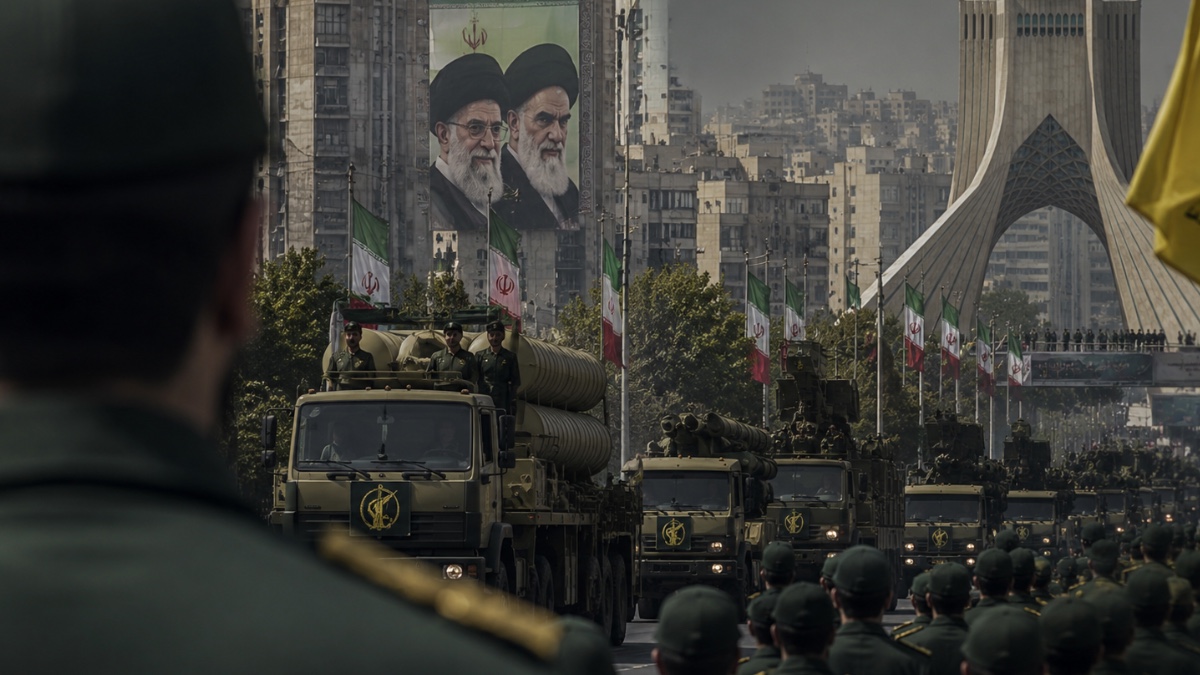
Donald Trump opened the Iran war with a direct message to the Islamic Revolutionary Guard Corps: surrender or face “certain death.” The line was designed to project collapse before collapse had happened, a psychological strike aimed at soldiers, commanders and police units inside Iran’s security machine. Instead, the Guards did not break, did not defect in visible numbers and did not hand the state to protesters, as Trump urged Iranians to do in the same February 28 address. The result is the opposite of the political outcome Trump described: Iran’s most ideological armed institution is damaged, but it is also more central, more necessary and harder to remove.
The reversal is clearest in the deal announced Sunday, June 14, to end the war and reopen the Strait of Hormuz. Trump said he authorized the removal of the U.S. naval blockade, while Iranian Deputy Foreign Minister Kazem Gharibabadi said Tehran would wait for the formal signing, scheduled for Friday, June 19, before implementing the agreement. That is not the posture of a shattered security establishment. It is the posture of a state whose military-security elite survived long enough to turn geography into leverage, forcing Washington to negotiate over shipping, sanctions relief and a separate 60-day track for unresolved nuclear questions.
Khamenei’s Son Needs Generals
The war also changed who rules inside Tehran. Reports found that after Ayatollah Ali Khamenei was killed on the first day of the war, his wounded son Mojtaba was elevated into a system increasingly dominated by IRGC commanders rather than by a single decisive clerical authority. People familiar with Iranian deliberations said Mojtaba’s role has been largely to legitimize decisions made by generals, while the real wartime circle runs through the Supreme National Security Council, the Supreme Leader’s office and the Guards. That means the United States may have removed a singular leader only to accelerate a more militarized order, one less flexible, less transparent and more dependent on the IRGC for survival.
This outcome was predictable because the IRGC is not just another branch of Iran’s armed forces. It was built after the 1979 revolution to protect the Islamic Republic, sits in a chain of command tied to the supreme leader and has expanded into intelligence, domestic repression, ballistic missiles, foreign operations and major economic sectors. Official statements have described the Guards as answering only to Iran’s top leader, running a vast construction arm, controlling firms involved in roads, ports and telecommunications, and overseeing the Quds Force network behind Iran’s regional partnerships. The Basij militia, the IRGC’s domestic mobilization arm, gives the corps a street-level coercive capacity that airstrikes cannot easily erase.
Hormuz Becomes Bargaining Power
Trump’s military objectives were clear on paper: destroy Iran’s missiles, cripple its navy, sever support for proxies and prevent a nuclear weapon. The White House repeatedly framed Operation Epic Fury as a campaign that was dismantling Iran’s ability to threaten the United States and its allies. Yet the Strait of Hormuz gave Tehran a different measure of power: not the ability to win a conventional war, but the ability to impose costs on oil markets, Gulf governments, insurers, shippers and U.S. politics. The Energy Information Administration said flows through Hormuz in 2024 and early 2025 accounted for more than a quarter of global seaborne oil trade and about one-fifth of global petroleum liquids consumption, which explains why even a weakened Iran could still hold a global pressure point.
That is why the IRGC now looks more permanent in practical terms, not because it is invincible, but because it has become the institution through which every hard question must pass. A ceasefire requires the Guards’ consent, any reopening of Hormuz requires their restraint, and any internal dissent after the war runs into their intelligence networks and Basij-linked street power. U.S. intelligence assessments reported by a major newspaper expected the regime to survive in harder-line form, with the IRGC exerting greater control despite damage to Iran’s missile capability and navy. The old American theory was that pressure would split the regime; the current evidence points to consolidation among the men with guns, ports, missiles, patronage networks and prisons.
There is still risk in calling this an IRGC victory. The corps has lost commanders, assets and room for maneuver, while Iran faces economic strain, public anger and the unresolved problem of its nuclear stockpile. The announced deal leaves the nuclear file for later, and reports indicated that Iran still has 440.9 kilograms of uranium enriched up to 60%, a short technical step from weapons-grade level, according to the International Atomic Energy Agency. That makes the next phase more dangerous for Washington: Trump can say he forced Iran to the table, but the table is now occupied by a more entrenched IRGC, and any bargain that eases pressure without weakening that structure may leave the Guards stronger than before the war began.