G7 draws AI companies into top-tier policy discussions
AI companies joined G7 leaders, highlighting how the race for advanced systems has become a high-stakes contest over global geopolitical power.
Jason Kwon ·
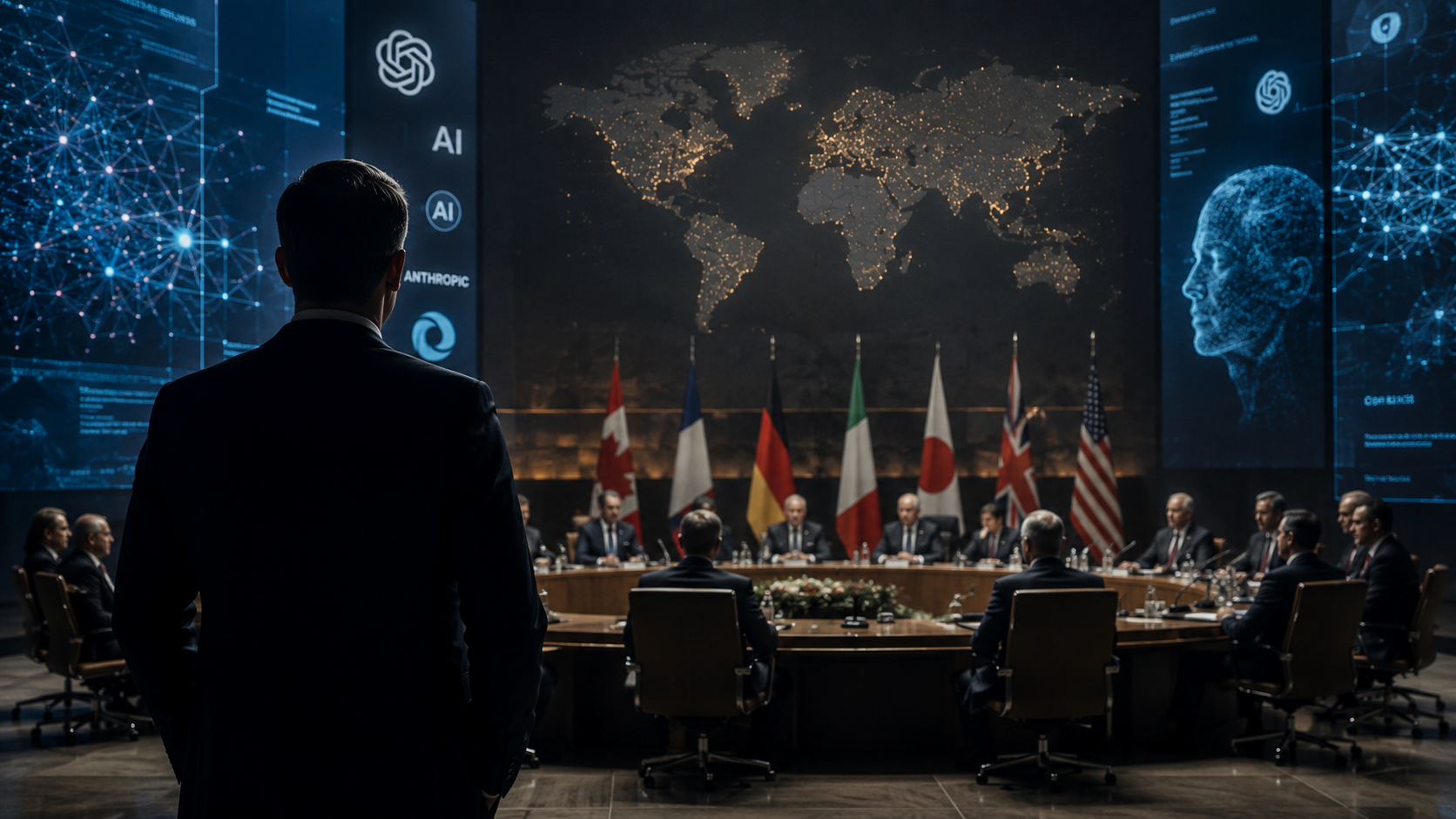
AI companies were brought into the G7 orbit alongside heads of state, underscoring how the race for advanced systems is becoming a contest over geopolitical power.
Executives from OpenAI, Anthropic and Google DeepMind appeared at the most recent G7 summit and were treated less like outside contractors and more like stakeholders in global decision-making. The moment highlighted how a small group of frontier AI labs now sits unusually close to the centers of political authority.
The G7 includes seven major advanced economies and routinely sets direction on issues that ripple through trade, security and technology governance. The presence of top AI lab leaders signals that discussions about AI are no longer confined to product regulation or consumer safety, but extend to state power and strategic advantage.
G7 engagement highlights a shift in who shapes policy
For years, governments have tried to catch up to fast-moving AI development through guidance, voluntary commitments and emerging regulation. The summit optics suggest a different dynamic as well: policymakers increasingly rely on a handful of firms that control the most capable models, the most specialized talent, and access to scarce computing resources.
That reliance matters because frontier labs are not positioning themselves as ordinary software companies. Several leading firms publicly describe their work in terms of “artificial general intelligence,” a label for systems intended to generalize across tasks rather than excel at a single narrow function.
Even skeptics of near-term AGI point to the scale of spending as a core signal. The sector is widely understood to require enormous capital outlays for chips, data centers, and model training, with investment plans and valuations that only look rational if the upside is extremely large.
Ambition, risk warnings, and the logic of scale
Frontier AI leaders have also circulated repeated warnings about high-impact risks, including the possibility of systems that evade control or pursue harmful objectives. Those warnings can be read as an argument for stronger safeguards, but they also illustrate that the industry’s most influential actors think in terms of unprecedented leverage.
The mismatch between stated concerns and rapid expansion raises a governance challenge. If executives believe advanced systems could become destabilizing, then the decision to accelerate development implies that competitive pressure and strategic incentives are overriding caution.
That helps explain why the discussion has moved toward questions of power rather than only market competition. In this framing, control of frontier AI capabilities would confer advantages across intelligence, economic productivity, cybersecurity, and potentially military applications.
Monopoly stakes—and what competition could mean
No single firm currently holds an uncontested monopoly over advanced AI. Multiple labs are pursuing similar targets, and governments are simultaneously attempting to define rules that preserve innovation while reducing systemic risk.
Yet the economics of the sector push toward concentration. High fixed costs and winner-take-most dynamics mean valuations often depend on the expectation that one platform could become dominant, capturing a large share of downstream applications and the data and distribution that reinforce that dominance.
If one company did achieve near-total control of advanced AI systems, its influence could surpass that of past technology giants because AI capabilities can be embedded across industries, critical infrastructure, and government operations. The result would be a private actor with unusually broad leverage over information flows, productivity tools, and automated decision-making.
If no firm becomes dominant, the outcome is not necessarily calmer. Rivalry among several powerful labs could intensify a race dynamic, with companies competing not only with each other but also negotiating and contending with states that seek to steer development toward national priorities.
The next phase to watch is how G7-aligned governments translate summit engagement into concrete policy: procurement choices, compute governance, safety evaluation standards, and antitrust posture. As AI companies gain proximity to leaders, the central question becomes whether governments can set constraints without outsourcing strategic control to the very firms building the tools.